







The United States Treasury Department recently deployed one of its most significant liquidity-management tools in an effort to stabilize a volatile debt market, only to meet immediate resistance from institutional investors. Treasury Secretary Scott Bessent announced a buyback operation involving $6 billion in longer-dated debt, a figure representing three times the volume of a standard operation. This move followed weeks of rhetorical intervention from the Treasury, aimed at anchoring the long end of the yield curve and tempering the rapid ascent of borrowing costs. Despite this aggressive intervention, the market reaction was contrary to the Treasury’s objectives. Immediately following the announcement, the yield on the 10-year Treasury note climbed to 4.84%, marking its highest level since late 2023. By the following Thursday morning, the yield continued its upward trajectory, reaching 4.92% and moving within striking distance of the psychologically and fundamentally significant 5% threshold.
The Mechanics of the Bond Market Rejection
The failure of the $6 billion buyback to suppress yields suggests a profound shift in market sentiment. In a typical buyback scenario, the government purchases its own outstanding securities to add liquidity and reduce the supply of specific bonds, which theoretically drives prices up and yields down. However, when the market "rejects" such a move, it indicates that the underlying selling pressure—driven by macroeconomic concerns—far outweighs the government’s capacity to intervene.
Financial analysts point to several factors contributing to this "hawkish" resilience in yields. Primarily, the market remains concerned with the sheer volume of U.S. sovereign debt, which has now surpassed $40 trillion. While buybacks can improve market functioning, they do not reduce the total debt burden; rather, they involve swapping long-term debt for short-term obligations. This "duration management" does little to address the fiscal deficit or the long-term inflationary pressures that bondholders demand compensation for.
Inflationary Overhang and the Producer Price Index
The surge in yields is closely tied to persistent inflationary data that continues to defy the Federal Reserve’s 2% target. The latest Producer Price Index (PPI) report served as a primary catalyst for the most recent spike in yields. Wholesale price inflation was recorded at 5.4% year-over-year, significantly exceeding consensus estimates. Because the PPI measures the costs faced by manufacturers and service providers, it is often viewed as a leading indicator for the Consumer Price Index (CPI). If businesses face higher input costs, those costs are eventually passed down to the consumer, suggesting that the "last mile" of the inflation fight remains the most difficult.
Furthermore, the Federal Reserve’s current stance under Chair Kevin Warsh has offered little reprieve for bond bulls. The central bank has refrained from signaling imminent rate cuts, maintaining a "higher-for-longer" posture that keeps upward pressure on the entire yield curve. As long as the Fed perceives inflation as a persistent threat, the floor for Treasury yields remains elevated.
Energy Markets and Geopolitical Risk
Compounding the pressure from domestic inflation is the volatile situation in the Middle East, which has sent shockwaves through the energy sector. Global oil benchmarks have seen substantial gains, with Brent crude trading near $105 per barrel and West Texas Intermediate (WTI) approaching the $100 mark.
Rising energy prices act as a "double headwind" for the economy. First, they contribute directly to headline inflation, complicating the Federal Reserve’s path toward normalization. Second, they act as a tax on consumers, reducing discretionary spending. For the bond market, high oil prices translate to higher inflation expectations, which naturally leads to higher yields. Market analysts, including those from Fry’s Investment Report, suggest that Treasury operations alone cannot solve the yield crisis as long as an "oil shock" remains a primary driver of economic uncertainty.
The 5% Threshold: A Critical Juncture for Equities
The 10-year Treasury yield is often described as the "gravity" that governs asset prices. Because it serves as the risk-free rate used in discounted cash flow models, a higher yield reduces the present value of future corporate earnings. This is particularly impactful for high-growth sectors, such as technology and Artificial Intelligence (AI).
Technology expert Luke Lango has identified 5% on the 10-year yield as a "line in the sand" for the current bull market. According to Lango’s analysis, the market can currently withstand elevated yields due to robust corporate earnings. However, a sustained breach of the 5% level could fundamentally alter the investment landscape. At 5%, the cost of capital becomes restrictive enough to potentially "break" the consumer and force a contraction in corporate capital expenditure (capex). For the AI sector, which relies on massive infrastructure investment and high-revenue growth, a move above 5% represents a systemic risk that could stall the current technological expansion.
Strategic Shifts: Elon Musk’s Vertical AI Ambitions
While the macro environment remains precarious, specific sectors of the economy continue to see aggressive development. Elon Musk’s various enterprises—Tesla, SpaceX, xAI, and X—are increasingly being viewed by analysts as a singular "Vertical AI" empire. This strategy involves controlling the entire stack of AI development, from the data centers and computing power to the robotics and connectivity (via Starlink).
Investors are currently focusing on the specialized suppliers that provide the essential components for this empire. As Musk scales his operations, small-cap companies providing specialized sensors, thermal management systems for data centers, and advanced robotics components are positioned to benefit. Analysts suggest that even in a high-yield environment, these "chosen" suppliers may find insulation through their integration into Musk’s mission-critical supply chains.
Defensive Positioning with "Forever Stocks"
In response to the "twitchy" nature of the current market, some investment strategists are advocating for a return to "Forever Stocks"—businesses with durable, essential models that can withstand both inflationary pressure and technological disruption.
A prominent example currently highlighted by Eric Fry is Primo Brands Corp. (PRMB), a leader in the North American branded water industry. As a vertically integrated operation managing over 80 springs and a vast distribution network, Primo Brands provides a product—clean hydration—that is immune to being digitized or replaced by artificial intelligence. While the company utilizes AI to optimize its forecasting and warehouse management (making it an "AI Applier"), its core value proposition is "defiantly analog."
Financially, Primo Brands has shown resilience, growing net sales to $1.8 billion in its most recent quarter and raising its full-year outlook. Despite the stock’s recent lateral movement, institutional price targets remain optimistic, with some analysts setting targets as high as $31. This type of defensive, cash-generating business is increasingly favored by investors looking to hedge against a potential break in the 10-year yield.
Tactical Trading and the "Expected Move" Framework
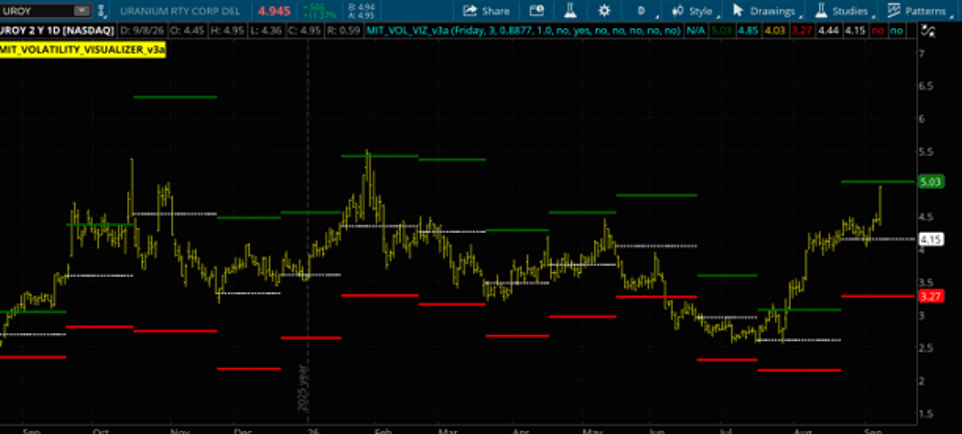
Beyond long-term holdings, the current volatility has created opportunities for tactical traders using sophisticated technical tools. Jonathan Rose’s "Expected Move" framework has recently gained attention following a successful trade in Uranium Royalty Corp. (UROY). This trade yielded a 65% return for subscribers in just ten trading days.
The "Expected Move" is a calculation derived from options pricing that determines the range within which market makers expect a stock to stay over a specific timeframe. When a stock’s price moves to the outer edges of these statistical bands, it often signals a "misalignment" between market structure and price. In the case of UROY, the stock was identified as being at the edge of its expected low, suggesting a high-probability move to the upside. This success highlights a growing trend among retail traders to focus on market structure and volatility "maps" rather than solely relying on fundamental narratives, which can be slow to react to rapid market shifts.
Future Outlook and Market Implications
As the market enters the final weeks of the quarter, all eyes remain on the 10-year Treasury yield. The failure of the Treasury’s $6 billion buyback to calm the market has signaled to investors that the "invisible hand" of the market is currently more powerful than government intervention.
If yields stabilize below 5%, the AI-driven growth narrative is likely to persist, supported by the ongoing "Vertical AI" expansion led by major tech innovators. However, if the combination of sticky PPI data, rising oil prices, and fiscal concerns pushes yields above that critical 5% mark, a broader re-rating of risk assets may be inevitable. In such a scenario, the rotation into defensive "Forever Stocks" and the use of volatility-based trading tools are expected to become the dominant strategies for wealth preservation. For now, the bond market remains the primary arbiter of the financial system’s direction, and its current message is one of extreme caution.


