
Virtual reality (VR) has made colossal strides in recent years, transforming from a niche technological curiosity into a powerful medium capable of delivering deeply immersive experiences. While advancements in visual fidelity and spatial audio have brought virtual worlds to life with unprecedented realism, a crucial sensory dimension has remained largely absent: smell. This olfactory void has represented a significant frontier for VR, limiting the depth of immersion and the potential for truly holistic virtual experiences. However, a groundbreaking development by a team of researchers at the Institute of Science Tokyo, in collaboration with Rakuten Mobile, is poised to bridge this gap, introducing the sense of smell to the virtual realm through a sophisticated wearable device.
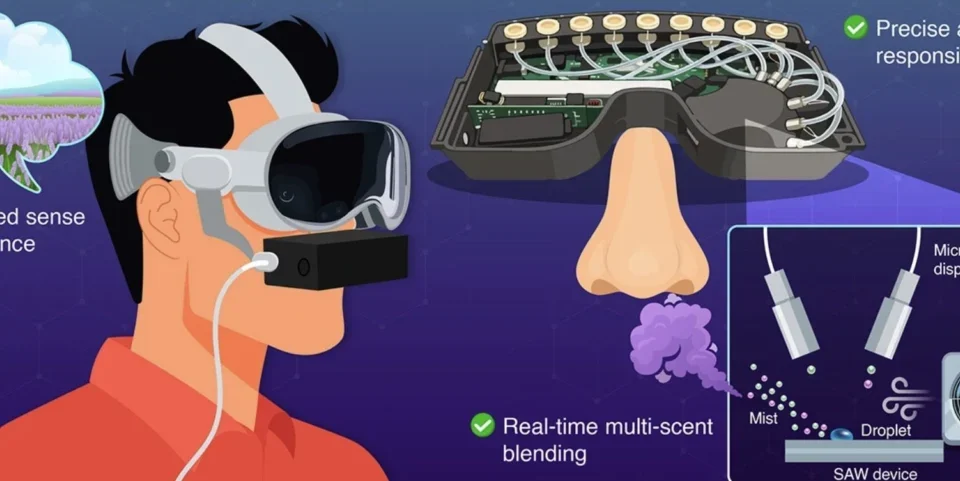
This innovative system is designed to integrate seamlessly with existing VR headsets, offering users the ability to perceive scents that are synchronized with their virtual environments. The core of the technology lies in its ability to dynamically blend up to eight different fragrance components in real-time, creating a complex and contextually relevant olfactory landscape. This means that as users explore virtual pine forests, bustling marketplaces, or serene beaches, their sense of smell will be engaged, enhancing the feeling of presence and authenticity.
The Science Behind the Scent
The device, developed by the research team led by Professor Takamichi Nakamoto, is remarkably compact, allowing it to be worn alongside standard VR head-mounted displays. Its functionality is driven by a sophisticated mechanism that analyzes the visual and contextual cues within the virtual scene. Based on this analysis, the device precisely blends specific fragrance components to generate a matching scent. This meticulous control over scent composition and release is crucial for achieving a realistic and non-overwhelming sensory experience.

At the heart of this scent generation process is a carefully orchestrated interplay between several key components: a microdispenser, an ultrasound atomizer, and a miniature pump. The microdispenser precisely measures and dispenses the base fragrance oils, while the ultrasound atomizer converts these liquids into a fine mist of airborne particles. The tiny pump then regulates the flow and timing of this mist, ensuring that scents are released at the exact moment and in the appropriate quantity to correspond with the virtual experience. This precision allows for scents to emerge quickly and dissipate cleanly, avoiding the lingering artificiality that could detract from the immersion.
The researchers have rigorously tested the device using virtual travel content, enabling participants to virtually visit diverse locations and experience the associated scents. Early user feedback from these trials has been overwhelmingly positive, with participants reporting a significant increase in the perceived realism and presence within the virtual environments. The ability to not only see and hear but also smell these simulated spaces has been described as a transformative aspect of the VR experience.
Professor Nakamoto articulated the driving motivation behind the project, stating, "We wanted to develop a system that could reproduce complex scents quickly during immersive virtual experiences." This objective highlights a commitment to creating a fluid and responsive olfactory component that complements, rather than disrupts, the user’s journey through the virtual world. The success in achieving rapid scent generation and clean dissipation suggests a sophisticated understanding of olfaction and its integration with digital media.
Beyond Entertainment: The Broader Implications of Olfactory VR
While the immediate application of this technology is in enhancing entertainment and gaming experiences, its potential extends far beyond mere amusement. The integration of smell into VR opens up a multitude of possibilities across various industries and applications.

The concept of incorporating scent into immersive experiences is not entirely new. 4DX cinema, for instance, has already demonstrated the effectiveness of synchronized scents in augmenting the movie-going experience. The VR scent technology builds upon this precedent, offering a more personalized and interactive approach.
In the realm of virtual entertainment, the addition of smell can elevate gaming and interactive storytelling to new heights. Imagine the thrill of smelling gunpowder in a combat simulation, the aroma of freshly baked bread in a virtual bakery, or the crisp scent of an autumn forest during a virtual hike. These olfactory cues can deepen emotional engagement and create more memorable experiences.
Beyond entertainment, the technology holds significant promise for training simulations. For instance, medical trainees could practice procedures in a virtual operating room that replicates the sterile, antiseptic smell, or emergency responders could train in simulated hazardous environments where the presence of specific fumes is crucial for realism and safety. This is particularly valuable for scenarios where replicating smells in the real world might be dangerous, expensive, or impractical.
Another compelling application lies in fragrance product demonstrations. Perfume companies could allow consumers to experience the nuances of their scents virtually before making a purchase, offering a more engaging and informative alternative to traditional sampling methods. This could revolutionize the way consumers interact with and evaluate fragrance products.
Furthermore, the technology could find a powerful application in therapeutic settings, particularly for elderly patients. Smell is intrinsically linked to memory, and the ability to recreate familiar or comforting scents from a person’s past could be a powerful tool for reminiscence therapy, helping to stimulate memories, improve mood, and enhance overall well-being. This connection between scent and memory has been extensively documented in psychological research, underscoring the potential of this technology in healthcare.

The researchers have actively showcased their device at multiple international conferences, where it has garnered considerable interest and positive feedback from industry professionals and attendees. While the current iteration is a research prototype, the path from laboratory innovation to a commercially available product is often a lengthy one, involving further refinement, scaling up production, and addressing regulatory considerations. Nevertheless, this development represents a significant leap forward in the pursuit of truly multi-sensory virtual reality.
A Timeline of Sensory Integration in VR
The journey towards multi-sensory VR has been gradual, with each sensory modality being introduced and refined over time.
-
Early VR (1980s-1990s): The nascent stages of VR were primarily focused on visual and auditory experiences. Devices like the VPL Research EyePhone offered rudimentary visual immersion, while early sound systems aimed for basic stereo output. The focus was on creating a sense of presence through sight and sound.
-
The Rise of Haptics (2000s-2010s): As display technology improved, so did the development of haptic feedback. Controllers with vibration motors became commonplace, allowing users to feel impacts, textures, and other physical sensations within virtual environments. This added a tactile dimension to VR, further enhancing immersion.

-
Advancements in Visuals and Audio (2010s-Present): The past decade has seen dramatic improvements in VR headset resolution, refresh rates, and field of view, creating incredibly lifelike visuals. Simultaneously, spatial audio technologies have evolved, enabling sounds to be precisely located in 3D space, further contributing to the sense of immersion.
-
The Emergence of Olfactory VR (Present): The current research from the Institute of Science Tokyo and Rakuten Mobile marks a pivotal moment, introducing the sense of smell as the next frontier in VR sensory integration. This development, occurring in the mid-2020s, signifies a new era where VR aims to engage all human senses for a truly holistic experience.
Supporting Data and Context
The integration of smell into virtual environments is not just about novelty; it is rooted in the physiological and psychological impact of olfaction. Studies have consistently shown that smell is the sense most directly linked to memory and emotion. The olfactory bulb, responsible for processing smells, has direct connections to the amygdala (involved in emotion) and the hippocampus (involved in memory formation). This neural architecture explains why certain scents can evoke vivid memories and strong emotional responses.
For instance, research published in journals such as Chemical Senses has detailed how specific scent profiles can trigger autobiographical memories with remarkable clarity and intensity. This scientific backing lends significant weight to the therapeutic and nostalgic applications of olfactory VR.

Furthermore, the market for VR technology is projected to continue its robust growth. According to market research firms like Statista, the global VR market is expected to reach hundreds of billions of dollars in the coming years, indicating a substantial and expanding audience for advanced VR experiences. As the hardware becomes more sophisticated and the content more immersive, the demand for technologies that enhance this immersion, like olfactory feedback, is likely to increase.
Reactions and Future Outlook
While direct public statements from Rakuten Mobile regarding this specific research are not yet widely available, the company’s involvement signifies a strategic interest in exploring innovative applications of VR and advanced sensory technologies. Rakuten Mobile has previously demonstrated a commitment to cutting-edge technologies, including 5G deployment, suggesting a forward-looking approach to the digital landscape.
The positive reception at international conferences indicates that the scientific and technological communities recognize the significance of this breakthrough. Industry analysts suggest that the commercialization of such technology could pave the way for a new generation of VR content and hardware. The challenge, as with many advanced technologies, will be in achieving cost-effectiveness and widespread accessibility.
The long-term implications of olfactory VR are profound. It has the potential to redefine digital interaction, making virtual experiences more visceral, memorable, and impactful. As research progresses and the technology matures, we can anticipate a future where our virtual worlds engage not just our eyes and ears, but our entire sensory apparatus, offering unprecedented levels of immersion and connection. This development is a significant step towards fulfilling the original promise of virtual reality: to transport us to entirely new realities, engaging us on every level of human perception.