

The Divergence Between AI Sentiment and Infrastructure Spending
The current market environment is defined by a clash of narratives between AI developers and infrastructure providers. The debate reached a fever pitch following an essay by Anthropic CEO Dario Amodei, who advocated for a deliberate slowdown in AI development to prioritize safety testing. This sentiment was echoed by OpenAI’s Sam Altman and Tesla CEO Elon Musk, contributing to a sense of unease among retail and institutional investors.
However, Jensen Huang, CEO of NVIDIA Corporation, has countered these concerns, emphasizing that while safety is a priority, the immediate demand for self-improving AI and the massive infrastructure required to support it remains the primary economic driver. Financial analyst Louis Navellier, editor of Growth Investor, suggests that the market’s "panic reaction" ignores the concrete data regarding order backlogs and capital expenditure.
According to data from the global research firm Gartner, global spending on AI is projected to increase by nearly 50% this year, reaching approximately $2.67 trillion. Of this total, AI-specific infrastructure accounts for $1.48 trillion. Gartner analysts have characterized the buildout of AI data center capacity as the largest infrastructure project in human history. Projections indicate that total AI spending could climb to $3.64 trillion by 2027, with order books for critical components currently filled through 2032.
SanDisk and the Accelerating Momentum of Data Centers
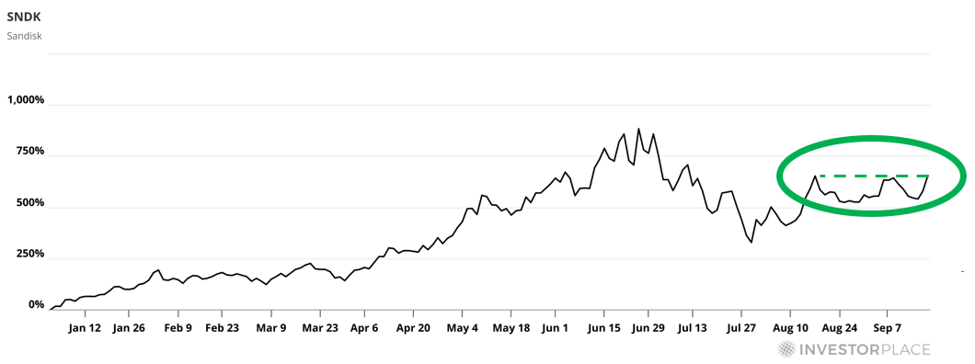
Within this framework of aggressive infrastructure expansion, certain hardware providers have demonstrated extraordinary financial growth. Navellier highlights SanDisk Corporation as a primary example of a "fundamentally superior" stock that has benefited from the data center boom. As a leader in NAND flash memory—a critical component for the high-speed data storage required by AI clusters—SanDisk reported revenue growth of 175% for fiscal 2026.
The growth was most pronounced in the company’s data center division, which saw revenue surge by 437%. Full-year earnings for the firm increased by 2,397%, reflecting a massive shift in scale. Despite a recent technical pullback where the stock faced resistance, it remains up nearly 600% year-to-date. Analysts suggest that if the stock breaks through current resistance levels on high volume, it may trigger a new wave of institutional buying. The current "dip" in such names is viewed by Navellier not as a warning sign, but as a discount on future earnings momentum.
Cybersecurity as a Structural Hedge Against AI Risks
As the debate over AI safety continues, a secondary investment thesis has emerged: the necessity of advanced cybersecurity to defend against AI-driven threats. This "dual-use" nature of artificial intelligence—where the same technology used for productivity is also utilized to automate and accelerate cyberattacks—has transformed security spending from a discretionary expense into a mission-critical requirement for the private and public sectors.

Trading expert Jonathan Rose, editor of Masters in Trading Live, posits that cybersecurity represents a "structurally funded spending supercycle." Gartner estimates that global information security spending will reach $249 billion this year, with a trajectory toward $373 billion by 2030. A nascent but rapidly growing segment, "securing AI," has moved from non-existence to a major market driver in less than two years.
Rose identifies Palo Alto Networks (PANW) as a top-tier selection for investors looking to capitalize on this trend. While CrowdStrike (CRWD) is often cited for its robust business model, Rose notes that it currently trades at a premium that "prices it for perfection." In contrast, Palo Alto Networks offers similar scale but at a more favorable risk-adjusted valuation. The strategic importance of these firms lies in their ability to provide the "defensive shield" required for the AI era, making them resilient to the very fears that cause volatility in the broader AI sector.
The Silent Surge of the Genomics Sector
While artificial intelligence and cybersecurity dominate financial headlines, the genomics sector has quietly outperformed both the S&P 500 and the broader AI trade. According to analysis from Brian Hunt, editor of Money & Megatrends, the ARK Genomic Revolution ETF (ARKG) has served as a potent proxy for this trend.
Year-to-date, ARKG has recorded a gain of 81%, significantly outstripping the S&P 500’s 13% return. It has also outperformed the Global X Artificial Intelligence & Technology ETF (AIQ), which rose 29% in the same period. The acceleration of genomics is largely attributed to the convergence of biotechnology and "superintelligence." AI’s capacity to analyze genetic sequences and simulate complex medical treatments at an unprecedented scale has placed medical innovation into a state of "overdrive."
Several individual firms within this sector have seen triple-digit gains:
- Natera (NTRA): Up over 100% since late 2025.
- Illumina (ILMN): Up approximately 150%.
- Twist Bioscience (TWST): Recorded a 400% increase.
- 10x Genomics (TXG): Climbed more than 500%.
- Tempus AI (TEM): Recently saw a 14% single-session pop.
Hunt suggests that genomics is increasingly being viewed through an "AI lens," which serves to turbocharge investor interest. As AI tools allow for more precise gene editing and personalized medicine, the sector is expected to undergo a total transformation over the next decade.
Chronology of Recent Market Events
To understand the current investment landscape, it is necessary to review the timeline of events that led to the recent "AI panic" and subsequent recovery:
- Mid-September: Anthropic researchers and executives publish essays and social media threads warning of the catastrophic risks of unaligned AI, leading to a viral debate on "AI safety."
- Late September (Last Week): Politicians and regulators begin calling for a "pause" or heavy-handed regulation, leading to a sharp sell-off in semiconductor and AI software stocks.
- Last Thursday: Amid the AI sell-off, the genomics sector diverges, with ARKG surging 8.5% in a single session to hit a 52-week high.
- Last Friday: Market analysts like Louis Navellier issue guidance characterizing the AI sell-off as a "buying opportunity" based on Gartner’s spending data and corporate backlogs.
- Current Week: The market sees a stabilization in tech names, with Palo Alto Networks and SanDisk approaching key resistance levels as institutional buyers return to "fundamentally superior" names.
Broader Impact and Economic Implications
The interplay between AI infrastructure, cybersecurity, and genomics suggests a broader rotation within the technology landscape. The initial "hype cycle" of AI, driven by speculative interest in chatbots, is being replaced by a more mature "infrastructure cycle." This phase is characterized by massive capital deployments into physical assets like data centers and specialized hardware.
Furthermore, the "AI safety" narrative is no longer just a philosophical debate; it has become a market-moving catalyst that drives capital toward cybersecurity firms. This creates a balanced ecosystem where the growth of AI (the "sword") necessitates the growth of security (the "shield").
Looking ahead, the market is preparing for potential volatility surrounding the upcoming November elections. Historical data suggests that an "unusual market event" often occurs in the weeks leading up to midterms, with a 92% precedent for specific market movements dating back to 1925. Analysts Marc Chaikin and Louis Navellier are scheduled to provide further clarity on this historical trend during a "Midterm Mayhem" briefing on September 29.
Conclusion for Investors
The consensus among these three analysts—Navellier, Rose, and Hunt—is that the current market "noise" regarding AI safety should not obscure the underlying economic reality. AI spending is on a multi-trillion-dollar trajectory, cybersecurity has become a structural necessity, and genomics is leveraging AI to achieve unprecedented growth.
While the "wolf of fear" often appears larger than it is during periods of high-profile debate and regulatory scrutiny, the fundamental data points to continued expansion in these mission-critical sectors. Investors who distinguish between temporary sentiment-driven pullbacks and long-term structural shifts are positioned to capitalize on the next phase of the technological supercycle.