SATELLAI Collar Outshines Halo Collar 5 in User Experience and Battery Life for Virtual Fencing Solutions

The landscape of pet containment is rapidly evolving, with GPS dog collars emerging as a sophisticated alternative to traditional physical fences. These innovative devices offer pet owners the ability to establish virtual boundaries, receiving immediate alerts when their canine companions approach or breach these digital perimeters. However, the decision-making process for selecting the right GPS collar extends beyond mere GPS specifications. Critical factors such as the ease of setup, the longevity of battery life, the effectiveness of integrated training tools, and the overall user experience within the companion app can significantly influence a dog owner’s satisfaction and the system’s efficacy.
To provide a comprehensive evaluation of these advanced pet containment systems, a rigorous testing protocol was implemented, involving two distinct canine subjects: Rufus, a 45-pound German Shepherd puppy belonging to the author’s mother, and Pluto, a robust 90-pound Rhodesian Ridgeback. Both dogs were outfitted with both the SATELLAI Collar and the Halo Collar 5, allowing for a direct comparison of their fit on varying canine physiologies and a detailed examination of how each system registered and reported boundary activity. The testing phase confirmed that both collars reliably delivered GPS fence notifications, and no discernible difference in their fundamental positioning accuracy was observed during the trials. Ultimately, the SATELLAI Collar distinguished itself through a more intuitive setup process, more accessible control interfaces, the provision of unlimited customizable fence configurations (a stark contrast to Halo’s similarly priced subscription model, which limits users to five fences), and a more extended advertised battery life.

Design and Comfort: Balancing Technology with Canine Well-being
The SATELLAI Collar features a thoughtfully designed padded strap enhanced with a reflective stripe for increased visibility. Its closure mechanism is magnetic, offering a sleek and user-friendly experience. The collar’s cloth cover also incorporates reflective edging, further contributing to safety. Critically, it boasts an IP68 dust- and water-resistance rating, signifying its durability and suitability for a wide range of environmental conditions. Initial testing with Rufus, followed by fitting it onto the larger frame of Pluto, provided ample opportunity to assess the collar’s adaptability and fit. Throughout outdoor testing sessions, the SATELLAI collar remained securely in place without any apparent discomfort for either dog. Despite housing substantial GPS and communication hardware, the collar’s design did not impede the dogs’ natural movements.
In contrast, the Halo Collar 5 adopts a more conventional approach with its buckle fastening system. While the author personally favored SATELLAI’s magnetic closure for its convenience, the Halo’s buckle performed flawlessly and ensured a comfortable fit for Pluto. The Halo collar carries an IP67 rating, offering protection against dust and water ingress under specific operational parameters. In terms of comfort during the testing period, neither collar presented a notable advantage over the other. Therefore, factors such as the fastening style and other distinguishing features emerged as more significant considerations for potential buyers.
Establishing Virtual Boundaries: A Tale of Two Setup Experiences
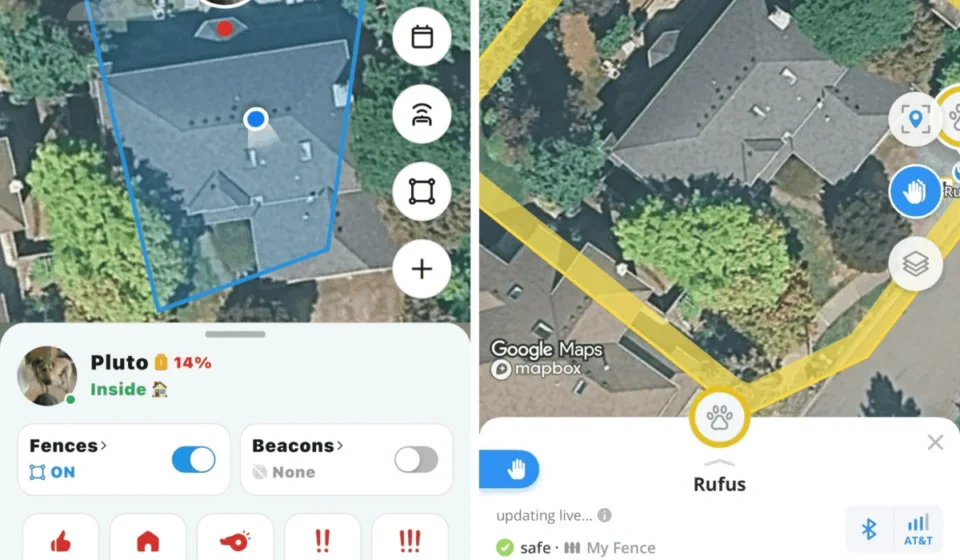
The initial setup of a virtual fence using the SATELLAI Collar left a strong positive impression. The process was initiated in the author’s mother’s backyard, an area bordered by expansive green space. The SATELLAI application empowers users to create highly customizable, irregularly shaped boundaries, liberating them from the constraints of pre-defined circular perimeters. This flexibility is particularly advantageous for yards with non-uniform layouts. The fence controls were readily discoverable within the app, allowing for the swift establishment of the desired containment area with minimal time spent navigating complex menus. During a subsequent testing session with Pluto, the SATELLAI app clearly displayed the polygon fence that had been configured, alongside the dog’s real-time location and his current fence status.

The Halo Collar 5 also facilitates the creation of GPS-defined boundaries, but its setup process was found to be less intuitive. Locating specific settings required more effort and time. A notable restriction was encountered when attempting to position the virtual fence in close proximity to a building. This proved to be an inconvenience for the author’s mother’s backyard, where the house is situated near a portion of the area intended for containment. While users with more open and unobstructed properties might have a different experience, the SATELLAI system proved significantly easier to configure for the specific layout encountered during testing. The combination of its flexible fence shaping capabilities and straightforward navigational architecture granted it a clear advantage in this critical aspect.
Real-World Performance: Navigating Boundaries and Alerts
During the initial SATELLAI testing session with Rufus, his exploration of the backyard was closely monitored while the virtual boundary’s integrity was assessed. Vibration feedback was selected as the primary alert mechanism. The application promptly notified the user when Rufus approached the fence, issuing a warning that he was moving towards the exterior perimeter. The separate whistle command was also tested, which Rufus clearly perceived and responded to by halting his movement. When the SATELLAI collar was subsequently fitted onto Pluto, the app registered a "Fence Breached" status while the polygon fence was active. Upon Pluto’s return to the designated safe area, a "Returned to Safety" alert was issued. This instance provided further confirmation of the system’s ability to accurately identify and report boundary activity, even with a significantly larger dog.
The Halo Collar 5 also consistently delivered boundary notifications throughout the testing period. With Pluto, its application meticulously recorded various events, including "Fence Breach Detected," "Returned to Safety," and "Fence Breach Avoided." The granularity of these distinct notification types was particularly appreciated, as they offered a more detailed explanation of the situation rather than a single, generic warning. Following the switch to Rufus, another "Fence Breach Detected" notification was received, and the app confirmed that fence feedback was actively engaged. These observations instilled confidence that both systems possessed the capability to accurately identify and report boundary events during the outdoor testing sessions.

It is important to note that while both collars provided comparable GPS performance, the author was not conducting controlled, scientific measurements of positioning accuracy. Both systems successfully reported boundary activity with the dogs, and neither exhibited a demonstrably superior tracking advantage during these real-world scenarios. It is crucial for owners to understand that GPS collars, by their nature, do not constitute physical barriers. The issuance of a notification does not inherently guarantee that a dog will cease its movement. Therefore, consistent training and diligent supervision remain paramount, irrespective of the specific collar chosen.
Advanced Technology: GPS Tracking and System Reliability
The SATELLAI Collar incorporates advanced positioning technology, utilizing dual-frequency GNSS (Global Navigation Satellite System) positioning, engaging five distinct satellite constellations, and featuring a dual-antenna design housed within a dedicated antenna chamber. The company asserts that its antennas operate on separate frequencies, a design choice intended to mitigate interference and enhance positioning reliability. Furthermore, its SteadyTrack+ system is engineered to support location updates occurring at a frequency of one second. While these technical specifications are compelling and may appeal to owners with extensive properties, the testing environment did not encompass a sufficient variety of terrains and conditions to independently verify these claimed positioning advantages.
The Halo Collar 5 employs dual-frequency positioning, accesses six satellite constellations, and features its AlwaysOn GPS system. Halo also advertises a capability of up to 20 positioning calculations per second. However, this figure is not directly comparable to SATELLAI’s location-update frequency, making a direct technical comparison challenging without further clarification from the manufacturers. In practical terms during the testing phase, both collars consistently supplied location data and fence notifications as anticipated. Their real-world performance appeared remarkably similar, underscoring the importance of factors such as ease of setup, control accessibility, and battery longevity as more influential decision-making criteria.

User Interface and Training Integration: A Focus on Usability
The SATELLAI application proved to be significantly easier to navigate. Whether the objective was to ascertain a dog’s current location, review the established fence parameters, or access feedback controls, the user generally knew where to look within the interface. The collar supports multiple feedback mechanisms, including vibration, audible whistle commands, and Doggie-Talkie communication via its integrated speaker and microphone. Through a degree of exploration within the app, it was discovered that users can record their own custom audio commands and assign them to specific buttons within the application. SATELLAI has also recently introduced an iOS widget that grants immediate access to frequently used commands, such as "Go Home" and "Whistle," without the necessity of opening the full application. While this new widget was not directly tested, it represents a convenient method for accessing essential controls without the need for a separate physical accessory.
The Halo Collar 5 adopts a more structured and guided approach to training. It offers a suite of lessons designed to acclimate dogs to the collar, reinforce recall commands, and build awareness of virtual boundaries. These instructional resources are highly valuable, as dogs require a clear understanding of what the feedback signals signify before consistent and reliable responses can be expected from owners. A particularly appealing feature of the Halo system is its optional physical remote. This accessory provides direct access to training controls, eliminating the need for users to navigate the phone application. However, it does introduce the requirement of carrying an additional device. While both training approaches have demonstrable merit, the SATELLAI’s superior app navigation and its phone-based shortcut options align more closely with the author’s anticipated usage patterns for a GPS dog collar.
Power Management and Added Functionality: Differentiating Features
While both collars exhibited comparable GPS performance during the practical testing period, the SATELLAI Collar holds a distinct advantage in its advertised battery life. Its substantial 1,600mAh battery is rated to provide up to three days of operational use when the Power-Saving Mode is activated. This contrasts with Halo’s advertised runtime of up to 48 hours. For owners who rely on virtual fencing on a daily basis, this extended time between charging cycles can represent a significant practical benefit. SATELLAI also claims up to 10 days of standby time. Importantly, the SATELLAI’s virtual fencing functionality remains active even in its Power-Saving Mode, and the system has undergone testing and demonstrated effectiveness across all operational modes.

Halo does not publicly disclose the specific battery capacity of its device on its website. However, a teardown analysis of the Halo Collar 5 suggests it is equipped with an 860mAh battery, which is considerably smaller than the SATELLAI’s 1,600mAh unit. Halo advertises approximately one hour for a full charge, whereas SATELLAI lists approximately two hours. In practical testing, both devices charged relatively quickly, so charging speed was not a decisive factor in the evaluation. SATELLAI also offers Sense AI, an advanced feature that analyzes activity and rest patterns to generate comprehensive behavioral summaries after an initial wear period. This AI component also possesses a conversational element, capable of referencing these patterns to answer user queries about a dog’s behavior. Halo, in parallel, provides activity-related features alongside its GPS fencing and training tools. The author did not conduct an in-depth evaluation of SATELLAI’s long-term health summary capabilities. It is noteworthy that both collars necessitate a subscription for their connected functionalities. SATELLAI consolidates all features under a single subscription plan, while Halo offers three distinct subscription tiers.
The Verdict: Which GPS Dog Collar Reigns Supreme?
Following a thorough testing and evaluation period of both the SATELLAI Collar and the Halo Collar 5, the SATELLAI Collar emerges as the recommended choice. The Halo Collar 5 performed capably, delivering the expected boundary alerts, providing valuable training resources, and offering the convenience of an optional physical remote. It stands as a competent alternative, and no significant differences in GPS accuracy were observed between the two systems during the trials.
However, the SATELLAI Collar demonstrated superior usability from the outset. Its highly customizable virtual fences provided a greater degree of flexibility, the application controls were more readily accessible, and the availability of quick-access commands within the app, complemented by an additional iOS widget option, was a significant advantage. Furthermore, its advertised battery life of up to three days presents a distinct advantage over Halo’s advertised 48 hours. For the specific needs and configuration of the author’s mother’s backyard, these practical differences render the SATELLAI Collar the superior overall option. This recommendation is not predicated on measurably superior GPS accuracy, but rather on its superior combination of user-friendliness, convenient magnetic closure, fencing flexibility, and extended battery life, which collectively better align with user requirements.

SATELLAI’s Black Friday sale is currently active, offering an opportunity to explore the SATELLAI Collar and its associated promotions. Interested consumers can visit satellai.com to learn more and take advantage of current offers.