Tesla is starting to roll out FSD v15, and Reality View shows what the car plans to do

Tesla has officially commenced the rollout of its Full Self-Driving (FSD) software version 15, a significant update poised to enhance the capabilities and transparency of its autonomous driving system. The company announced through its Super Intelligence X account that this latest iteration represents a comprehensive overhaul of the end-to-end driving network, boasting a claimed 25-fold improvement in handling safety-critical scenarios. This advancement is attributed to an upgraded vision encoder trained on an extensive dataset comprising millions of internet videos, enabling the system to better interpret and react to complex driving environments.
Revolutionizing Driver Interaction: The Advent of Tesla Reality View
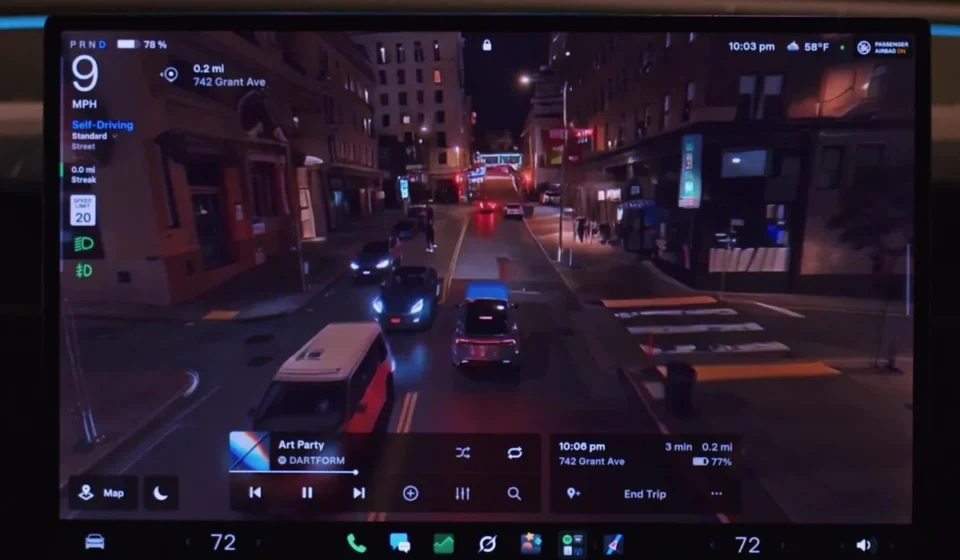
Perhaps the most visually striking and user-centric enhancement in FSD v15 is the introduction of Tesla Reality View. This innovative feature provides drivers with a dynamic, real-time visualization of their journey, offering unprecedented insight into the vehicle’s decision-making processes. Reality View projects a generative view from a virtual camera positioned above the vehicle, overlaying the real-world environment with graphical representations of the car’s planned actions. This allows drivers to see, and potentially influence, what FSD is intending to do next, fostering a greater sense of control and understanding.
The interface for Reality View is designed for flexibility, offering multiple viewing options to suit driver preferences. These include a full-screen mode for maximum immersion, a dedicated map view, a split-view that combines visual data with navigational information, and a quiet mode for drivers who prefer a less interactive experience. Crucially, upcoming turns are clearly indicated within the driving visualization, providing drivers with advance notice of the vehicle’s trajectory.

Beyond immediate driving maneuvers, FSD v15 also refines navigation functionalities. The system now learns from fleet-wide route preferences for the start and end points of trips, aiming to optimize common journeys. Future iterations of v15 are slated to expand this learning capability to encompass entire routes, further personalizing and streamlining navigation. Additionally, the system leverages a vehicle’s parking history to proactively identify potential parking spots at a destination. Drivers can also view multiple parking options displayed on the map, empowering them to make informed choices before arrival.
Enhanced Perception and Predictive Capabilities
The advancements in FSD v15 extend to its perception system, with Tesla reporting substantial improvements in the detection of various road elements and potential hazards. Drivers can expect more accurate identification of traffic signs, animals, road debris, potholes, and areas of standing water. The system’s ability to navigate through challenging conditions, such as school zones and inclement weather, has also been refined for smoother and more natural speed adjustments.
A notable safety feature introduced is the system’s ability to detect speed cameras. Upon identification, FSD v15 will proactively reduce the vehicle’s speed. Drivers retain the ability to override this slowdown by accelerating or by adjusting their speed profile. For recurring encounters with speed cameras, the system offers a learning mechanism: if a driver cancels the slowdown twice at the same camera location, the car will remember the spot and refrain from decelerating there in future instances. This feature aims to balance automated safety protocols with driver autonomy.

Introducing Bike Rack Mode for Practicality
Addressing specific user needs, FSD v15 introduces "Bike Rack Mode." This feature is designed to accommodate drivers who utilize bike racks or similar hitch-mounted accessories. When engaged, the car’s autonomous driving behavior is modified to facilitate a more convenient drop-off experience. Instead of attempting a reverse maneuver, the vehicle will pull over closer to the destination. In this mode, functions such as Autopark, Summon, and backup chimes and warnings are temporarily deactivated to prevent potential interference or unintended actions.
FSD v15: A Stepping Stone Towards Unsupervised Driving
It is important to note that FSD v15 remains a supervised system. This means that drivers are still required to remain attentive and ready to take control at all times. This contrasts with Tesla’s long-term vision of a fully unsupervised driving system, which is anticipated to be a prerequisite for vehicles that could eventually join its burgeoning Robotaxi fleet. The company has not yet specified which vehicle models will receive the FSD v15 software update first, indicating that availability may vary among its customer base.

Context and Historical Progression of Tesla’s FSD Development
The rollout of FSD v15 is the latest chapter in Tesla’s ambitious and often scrutinized journey towards developing fully autonomous vehicles. The FSD program, initially launched as "Autopilot," has undergone numerous iterations and updates since its inception. Early versions focused on basic driver assistance features like adaptive cruise control and lane keeping. Over time, Tesla progressively introduced more advanced capabilities, including automated lane changes, navigating complex intersections, and, more recently, features requiring human supervision.
The development has been characterized by a data-driven approach, with Tesla relying heavily on its fleet of vehicles to collect driving data, which is then used to train and refine its neural networks. This approach has allowed for rapid iteration but has also drawn attention from regulatory bodies concerned about the safety and reliability of the technology. The introduction of features like FSD Beta has allowed a select group of customers to test pre-release versions, providing valuable real-world feedback, albeit with the inherent risks associated with nascent autonomous systems.
Broader Implications for the Automotive Industry and Public Perception

The continuous evolution of Tesla’s FSD system, culminating in v15 and its advanced features like Reality View, has significant implications for the broader automotive industry. As Tesla pushes the boundaries of autonomous driving technology, other manufacturers are compelled to accelerate their own research and development efforts. The transparency offered by Reality View could set a new benchmark for driver-vehicle communication in the realm of advanced driver-assistance systems (ADAS) and autonomous driving.
The "25 times better handling of safety-critical cases" claim, if substantiated by rigorous testing and real-world performance, could significantly influence public perception of autonomous driving technology. A demonstrable improvement in safety, coupled with enhanced driver understanding through visualizations like Reality View, may help to alleviate some of the public’s reservations about relinquishing control to automated systems.
However, the path to widespread autonomous driving is fraught with challenges. Regulatory frameworks are still evolving to address the complexities of self-driving vehicles, including liability in the event of accidents. The ethical considerations surrounding autonomous decision-making in unavoidable accident scenarios remain a subject of intense debate. Furthermore, the cybersecurity of connected and autonomous vehicles is a critical concern, as sophisticated systems can be vulnerable to malicious attacks.
The continued development of FSD v15 signifies Tesla’s commitment to its long-term vision of a future where vehicles can drive themselves. The introduction of features like Reality View suggests a strategic shift towards making the technology more understandable and controllable for the human driver, a crucial step in building trust and acceptance as the technology matures. The impact of this rollout will be closely monitored by industry experts, regulators, and consumers alike, as it represents another significant stride in the ongoing transformation of personal transportation.