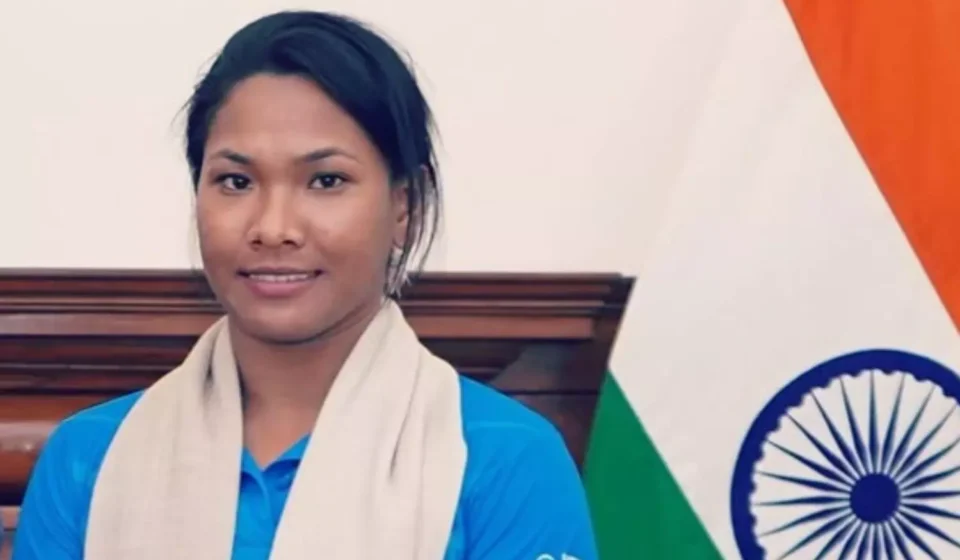
Asian Games Gold Medallist Swapna Barman Joins Trinamool Congress Ahead of 2026 West Bengal Assembly Elections

The political landscape of West Bengal witnessed a significant development on Friday as Swapna Barman, the 2018 Asian Games gold medallist in the heptathlon, officially joined the Trinamool Congress (TMC). The induction took place at the party’s headquarters in Kolkata, marking a major transition for the celebrated athlete from the world of international sports to the arena of active politics. Barman was welcomed into the party fold by senior TMC leaders and state ministers Bratya Basu and Chandrima Bhattacharya, who handed her the party flag in the presence of various officials and supporters.
This move comes at a critical juncture for the ruling party in West Bengal, which is already gearing up for the 2026 Legislative Assembly elections. Barman’s entry into politics follows weeks of intense speculation fueled by her recent high-profile interactions with Chief Minister Mamata Banerjee. The athlete, who hails from the Jalpaiguri district, is widely regarded as an icon in North Bengal, a region where the TMC is looking to consolidate its influence.
Speaking to the media following her induction, Barman expressed her admiration for the state government’s initiatives. "Chief Minister Mamata Banerjee’s multifaceted development work has deeply inspired me," Barman stated. "I joined the Trinamool Congress today to join her work and contribute to the progress of the state. I have always seen how the Chief Minister stands by the youth and the sporting community, and I believe that under her leadership, I can do more for the people of Bengal."
The Sporting Legacy of Swapna Barman
To understand the weight of Barman’s political entry, one must look at her storied career as one of India’s most resilient athletes. Born in 1996 in the town of Jalpaiguri, Barman’s journey is a classic tale of triumph over adversity. Coming from a humble background—her father was a van rickshaw puller and her mother worked in a tea garden—she faced immense financial and physical challenges.
Barman’s greatest claim to fame remains her historic gold medal at the 2018 Asian Games in Jakarta, Indonesia. Competing in the heptathlon—a grueling seven-event contest—she secured the top spot with a total of 6,026 points. Her victory was particularly notable because she competed while suffering from a severe toothache and wearing custom-made shoes to accommodate six toes on each foot, a condition that often caused her significant pain during competition.
In addition to her Asian Games gold, Barman’s trophy cabinet includes:
- A gold medal at the 2017 Asian Athletics Championships in Bhubaneswar.
- A silver medal at the 2023 Asian Athletics Championships in Bangkok.
- A silver medal at the 2017 Asian Indoor Athletics Championships.
- A bronze medal at the 2019 Asian Athletics Championships in Doha.
In recognition of her extraordinary contributions to Indian sports, she was conferred with the Arjuna Award in 2019, one of the country’s highest sporting honors. Her transition to politics is seen by many as a way to leverage her popularity to advocate for better sports infrastructure and youth development in the state.
Strategic Timing and the North Bengal Factor
The timing of Barman’s induction is strategically significant for the Trinamool Congress. With the 2026 West Bengal Assembly elections less than two years away, the party is actively seeking to diversify its candidate profile and appeal to younger voters and the sporting fraternity.
Furthermore, Barman’s roots in Jalpaiguri are of immense tactical value. North Bengal has historically been a challenging terrain for the TMC, with the Bharatiya Janata Party (BJP) making significant inroads in the region during the 2019 General Elections and the 2021 Assembly polls. By bringing a local hero and a tribal icon into the fold, the TMC aims to reclaim lost ground in districts like Jalpaiguri, Alipurduar, and Cooch Behar.
Political analysts suggest that Barman’s presence could help the party resonate with the Rajbanshi community and other indigenous groups in North Bengal. Her story of rising from poverty to international stardom serves as a powerful narrative that the TMC likely intends to utilize during its grassroots campaigns.
A Chronology of the Transition
The path to Barman’s political debut was paved over several months through a series of public appearances and signals.
- Late 2023 – Early 2024: Following her performance at the Asian Games in Hangzhou, Barman began participating more frequently in state-sponsored sporting events and youth festivals in West Bengal.
- Recent Public Interactions: Speculation reached a fever pitch during a recent public event where Barman was seen in a long, animated conversation with Chief Minister Mamata Banerjee. Observers noted the warmth between the two, suggesting a formal alliance was imminent.
- Friday Induction: The process culminated on Friday afternoon in Kolkata. Ministers Bratya Basu and Chandrima Bhattacharya emphasized that Barman’s "fighting spirit" on the field is exactly what the party values in its members.
- Immediate Future: Barman is expected to begin touring North Bengal shortly to engage with local youth and promote the state government’s ‘Khelashree’ scheme, which provides financial assistance to sports clubs and young athletes.
Official Responses and Party Statements
The induction ceremony was marked by high praise from the TMC leadership. Bratya Basu, the State Education Minister, highlighted the symbolic importance of Barman joining the party. "Swapna Barman is a symbol of struggle and success. Her decision to join the Trinamool Congress shows that the youth and the icons of our state trust the vision of Mamata Banerjee. We are proud to have a champion like her among us," Basu remarked.
Chandrima Bhattacharya, the Minister of State for Finance and Health, added that the party has always been a platform for those who want to serve the public. "Our party is not just about politics; it is about the social and cultural upliftment of Bengal. Swapna’s entry will inspire thousands of young girls across the state to dream big and work for their communities."
While the opposition parties, including the BJP and the CPIM, have yet to issue a formal joint statement, local leaders have characterized the move as a typical "celebrity recruitment drive" by the TMC. Opposition critics often argue that the induction of sports stars is a tactic to divert attention from administrative issues, though the TMC maintains that it is simply providing a platform for accomplished individuals to serve the public.
Supporting Data: The TMC’s "Star Power" Strategy
Swapna Barman is not the first athlete to join the Trinamool Congress. The party has a long-standing tradition of fielding sports personalities and celebrities in elections to capitalize on their mass appeal.
- Manoj Tiwary: The former Indian cricketer joined the TMC before the 2021 elections and currently serves as a Minister of State for Youth Affairs and Sports.
- Laxmi Ratan Shukla: Another former cricketer who served as a minister before taking a hiatus from politics.
- Yusuf Pathan: The World Cup-winning cricketer recently won a Lok Sabha seat from Baharampur on a TMC ticket.
- Kirti Azad: A member of the 1983 World Cup-winning team, he is also a prominent face within the party.
This strategy has yielded mixed but generally positive results for the party in terms of vote-share and visibility. Data from the 2021 Assembly elections showed that celebrity candidates often help in "swing" constituencies where the margin of victory is thin. For the TMC, Barman represents a "double-win": she is both a sporting celebrity and a representative of the geographically vital North Bengal region.
Broader Implications and Analysis
The entry of Swapna Barman into politics reflects a broader trend in Indian public life where the boundaries between sports, cinema, and governance are increasingly fluid. For Barman, the move offers a platform to address the systemic issues she faced as an athlete—such as the lack of specialized equipment and financial instability for rural sportspersons.
From a policy perspective, her involvement could lead to a more nuanced approach to the ‘Khelashree’ program. If she is given a formal role within the sports department or the youth wing, her first-hand experience with the rigors of international competition could prove invaluable in drafting policies that support athletes at the grassroots level.
However, the transition from the structured world of athletics to the often-volatile world of West Bengal politics is not without its challenges. Barman will need to navigate complex caste dynamics, regional grievances, and the intense scrutiny that comes with being a public figure in a politically polarized state. Her ability to translate her sporting discipline into administrative or grassroots efficacy will be the ultimate test of her political career.
Conclusion
As West Bengal moves closer to the 2026 elections, the induction of Swapna Barman serves as a clear signal of the Trinamool Congress’s intent to diversify its ranks and strengthen its hold on North Bengal. For the people of Jalpaiguri and the sporting community at large, Barman’s new role represents a hope that the "Golden Girl" of Indian heptathlon can bring the same level of dedication and success to the halls of governance as she did to the athletic track. Whether this move will result in a "gold medal" at the ballot box remains to be seen, but for now, the TMC has successfully secured one of the state’s most prominent and respected icons.