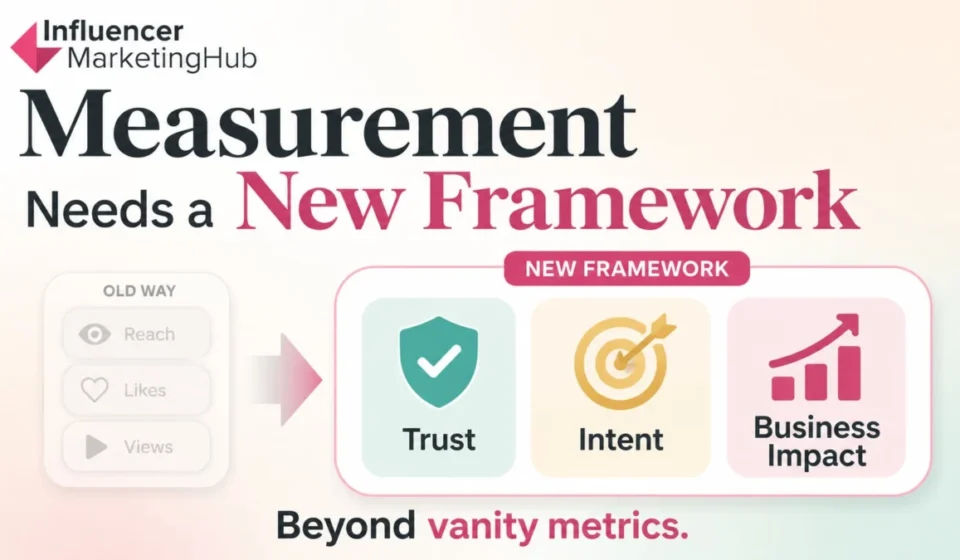
Rethinking the Metrics of Influence: A New Framework for Measuring the Creator Economy in 2026 and Beyond

As the creator economy matures into a cornerstone of global advertising, industry leaders and marketing agencies are signaling a fundamental shift in how success is defined and measured. For years, the industry relied on a standardized set of platform-native metrics—views, likes, and engagement rates—to justify multi-million dollar investments. However, as the sector approaches 2026, a consensus is emerging among top-tier agencies and brand strategists that these metrics, while still relevant for measuring reach, no longer provide a comprehensive picture of business impact. The transition toward a more nuanced, layered measurement stack reflects the growing complexity of consumer behavior and the integration of artificial intelligence into the digital discovery process.
The Evolution of Creator Marketing Evaluation
The history of influencer marketing measurement has moved through several distinct phases. In the early 2010s, "vanity metrics" such as follower counts were the primary currency of the industry. By the late 2010s, the focus shifted toward engagement rates, as brands sought to identify creators with active, rather than passive, audiences. Entering the mid-2020s, the industry has reached a third inflection point: the recognition that a "one-size-fits-all" scorecard is fundamentally flawed.
Currently, many marketing teams continue to evaluate creator content through a single lens, regardless of the content’s strategic intent. A top-of-funnel awareness video designed to build brand affinity is often judged by the same conversion-focused metrics as a "shoppable" post or a direct-response product demo. Industry analysts argue that this lack of context leads to incomplete conclusions, often resulting in brands underfunding high-value awareness campaigns or overvaluing low-quality reach that fails to drive long-term business growth.
The Layered Measurement Stack: A Three-Tiered Approach
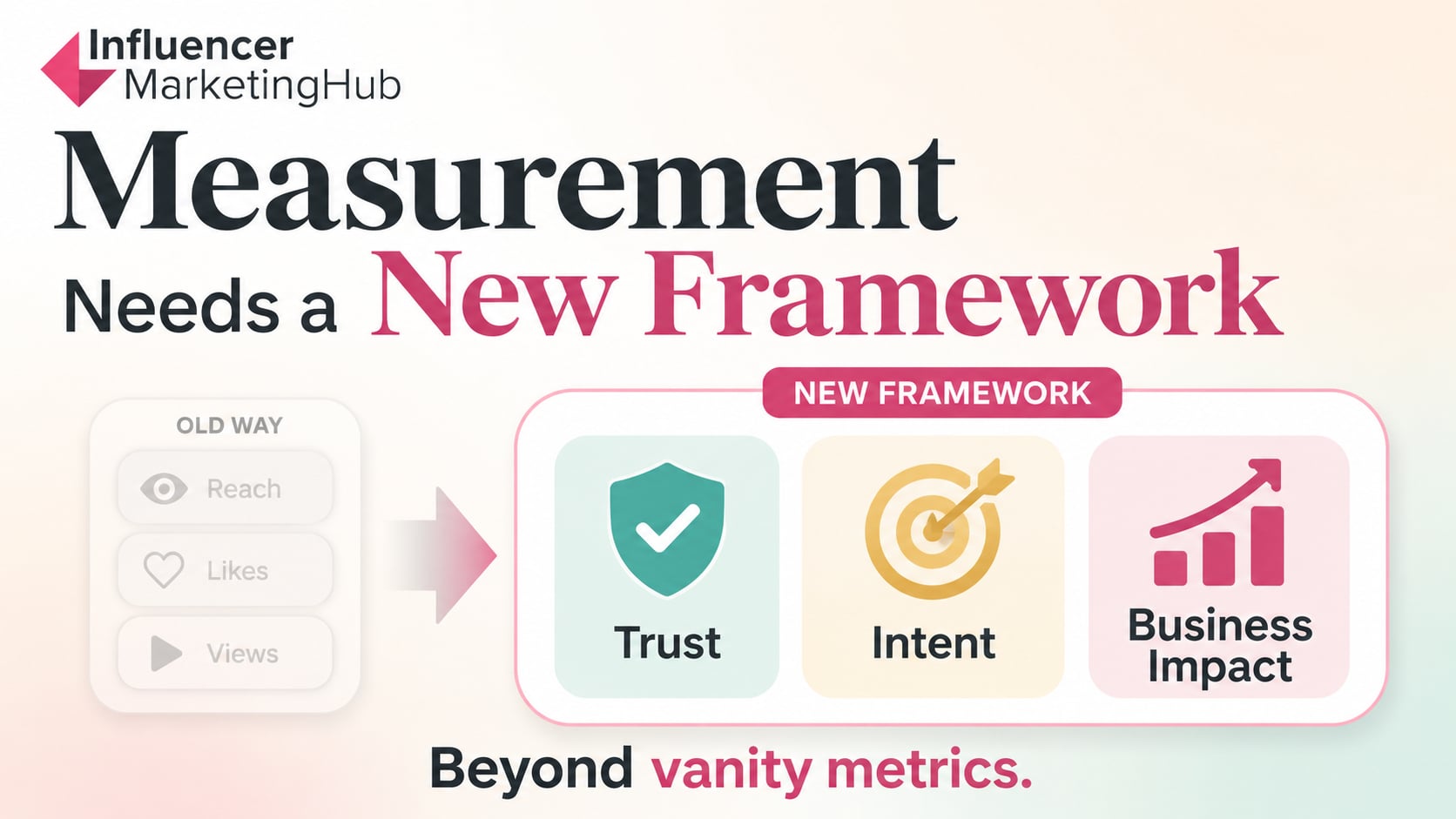
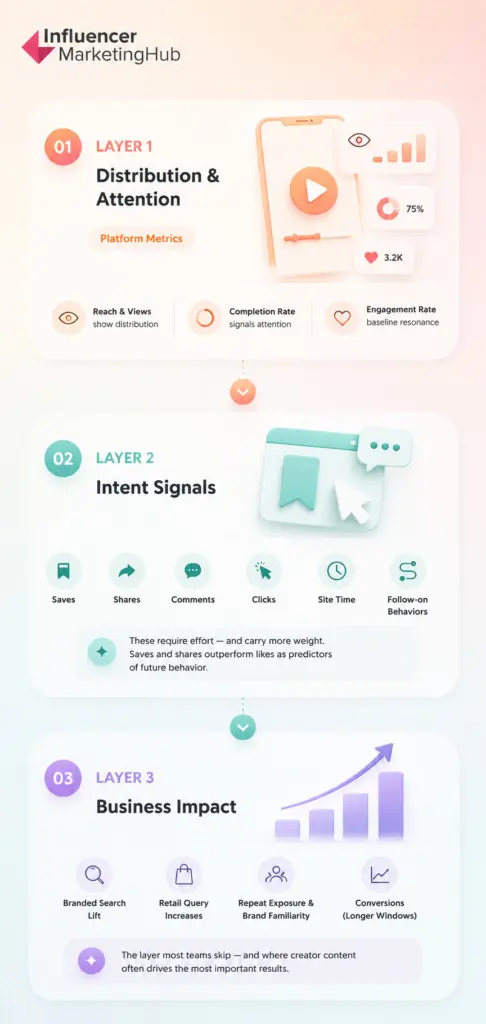
To address these shortcomings, a new framework is being adopted by leading firms, including Intuition Media Group. This approach moves away from a singular ROI figure in favor of a layered stack that evaluates performance across three distinct dimensions: distribution, intent, and business impact.
Layer 1: Distribution and Attention Efficiency
The first layer focuses on traditional platform metrics. While these are often criticized as being "surface-level," they remain essential for determining whether content has cleared the initial hurdle of visibility. Key indicators in this layer include:
- View-Through Rates (VTR): Assessing how long a viewer stays with the content before scrolling.
- Completion Rates: Measuring the percentage of the audience that watches a video in its entirety.
- Reach and Distribution Efficiency: Calculating the cost-per-thousand (CPM) relative to the quality of the audience reached.
These signals indicate the content’s ability to capture attention in an increasingly crowded digital landscape. However, in the 2026 framework, these are treated as baseline requirements rather than end-state goals.
Layer 2: Intent Signals and Audience Effort
The second layer analyzes "high-intent" actions that require more effort from the user than a simple double-tap "like." According to recent industry data, saves and shares have become more accurate predictors of future purchasing behavior than any other engagement metric.
- Saves: Indicates that the content has educational or inspirational value that the user wishes to revisit.
- Shares: Signals a high degree of brand trust and social currency.
- Comment Sentiment and Tags: Moving beyond the quantity of comments to analyze the quality of the discourse, specifically looking for users tagging friends or asking product-specific questions.
For endorsement-driven content, these signals carry significantly more weight because they demonstrate that the creator has successfully moved the audience from passive consumption to active consideration.
Layer 3: Direct and Indirect Business Impact
The third and most critical layer involves measuring the actual business outcomes. This is the area where most marketing programs historically struggle due to the "dark social" effect—where conversions happen outside of tracked links. The 2026 measurement model incorporates:
- Branded Search Lift: Measuring the increase in search engine queries for a brand following a creator campaign.
- Retail Foot Traffic and Query Data: Utilizing geo-fencing and retailer-specific data to see if digital content translated into physical store visits.
- Media Mix Modeling (MMM): Integrating creator performance into broader econometric models to see how it compounds with other channels like Connected TV (CTV) or Out-of-Home (OOH) advertising.
The Role of AI-Driven Discovery in 2026
A major catalyst for this measurement overhaul is the rapid adoption of AI-driven search and discovery tools. By 2026, industry research suggests that more than 50% of U.S. consumers utilize large language models (LLMs) and AI search engines—such as OpenAI’s SearchGPT or Google’s AI Overviews—as part of their pre-purchase research.
AI models do not generate opinions in a vacuum; they synthesize information from existing digital ecosystems. High-quality creator content serves as a vital data source for these AI tools. When a creator provides a detailed review or a "how-to" guide, that content informs the AI’s recommendation when a consumer asks, "What is the best skincare routine for sensitive skin?"
This creates a "hidden" influence where a creator’s video might not result in an immediate click, but it ensures the brand is included in the AI-generated "consideration set" when the consumer eventually makes a purchase. Consequently, the value of creator content is being redefined as "digital shelf space" that influences AI outputs, a metric that traditional dashboards are currently unable to capture fully.
Segmentation and the Failure of Uniform Benchmarks
The emerging consensus among agency leaders, including Paula Bruno, CEO of Intuition Media Group, is that creator content must be segmented by its functional role in the marketing funnel. The "2026 Framework" advocates for custom success criteria based on two primary categories:
- Endorsement and Trust Content: This content is built for long-term brand equity. Success is measured by the depth of engagement (saves and shares) and the sentiment of the conversation. These pieces often exhibit a "long-tail" effect, where their value compounds over months rather than days.
- Mental Availability and Recall Content: This content is designed for broad reach and frequency. Its success is measured by its ability to drive search behavior and brand familiarity across multiple touchpoints.
By separating these two categories, brands can avoid the pitfall of penalizing awareness-driven content for a lack of immediate conversion signals, while simultaneously ensuring that performance-driven content is not overvalued based on reach alone.
Industry Implications and the Path Forward
The shift toward this sophisticated measurement model has significant implications for budget allocation. As brands demand more accountability, the "spray and pray" method of influencer marketing is being replaced by "creator ecosystems." These ecosystems are designed to be culturally relevant but are built on a foundation of measurable business performance.
Data from recent marketing surveys indicates that nearly 70% of CMOs plan to increase their creator economy budgets in 2026, provided that agencies can bridge the gap between social engagement and bottom-line impact. The move toward a layered measurement stack is not merely a technical adjustment; it is a necessary evolution to ensure the long-term sustainability of the creator economy.
In conclusion, the 2026 measurement framework represents a more honest and holistic approach to digital marketing. By acknowledging that platform metrics are a piece of the puzzle rather than the whole picture, and by accounting for the rising influence of AI-driven discovery, brands can more accurately value the impact of creator partnerships. As the industry moves forward, the focus will continue to shift from "how many people saw this" to "how did this content change consumer behavior and drive business growth."