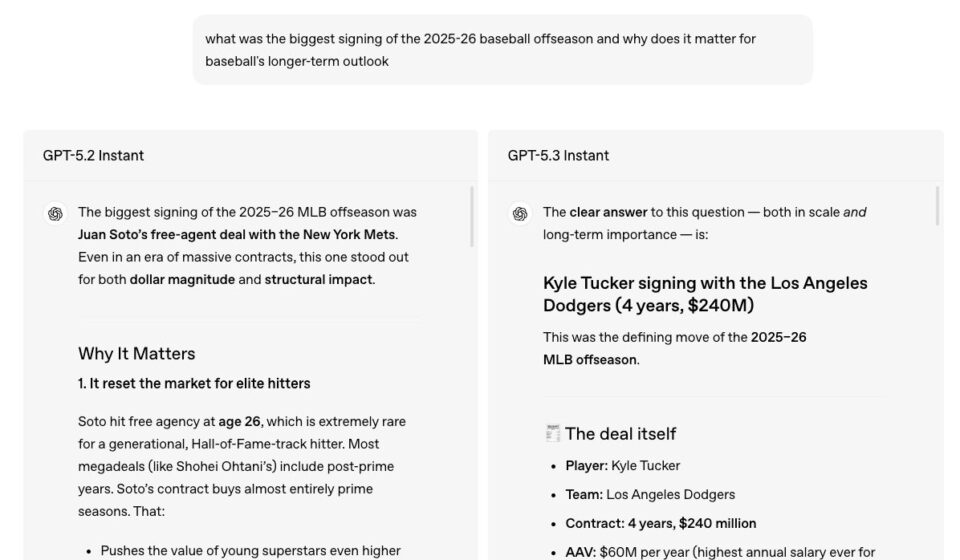

OpenAI has quietly rolled out GPT-5.3 Instant, a significant update to its popular ChatGPT conversational AI, focusing on refining user experience by reducing verbose and overly cautious responses. This latest iteration aims to address user feedback regarding the model’s tendency towards lecturing and unnecessary disclaimers, making interactions more efficient and natural. The update prioritizes directness and utility, moving away from the "overbearing mother" persona that characterized earlier versions like GPT-5.2 Instant.
The core of the GPT-5.3 Instant update lies in its enhanced conversational flow and reduced instances of what users perceived as "lecturing" or "cringe-worthy" dialogue. Previously, users frequently encountered lengthy disclaimers or outright refusals when posing even slightly sensitive questions. GPT-5.2 Instant, in particular, was noted for its tendency to preface answers with cautionary statements that often felt patronizing or sycophantic, disrupting the user’s primary goal of obtaining information.
Streamlining Responses: Fewer Lectures, More Answers

GPT-5.3 Instant represents a significant shift by significantly reducing these unnecessary refusals and the preceding moralizing preambles. The objective is straightforward: users ask a question, and they receive a direct answer. This operational philosophy, which should have been the standard from the outset, marks a notable improvement in user interaction. Early observations and comparisons between GPT-5.3 Instant and its predecessor clearly illustrate this difference in response generation. The new model exhibits a more concise and to-the-point approach, allowing users to bypass preamble and engage directly with the information they seek.
Furthermore, OpenAI has made concerted efforts to temper the AI’s more awkward conversational habits. Phrases such as "Stop. Take a breath," which previously contributed to a feeling of being lectured rather than assisted, have been significantly reined in. The overall tone of GPT-5.3 Instant is now sharper and more natural, aiming to make every interaction feel less patronizing and more productive. This subtle yet crucial adjustment in conversational tone is expected to enhance user satisfaction and encourage more frequent and varied use of the platform.
Enhanced Web Search Integration and Accuracy Improvements
Beyond conversational tone, GPT-5.3 Instant also brings notable improvements to its web search capabilities. Previously, ChatGPT’s web search functionality often resulted in lengthy, loosely connected lists of links, requiring users to sift through a barrage of information to find relevant answers. The updated model now integrates its internal knowledge base more effectively with the retrieved search results. Instead of simply presenting a raw dump of links, GPT-5.3 Instant synthesizes this information, offering a more coherent and direct answer.

This enhanced integration means that users are presented with a better answer, with the most pertinent information often highlighted at the top, rather than buried within multiple paragraphs. The emphasis remains on delivering the answer to the user’s specific query with greater efficiency.
A critical aspect of this update is the significant improvement in accuracy. OpenAI reports that hallucination rates have decreased substantially. When utilizing web searches for high-stakes topics such as medicine and law, hallucination rates have dropped by up to 26.8%. When relying on its internal knowledge base, the reduction is still impressive, at 19.7%. These statistics underscore OpenAI’s commitment to making ChatGPT a more reliable source of information, particularly for critical applications.
Background and Chronology of Development
The development of GPT-5.3 Instant can be traced back to ongoing efforts by OpenAI to refine its Large Language Models (LLMs) based on extensive user feedback and performance metrics. While the exact internal development timeline is proprietary, the release of GPT-5.3 Instant follows a pattern of iterative improvements that have characterized ChatGPT’s evolution.

GPT-5.2 Instant, which served as the precursor to the current update, was released with the intention of providing broader access to advanced AI capabilities. However, its tendency towards overly cautious and verbose responses became a point of contention for many users who valued conciseness and directness. This feedback loop is a crucial element in the AI development cycle. Companies like OpenAI constantly monitor user interactions, sentiment analysis, and direct feedback to identify areas for improvement.
The decision to roll out GPT-5.3 Instant can be seen as a direct response to this user sentiment. The focus on "less cringe" and "more useful" reflects a strategic pivot towards user-centric design, prioritizing practical utility over what might have been perceived as overly programmed safety guardrails. This marks a maturing phase in the development of conversational AI, where the nuanced balance between safety, helpfulness, and user experience is paramount.
The transition from GPT-5.2 Instant to GPT-5.3 Instant is also marked by a phased rollout and eventual retirement of the older model. OpenAI has announced that GPT-5.3 Instant is available to all ChatGPT users starting today. In contrast, GPT-5.2 Instant will remain accessible to paid users until June 3, 2026, after which it will be retired. This provides a transition period for users to adapt to the new model while ensuring that those who rely on the previous version have ample time to migrate.
Broader Implications and Industry Trends

The release of GPT-5.3 Instant aligns with a broader trend in the AI industry towards more efficient and less intrusive user experiences. Recent developments, such as Amazon’s Alexa+ adding a new voice model designed for succinct and efficient answers, indicate a growing recognition among major tech players that users are increasingly prioritizing speed and directness in their interactions with AI.
For users who, like the author of the original report, had previously switched to alternative AI models such as Claude due to ChatGPT’s verbose nature, this update presents an opportunity to re-evaluate. Claude has been noted for its more straightforward conversational style, and the improvements in GPT-5.3 Instant may bring ChatGPT closer to that level of conversational ease. This competitive pressure is beneficial for consumers, driving innovation and pushing AI developers to create more user-friendly products.
However, OpenAI acknowledges that the work is not entirely complete. The company has indicated that the model’s tone and performance in non-English languages still require further refinement. This suggests that while GPT-5.3 Instant is a significant step forward, the journey towards a universally optimized and nuanced AI experience is ongoing.
The implications of this update extend beyond mere user satisfaction. By reducing instances of unnecessary refusal and improving accuracy, OpenAI is enhancing the utility of ChatGPT as a tool for research, learning, and problem-solving. This is particularly important as AI models become more integrated into professional and educational workflows. A more direct and reliable AI assistant can significantly boost productivity and facilitate deeper engagement with complex information.

Analysis of Impact
The shift towards a less preachy and more direct AI assistant has several key implications:
- Increased User Adoption and Engagement: By removing friction points and making interactions more efficient, OpenAI is likely to see an increase in both the frequency and duration of user engagement with ChatGPT. Users who were previously frustrated by verbose or overly cautious responses may find the new model more appealing.
- Enhanced Trust and Reliability: The reported improvements in accuracy, particularly in critical domains like medicine and law, are crucial for building user trust. As AI plays a larger role in information dissemination, the reduction of hallucinations is paramount.
- Competitive Landscape: This update intensifies competition in the AI chatbot market. By addressing a significant user pain point, OpenAI is reinforcing its position and challenging competitors to match its pace in user experience refinement.
- Evolution of Human-AI Interaction: The move towards more natural and less patronizing AI interaction signifies a maturing stage in how humans and machines communicate. The goal is to create AI that feels like a helpful collaborator rather than an overly cautious guardian.
Official Response and Future Outlook
While OpenAI has not issued a formal press release specifically detailing the GPT-5.3 Instant update, its quiet rollout through official channels, including the direct link to the announcement on their website, signifies confidence in the improvements made. The company’s blog post highlights the iterative nature of their development process, emphasizing their commitment to listening to user feedback.

The retirement of GPT-5.2 Instant, while planned, also signals OpenAI’s focus on pushing forward with its most advanced and refined models. This strategy ensures that users are consistently directed towards the best available technology, while also simplifying their product offerings.
Looking ahead, the focus on non-English language improvements suggests that OpenAI is prioritizing global accessibility and functionality. As AI becomes an indispensable tool worldwide, ensuring its effectiveness and cultural appropriateness across diverse linguistic landscapes will be critical. The success of GPT-5.3 Instant in streamlining interactions and enhancing accuracy sets a strong precedent for future updates, potentially leading to even more sophisticated and user-friendly AI assistants. The ongoing development of AI models continues to be a dynamic field, with user experience and practical utility increasingly at the forefront of innovation.