
JPMorgan Chase, the largest financial institution in the United States by assets, has initiated a series of quiet markdowns on the valuation of specific loans within its private-credit portfolios. This tactical adjustment, while subtle, targets a sector that has become the backbone of modern technological expansion: software and enterprise technology. The move has sent a ripple of caution through the financial sector, as it suggests that the collateral backing billions of dollars in private debt may not be as robust as previously estimated. Market analysts suggest this is a significant indicator of shifting risk tolerances among major lenders, particularly as the frenzy surrounding Artificial Intelligence (AI) infrastructure begins to face the harsh reality of capital expenditure versus tangible returns.
The Mechanism of the JPMorgan Loan Markdowns
The decision by JPMorgan’s Wall Street trading division to reduce the value of these loans mirrors defensive measures taken during the onset of the COVID-19 pandemic. By adjusting the "mark-to-market" value of these assets, the bank is effectively signaling a reduction in the perceived recovery value of the debt should borrowers default. The majority of these loans were extended to software firms, many of which are currently caught in a transition phase, attempting to pivot their business models to integrate generative AI or struggling to maintain margins in an increasingly competitive cloud environment.
This adjustment comes at a critical juncture for the private credit industry. Unlike public debt markets, where prices are discovered through daily trading, private credit valuations are often based on internal models and periodic assessments. When a Tier-1 bank like JPMorgan begins to preemptively write down these assets, it often forces other institutional lenders to re-examine their own books, potentially leading to a broader tightening of credit availability for tech startups and mid-market software companies.
The Evolution and Scale of the Private Credit Market
To understand the gravity of JPMorgan’s move, one must examine the meteoric rise of private credit over the last fifteen years. Following the 2008 financial crisis, the implementation of the Dodd-Frank Act and the Basel III accords significantly increased the regulatory capital requirements for traditional banks. This created a vacuum in the middle-market lending space, which was rapidly filled by non-bank financial institutions such as Apollo Global Management, Blackstone, and Blue Owl Capital.
Today, the private credit market has ballooned into a nearly $2 trillion industry. Its primary appeal to borrowers is flexibility and speed; for lenders, it offers higher yields than traditional investment-grade corporate bonds. However, a significant portion of this lending is concentrated in the technology sector. Software companies, characterized by recurring revenue models but often lacking physical collateral, became the darlings of private lenders. The current concern is that the high interest rate environment, combined with the massive capital requirements of the AI era, is placing unprecedented strain on the cash flows of these borrowers.
Oracle and the High-Stakes AI Infrastructure Race
The tension between market enthusiasm and fiscal reality was on full display during Oracle Corporation’s most recent quarterly earnings report. Oracle shares surged by as much as 14% following the announcement of strong results and a bullish outlook on its AI expansion. CEO Clayton Magouyrk and other top executives moved quickly to reassure the market that the company’s aggressive buildout of data centers remains financially sustainable.
Oracle’s strategy is emblematic of the "all-in" approach taken by major tech firms. The company recently entered a landmark agreement to provide 4.5 gigawatts of cloud computing power to OpenAI between 2027 and 2032. Financial analysts have calculated the staggering costs associated with such a venture: building a single gigawatt of data center capacity currently costs approximately $50 billion. Of this, roughly $35 billion is allocated to high-end Nvidia GPUs, while the remaining $15 billion covers physical infrastructure, networking, and power systems.
Under these estimates, Oracle is projected to spend approximately $225 billion through 2027 to fulfill its commitments. While the projected revenue from the OpenAI deal is $300 billion, the margin for error is remarkably thin. Any delay in deployment, increase in energy costs, or a pivot in OpenAI’s demand could turn a profitable venture into a massive liability. Furthermore, as cloud computing becomes increasingly commoditized—with providers using identical hardware and software stacks—the ability to maintain premium pricing is under constant threat.
Signs of Liquidity Stress in Private Lending
The risks inherent in this debt-fueled expansion are already beginning to manifest in the private credit ecosystem. Blue Owl Capital, a dominant player in technology-focused private lending, recently experienced a significant surge in redemption requests from investors in one of its primary funds. To meet these liquidity demands, the firm was forced to restrict withdrawals and sell approximately $1.4 billion in loans.
While these redemptions were not explicitly triggered by "bad AI loans," they highlight a growing fragility. Many software companies that were funded via private credit are finding their business models disrupted by the very AI technology they are trying to adopt. If a software firm’s core product becomes obsolete due to an AI-driven competitor, its ability to service high-interest private debt evaporates. JPMorgan’s decision to mark down software loans suggests that the bank is pricing in this exact scenario of "AI-driven obsolescence" among its borrowers.
A Chronology of the AI Investment Cycle
The current market state can be understood through a distinct timeline of events that have shaped the AI boom:
- November 2022: The launch of ChatGPT triggers a global race for AI supremacy, leading to an immediate surge in demand for compute power.
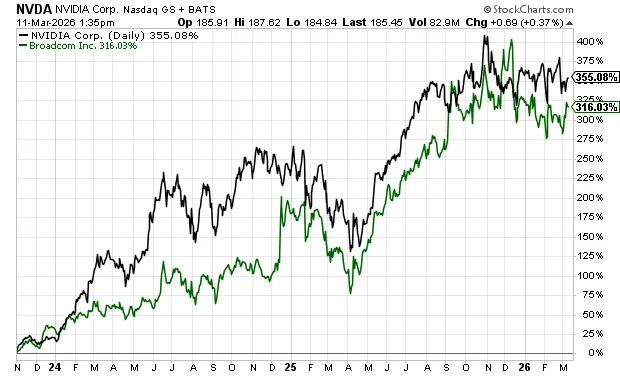
- 2023 – The Compute Phase: Nvidia and Broadcom emerge as the primary beneficiaries. Demand for GPUs exceeds supply to such an extent that OpenAI is forced to temporarily suspend new ChatGPT Plus signups.
- Early 2024 – The Infrastructure Phase: Hyperscalers (Microsoft, Google, Oracle) announce record-breaking capital expenditure budgets to build the data centers required to run Large Language Models (LLMs).
- Late 2024 to Present – The Reality Check: Major banks begin to question the valuation of software debt. Concerns arise regarding the "Return on Invested Capital" (ROIC) for AI projects, leading to defensive moves like the JPMorgan markdowns.
The Shift Toward Physical Bottlenecks
As the "compute bottleneck" begins to ease with increased chip production, a new set of constraints is emerging. Macroeconomic experts, including Eric Fry, suggest that the next phase of the AI boom will not be driven by software or even the chips themselves, but by the raw materials and utility infrastructure required to keep the data centers running.
The demand for copper serves as a primary example of this shift. Modern data centers require massive amounts of copper for power distribution and cooling systems. Industry projections suggest that to maintain the current trajectory of AI and green energy growth, the world will need to mine as much copper in the next 18 years as has been mined in the last 10,000 years. This physical reality creates a "hard ceiling" for AI expansion that software valuations often ignore.
Similarly, the electrical grid is facing a crisis of capacity. AI data centers consume exponentially more power than traditional server farms. In certain regions of the United States and Europe, new data center projects are being delayed by years because the local utility companies cannot provide the necessary wattage.
Broader Market Implications and Investor Sentiment
The divergence between Oracle’s stock rally and JPMorgan’s loan markdowns illustrates a bifurcated market. On one side, equity investors are betting on the transformative potential of AI to generate long-term wealth. On the other, debt providers—who focus on capital preservation—are beginning to pull back, wary of a "bubble" fueled by cheap credit and optimistic projections.
For the broader economy, the tightening of credit in the software sector could lead to a wave of consolidation. Smaller software firms that cannot secure additional private funding may be forced to merge with larger incumbents or face insolvency. This would further concentrate power among the "Magnificent Seven" and a few other well-capitalized tech giants, while simultaneously increasing the systemic risk if one of these giants encounters financial distress.
Conclusion: The Case for Strategic Caution
JPMorgan’s quiet adjustment of its loan books serves as a significant warning to the financial community. It suggests that the "easy money" phase of the AI revolution is concluding, and a more disciplined, resource-constrained era is beginning. While the long-term potential of Artificial Intelligence remains undisputed, the path to profitability is fraught with high-interest debt, astronomical infrastructure costs, and physical supply chain bottlenecks.
Investors and financial institutions are now tasked with distinguishing between companies that are merely "spending" on AI and those that are "earning" from it. As the focus shifts from software algorithms to the copper, electricity, and hardware that power them, the market is likely to see a rotation of capital toward the industrial and utility sectors that provide the fundamental inputs for the digital age. In this environment, caution is not merely a defensive posture; it is a necessary strategy for navigating the next phase of the global technological transition.