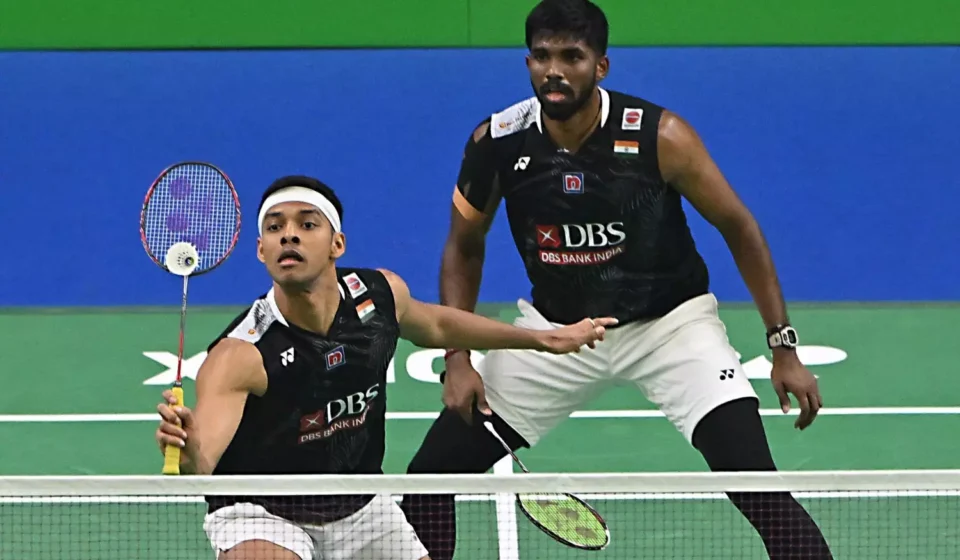
Satwiksairaj Rankireddy and Chirag Shetty Survive Thriller as Tharun Mannepalli Advances to Swiss Open Quarter-Finals

The landscape of international badminton shifted its focus to Basel this week as the 2026 Swiss Open Super 300 entered its high-stakes knockout phase. In a day defined by grueling marathons and significant upsets, India’s premier men’s doubles pairing, Satwiksairaj Rankireddy and Chirag Shetty, narrowingly avoided an early exit, securing their place in the quarter-finals after one of the most intense matches of the season. The Indian duo, currently carrying the mantle of national expectations, overcame a spirited challenge from Japan’s Hiroki Okamura and Kyohei Yamashita in a three-game thriller that tested the physical and mental limits of all four athletes on the court. While the top-seeded Indians moved forward, the day offered a mixture of triumph and tribulation for the Indian contingent, with rising star Tharun Mannepalli securing a career-defining win, while several other prominent shuttlers saw their campaigns come to a premature end.
The Marathon in Basel: Rankireddy and Shetty’s 74-Minute Siege
The headline act of the afternoon featured Satwiksairaj Rankireddy and Chirag Shetty against the lower-ranked but tactically disciplined Japanese pair of Hiroki Okamura and Kyohei Yamashita. On paper, the Indians entered as favorites, but the reality on the court proved far more complex. The match, which spanned 74 minutes, was a masterclass in defensive resilience and high-octane attacking badminton.
The opening game saw Rankireddy and Shetty establish an early rhythm. Utilizing their trademark aggressive smash-and-net-rush strategy, they managed to keep the Japanese pair on the back foot, clinching the first set 21-15. However, the momentum shifted dramatically in the second game. Okamura and Yamashita adjusted their defensive formation, successfully neutralizing Rankireddy’s thunderous back-court smashes and forcing the Indians into longer rallies. This tactical pivot paid dividends as the Japanese pair took the second set 21-15, forcing a decider.
The third game will likely be remembered as one of the most competitive sets in the history of the Swiss Open. Neither pair was able to establish a significant lead, with the scoreline remaining deadlocked at various intervals, most notably at 13-13. From that point onward, the match transformed into a battle of nerves. In the BWF scoring system, a two-point cushion is required to win, and as the score crept past the standard 21-point mark, the pressure reached a fever pitch. Both pairs squandered multiple match points, with the shuttle frequently changing hands amidst desperate dives and lightning-fast reflex saves. Ultimately, it was the experience and composure of the Indian pair that shone through, as they finally secured the two-point gap required to win the game 28-26, sealing a 21-15, 15-21, 28-26 victory.
Technical Analysis of the Decider
The 28-26 scoreline in the final set highlights a rare level of parity in professional badminton. Analysis of the match data suggests that Rankireddy and Shetty relied heavily on their service-return quality during the closing stages. By keeping the shuttle low and preventing Yamashita from lifting, the Indians were able to dictate the front-court exchanges. However, the Japanese pair’s ability to retrieve seemingly impossible shots extended the rallies, often exceeding 30 strokes per point in the final minutes.
Rankireddy’s endurance was particularly noteworthy. Despite the physical toll of the previous 60 minutes, he continued to generate high-velocity smashes, while Shetty’s interceptions at the net provided the crucial points needed to break the Japanese resistance. This victory ensures their progression to the quarter-finals, where they are scheduled to face the Danish duo of Christian Kjaer and Rasmus Kjaer. The Danish pair is known for a traditional European style of play—heavy on tactical positioning and flat, fast exchanges—which will provide a different set of challenges for the Indian top seeds.
Tharun Mannepalli’s Breakthrough Performance
In the men’s singles category, Tharun Mannepalli emerged as a significant narrative of the tournament. Mannepalli, who has been steadily climbing the BWF rankings over the past eighteen months, faced Malaysia’s Justin Hoh in a match that lasted 43 minutes. Mannepalli displayed a sophisticated tactical approach, utilizing the full width of the court to displace Hoh and create openings for cross-court winners.
The Indian took the first game comfortably at 21-14, but the second game proved to be a tighter affair. Hoh increased the pace of the game, challenging Mannepalli’s defensive coverage. However, the Indian remained composed during the "clutch" points at the end of the set, clinching it 22-20. This victory sets up a high-profile quarter-final clash against Indonesia’s Anthony Sinisuka Ginting. Facing Ginting, a former world number two known for his explosive speed and deceptive wristwork, represents a significant step up in competition for Mannepalli and will serve as a litmus test for his aspirations at the elite level.
Disappointments for the Indian Contingent: George, Crasto, and Kapila
While the day saw significant victories, it also marked the end of the road for several other Indian hopefuls. Kiran George, who had earlier recorded a sensational upset by defeating former world champion Loh Kean Yew of Singapore in the opening round, was unable to sustain his momentum. Facing Hong Kong’s Jason Gunawan, George engaged in a grueling 70-minute battle. Despite winning the second game to force a decider, George eventually succumbed to Gunawan’s relentless consistency, losing 18-21, 21-16, 16-21. George’s exit is a missed opportunity for the youngster to capitalize on his giant-killing start to the tournament, yet his performance against Loh Kean Yew remains a highlight of his season.
In the mixed doubles circuit, the pairing of Tanisha Crasto and Dhruv Kapila fell short against China’s Gao Jia Xuan and Wu Meng Ying. The Chinese pair dominated the mid-court exchanges, preventing Crasto and Kapila from establishing their offensive rhythm. The Indians lost in straight games, 15-21, 17-21, highlighting the continued dominance of Chinese developmental pairs in the Super 300 circuit.
The struggles continued in the men’s doubles for Hariharan Amsakarunan and MR Arjun. Facing a formidable pair from Chinese Taipei, the Indians were unable to find their footing, losing 17-21, 11-21. The second set, in particular, saw a breakdown in communication and defensive rotations, allowing the Taipei pair to cruise to a comfortable victory in the Round of 16.
Women’s Singles: Malvika Bansod Bows Out
The Indian challenge in the women’s singles category also came to an end on Thursday. Malvika Bansod, the last remaining Indian in the draw, faced a daunting task against Thailand’s world No. 4, Pornpawee Chochuwong. Chochuwong’s superior court coverage and tactical variety proved too much for Bansod. The Thai star dictated the tempo from the opening serve, utilizing deceptive drops and deep clears to keep Bansod out of position. The match ended 11-21, 15-21 in favor of Chochuwong, leaving India without representation in the women’s singles quarter-finals.
Chronology of Key Events: Swiss Open Thursday Session
- 11:00 AM CET: Tharun Mannepalli begins his match against Justin Hoh, securing the first game in 18 minutes.
- 11:45 AM CET: Mannepalli seals his quarter-final berth with a 22-20 win in the second game.
- 1:30 PM CET: Satwiksairaj Rankireddy and Chirag Shetty take to the court for their marathon encounter against Okamura and Yamashita.
- 2:44 PM CET: After 74 minutes of play, the Indian men’s doubles pair converts their final match point to win 28-26 in the decider.
- 3:15 PM CET: Kiran George starts his three-set struggle against Jason Gunawan.
- 4:25 PM CET: George exits the tournament after a 70-minute loss.
- 5:30 PM CET: Mixed doubles and men’s doubles secondary pairs (Crasto/Kapila and Amsakarunan/Arjun) suffer straight-game defeats.
- 7:00 PM CET: Malvika Bansod’s loss to Pornpawee Chochuwong concludes the Indian involvement for the day.
Broader Implications and Analysis
The results at the 2026 Swiss Open carry significant weight for the BWF World Tour rankings and the upcoming major championships. For Rankireddy and Shetty, the ability to win "ugly"—winning matches where they are not at their technical best but rely on mental fortitude—is a hallmark of championship-caliber players. Their survival in Basel keeps them in the hunt for valuable ranking points that determine seeding for the season-ending World Tour Finals.
For the younger players like Tharun Mannepalli, the tournament represents a vital stage for growth. The opportunity to face top-ten opponents like Anthony Ginting provides invaluable experience that cannot be replicated in training. Meanwhile, the exits of Kiran George and Malvika Bansod underscore the intense depth of the Asian badminton circuit, where lower-ranked players from Hong Kong, Thailand, and China frequently challenge established names.
The Swiss Open, traditionally held at the St. Jakobshalle in Basel, serves as a crucial leg of the European circuit. As a Super 300 event, it offers a total prize purse of $210,000 and serves as a primary ground for mid-tier players to break into the top tier of the sport. For the Indian contingent, the focus now shifts entirely to the quarter-finals, where Rankireddy/Shetty and Mannepalli remain the nation’s final hopes for silverware.
As the tournament progresses into the final stages, the physical conditioning of the athletes will be under scrutiny. Rankireddy and Shetty’s 74-minute exertion may impact their recovery ahead of their match against the Danes, while Mannepalli will need to produce the performance of his life to upset the Indonesian maestro, Ginting. The coming days will determine whether India can secure a podium finish in Basel or if the 2026 Swiss Open will be remembered as a tournament of "what ifs" for the powerhouse badminton nation.