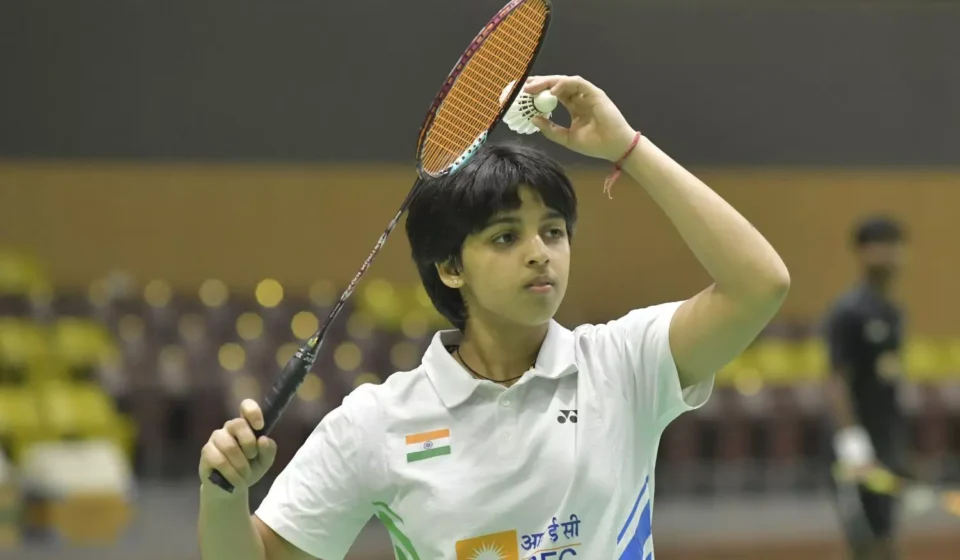
Indian Shuttlers Tanvi Sharma and Isharani Baruah Secure Semi-Final Berths at 2026 Orleans Masters as Women’s Singles Resurgence Continues

The landscape of Indian women’s singles badminton witnessed a significant moment of transition and triumph on Friday at the 2026 Orleans Masters, as teenage sensation Tanvi Sharma and the resilient Isharani Baruah secured their places in the semi-finals. Held at the Palais des Sports in France, this BWF Super 300 tournament has become a focal point for the next generation of Indian talent aiming to fill the void left by veteran stalwarts. While the day was marked by celebrations for the singles contingent, it also saw the conclusion of the Indian campaign in the men’s doubles category, highlighting both the potential and the hurdles facing the nation’s shuttlers on the international circuit.
The Ascent of Tanvi Sharma: A Tactical Masterclass
The headline performance of the day belonged to 17-year-old Tanvi Sharma, who delivered a clinical performance to dismantle Japan’s Natuski Nidaira. Sharma, who has been rapidly ascending the BWF world rankings over the last twelve months, faced a seasoned opponent in the sixth-seeded Nidaira, who brought a decade more of professional experience to the court. However, age proved to be a mere number as Sharma dictated the tempo of the match from the opening serve.
The match, which lasted 43 minutes, saw Sharma utilize her superior reach and deceptive net play to keep Nidaira off-balance. In the first game, Sharma established an early lead, neutralizing Nidaira’s defensive baseline game with sharp, cross-court smashes. Winning the opening set 21-14, Sharma maintained her momentum in the second, refusing to allow the Japanese veteran any room for a comeback. The second set mirrored the first, ending 21-14, as Sharma demonstrated a level of composure rarely seen in players of her age group.
This victory is not merely a statistical win but a statement of intent. Analysts noting Sharma’s progress have pointed toward her improved physical conditioning and her ability to sustain high-intensity rallies as key factors in her recent success. Her victory over a seeded player like Nidaira ensures she will gain significant ranking points, pushing her closer to the top 30 in the world—a crucial threshold for qualifying for higher-tier Super 750 and Super 1000 events.
An Unfortunate Conclusion to the All-India Quarter-Final
On the other side of the draw, the quarter-final clash between Isharani Baruah and Malvika Bansod promised to be a showcase of domestic rivalry on the global stage. However, the encounter ended prematurely when Bansod was forced to retire due to physical distress. Before the retirement, Baruah had been in dominant form, capitalizing on what appeared to be a physically compromised Bansod.
Baruah took the first game comfortably at 21-9, showcasing a wide array of attacking strokes and exploiting gaps in Bansod’s movement. In the second game, with Baruah leading 15-7, Bansod signaled to the chair umpire that she could no longer continue. While the specific nature of the injury was not immediately disclosed by the Indian coaching staff, Bansod’s withdrawal underscores the grueling nature of the BWF World Tour, where back-to-back tournaments often lead to cumulative fatigue and injury risks.
For Isharani Baruah, the progression to the semi-final marks a career-best performance at the Super 300 level. Baruah has often played in the shadow of more publicized contemporaries, but her run in Orleans demonstrates a tactical maturity and defensive solidity that makes her a formidable opponent in the final four.
Men’s Doubles: A Hard-Fought Exit for Amsakarunan and Arjun
The news was less favorable in the men’s doubles category, where the Indian pair of Hariharan Amsakarunan and MR Arjun saw their tournament run come to an end. Facing the third-seeded Indonesian duo of Leo Rolly Carnando and Bagas Maulana, the Indians were tested by the relentless speed and flat-exchange style synonymous with Indonesian badminton.
The first game was a one-sided affair, with Carnando and Maulana asserting their dominance early to take it 21-12. However, Amsakarunan and Arjun showed remarkable resilience in the second game. Adjusting their service returns and finding more rhythm in their rotations, the Indian pair pushed the third seeds to the limit. The game went into a deuce, but the Indonesians’ experience in high-pressure situations allowed them to clinch the set 22-20, thereby sealing the match in straight games.
Despite the loss, the performance of Amsakarunan and Arjun in the second set provides a blueprint for their future development. Their ability to bridge the gap against a top-10 world-ranked pair suggests that with more consistency in their defensive transitions, they remain strong contenders for future podium finishes.
Chronology of India’s Campaign at the 2026 Orleans Masters
The 2026 Orleans Masters has been a productive week for the Indian contingent, characterized by steady progression through the rounds.
- Tuesday/Wednesday (Rounds of 32): The opening rounds saw a high success rate for Indian singles players. Tanvi Sharma signaled her form early with a straight-games win over European opposition, while Malvika Bansod survived a three-game thriller to advance.
- Thursday (Round of 16): The field narrowed as Isharani Baruah pulled off an upset against a higher-ranked Thai opponent. Meanwhile, the men’s doubles pair of Amsakarunan and Arjun secured a gritty win to set up their quarter-final clash with the Indonesians.
- Friday (Quarter-Finals): The day’s events confirmed two semi-final spots for India in women’s singles, while the men’s doubles journey concluded.
Supporting Data and Technical Analysis
The success of the Indian women in Orleans is backed by compelling data. Tanvi Sharma’s win percentage in 2026 has surged to 78%, a significant increase from 62% in the previous calendar year. Furthermore, the average duration of her matches has decreased, suggesting a more efficient scoring ability that preserves energy for the latter stages of tournaments.
In the match against Nidaira, Sharma’s "unforced error" count was recorded at a low 9, compared to Nidaira’s 17. This disciplined approach was the deciding factor in a match where the physical intensity was high. For Isharani Baruah, her path to the semi-final has been defined by her "net-kill" efficiency, which has hovered around 85% throughout the tournament.
Looking Ahead: The Semi-Final Challenge
The semi-finals on Saturday present a monumental challenge for Tanvi Sharma as she prepares to face former world champion and Olympic medalist Nozomi Okuhara. The Japanese veteran remains one of the most respected figures in the sport, known for her "never-say-die" attitude and exceptional court coverage.
For Sharma, this match represents a litmus test. Facing Okuhara requires not just technical skill but the mental fortitude to endure long, grueling rallies. If Sharma can maintain the aggressive posture she displayed against Nidaira while minimizing errors, the match could serve as a "passing of the torch" moment for Indian badminton.
Isharani Baruah will also face a formidable opponent in the semi-finals (pending the conclusion of the other quarter-final brackets). Her objective will be to maintain the rhythm she found against Bansod and utilize her fresh legs, given the shortened nature of her quarter-final match.
Broader Impact and Institutional Implications
The performance of the Indian players in Orleans is a testament to the decentralized growth of badminton in India. Both Sharma and Baruah have benefited from the National Centre of Excellence and various private academies that have focused on sports science and personalized coaching.
The Badminton Association of India (BAI) has recently emphasized the importance of Super 300 and Super 500 events for building the "bench strength" of the national team. With veteran stars focusing on managing their workloads for Major Championships, the emergence of players like Sharma and Baruah ensures that India remains a powerhouse in the women’s singles category.
The implications for the BWF World Rankings are also significant. A semi-final appearance at a Super 300 event provides 4,900 ranking points, while a win in the final would grant 7,000 points. For Sharma, this could mean a jump of nearly 10-15 places in the world rankings, potentially making her the third-highest-ranked Indian woman, trailing only the established top-tier players.
Conclusion
As the 2026 Orleans Masters moves into its penultimate day, the spotlight remains firmly on India’s rising stars. The blend of youth, tactical intelligence, and the unfortunate but real physical demands of the sport have shaped a tournament that reflects the current state of international badminton. While the exit of the men’s doubles pair is a setback, the dual representation in the women’s singles semi-finals provides plenty of optimism for Indian fans. All eyes now turn to Saturday’s matches, where Tanvi Sharma and Isharani Baruah will seek to turn their impressive runs into a shot at championship glory.