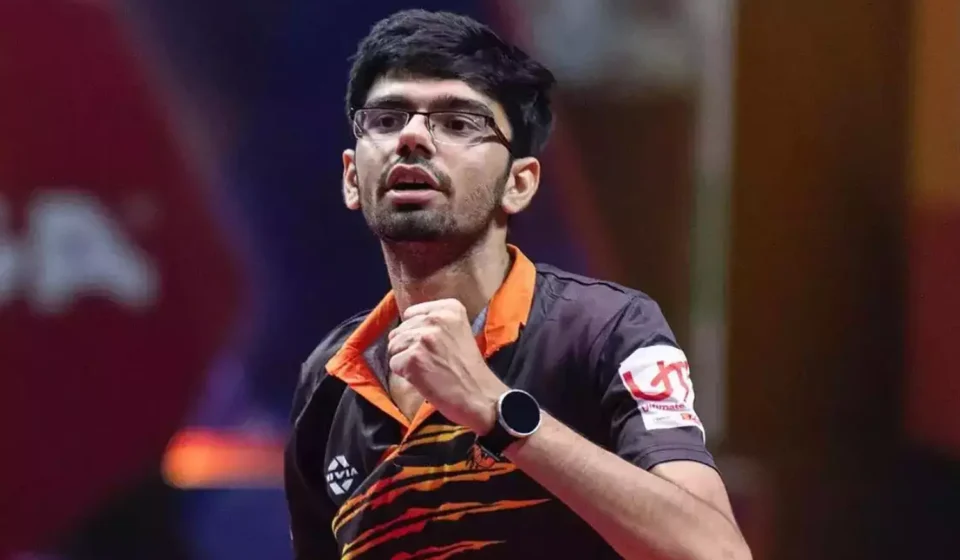
Manav Thakkar and Yashaswini Ghorpade Clinch Singles Titles at 87th Table Tennis Senior National Championships in Indore

The 87th Table Tennis Senior National Championships reached a dramatic conclusion on Friday in Indore, as Manav Thakkar and Yashaswini Ghorpade, both representing the Petroleum Sports Promotion Board (PSPB), were crowned the men’s and women’s singles champions. The final day of the tournament showcased a blend of veteran dominance and the emergence of teenage prodigies, underscoring the shifting landscape of Indian table tennis. While Thakkar’s victory reaffirmed his status as one of the world’s elite paddlers, Ghorpade’s triumph came at the end of a grueling seven-game marathon that highlighted the increasing depth and competitiveness of the domestic women’s circuit.
A Marathon Battle in the Women’s Singles Final
The women’s singles final was the centerpiece of the afternoon, featuring a clash between the experienced Yashaswini Ghorpade and the rising teenage sensation Syndrela Das. Das had entered the final as the tournament’s "giant killer," having caused a major upset in the semi-finals by eliminating the reigning champion, Diya Chitale. Her momentum carried into the final, where she pushed Ghorpade to the absolute limit in a match that lasted over 60 minutes.
The contest was a tactical seesaw. Ghorpade, utilizing her superior reach and experience in high-pressure situations, took the lead on three separate occasions. She secured the first, third, and fifth games, often capitalizing on Das’s occasional unforced errors during long rallies. However, the teenage challenger refused to be intimidated by the stakes or the pedigree of her opponent. Following every game loss, Das responded with aggressive forehand winners and a resilient defensive game, equalizing the score line at 1-1, 2-2, and eventually 3-3 to force a deciding seventh game.
In the final set, the atmosphere in the arena reached a fever pitch. Leads exchanged hands multiple times as both players transitioned between cautious placement and high-risk attacking play. In the closing moments of the decider, Ghorpade’s composure proved to be the deciding factor. She managed to string together a series of precise points, holding her nerves to clinch the game and the match with a 4-3 scoreline. The victory marks a significant milestone in Ghorpade’s career, solidifying her position as a premier talent within the PSPB ranks and the national setup.
Thakkar Demonstrates World-Class Dominance
In contrast to the high-drama women’s final, the men’s singles championship match saw a more clinical display of power and precision. Manav Thakkar, currently ranked among the top 35 paddlers globally, faced off against Jeet Chandra of the Railways Sports Promotion Board (RSPB). Thakkar entered the match as the heavy favorite, and his performance justified the billing.
The match began with Thakkar establishing a commanding 2-0 lead, using his rapid-fire transitions and superior spin control to keep Chandra on the defensive. However, Chandra, a seasoned campaigner on the national circuit, mounted a spirited comeback in the middle stages. He fought back to take the third game and appeared to be gaining momentum in the fourth. Recognizing the shift in energy, Thakkar raised the intensity of his game. He adjusted his service returns and increased the pace of his backhand loops, stifling Chandra’s comeback attempt to take a 3-1 lead.
The fifth and final game was a showcase of why Thakkar has ascended the international rankings. He moved with exceptional fluidity, closing out the match in under 35 minutes with a final score of 4-1. For Thakkar, this title serves as a crucial confidence booster as he continues to represent India on the World Table Tennis (WTT) tour, while for Chandra, the silver medal capped a strong tournament where he also tasted success in the doubles category.
Success in Doubles: A Showcase of Synergy
The final day also saw the crowning of champions in the doubles categories, where teamwork and tactical synchronization were on full display.
In the mixed doubles final, the pairing of Ankur Bhattacharjee and Suhana Saini emerged victorious after a tightly contested five-game battle. They defeated the duo of Ankit Bose and Sampriti Roy with a 3-2 scoreline. The match was characterized by rapid exchanges and tactical shifts, with Bhattacharjee’s aggressive play at the net complementing Saini’s consistent baseline returns.
The men’s doubles title was claimed by Jeet Chandra and Anirban Ghosh. Despite Chandra’s later loss in the singles final, his performance in the doubles final was exemplary, as he and Ghosh demonstrated a seamless understanding of each other’s playing styles to secure the gold. On the women’s side, the veteran pair of Sutirtha Mukherjee and Kaushani Nath were crowned champions. Mukherjee, who has been a mainstay of the Indian national team, utilized her vast international experience to guide the pair to a decisive victory, further cementing her reputation as one of the country’s most reliable doubles specialists.
Tournament Chronology and Path to the Finals
The 87th edition of the Senior National Championships followed a rigorous schedule, starting with team events followed by the individual brackets.
- Early Rounds: The initial stages of the tournament saw over 300 participants from various state associations and institutional boards like PSPB, RSPB, and ESIC.
- Quarter-Finals and Semi-Finals: The quarter-final stage saw the exit of several seeded players, particularly in the women’s draw, setting the stage for Syndrela Das’s remarkable run. Das’s semi-final victory over Diya Chitale was noted by analysts as one of the most significant upsets in recent national championship history.
- The Final Day: Friday served as the culmination of the event, with all five major category finals (Men’s Singles, Women’s Singles, Men’s Doubles, Women’s Doubles, and Mixed Doubles) being decided.
Institutional Dominance: PSPB and RSPB
The results of the 87th National Championships once again highlighted the dominance of institutional boards in Indian table tennis. The Petroleum Sports Promotion Board (PSPB) continues to be the powerhouse of the sport, providing the resources and training environments necessary for athletes like Thakkar and Ghorpade to excel. The Railways Sports Promotion Board (RSPB) also maintained its status as a top-tier contender, with Jeet Chandra and Anirban Ghosh leading their charge.
This institutional support system has historically been the backbone of Indian table tennis, allowing players to focus on their professional development with financial security. However, the rise of young players from state associations—like those seen in the mixed doubles and the emergence of Syndrela Das—suggests that the talent identification programs at the grassroots level are beginning to yield results that can challenge the institutional monopoly.
Technical Analysis and Strategic Trends
Observers at the Indore event noted several technical trends that are currently shaping the Indian game. There is a visible shift toward a faster, more aggressive style of play, mirroring the trends seen on the international WTT circuit.
- Increased Pace: Players are taking the ball much earlier on the rise, reducing the reaction time for opponents. Manav Thakkar’s performance was a prime example of this "close-to-the-table" aggression.
- Service Variety: The importance of sophisticated service routines was evident in the women’s final, where Yashaswini Ghorpade used subtle variations in spin to disrupt Syndrela Das’s rhythm during the crucial seventh game.
- Physical Conditioning: The length of the women’s final (over an hour) and the intensity of the doubles matches highlighted the improved fitness levels of Indian paddlers. The ability to maintain high-speed lateral movement over seven games has become a prerequisite for success at the national level.
Implications for the National Team and International Rankings
The outcomes in Indore carry significant weight for the upcoming international calendar. As the Table Tennis Federation of India (TTFI) looks toward the next cycle of Asian and World Championships, the performance of younger athletes will give selectors much to consider.
Manav Thakkar’s victory reinforces his position as a core member of the national squad. His ability to dominate domestically while maintaining a high world ranking makes him a vital asset for India’s prospects in team events. For Yashaswini Ghorpade, this title is a statement of intent, proving she can handle the pressure of being a frontrunner while fending off the "next generation" of talent.
Furthermore, the performance of Syndrela Das cannot be overlooked. Despite her loss in the final, her trajectory suggests she will be a mainstay of the national conversation for years to come. Her success against established stars like Diya Chitale indicates that the gap between the junior and senior ranks is narrowing rapidly.
Conclusion
The 87th Table Tennis Senior National Championships in Indore concluded as a resounding success, both in terms of organizational execution and the quality of competition. By crowning Manav Thakkar and Yashaswini Ghorpade, the tournament celebrated established excellence while simultaneously shining a spotlight on the future of the sport. As the athletes transition back to the international circuit, the lessons learned and the confidence gained in Indore will undoubtedly play a role in their pursuit of global honors. The event served as a reminder that while experience often triumphs, the relentless energy of youth is constantly pushing the boundaries of Indian table tennis.