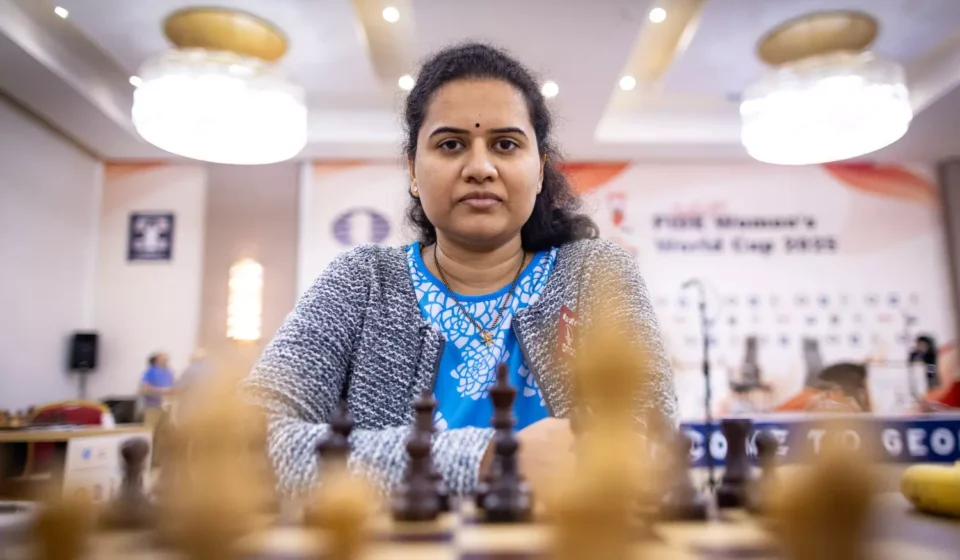
Koneru Humpy Withdraws From FIDE Women’s Candidates Tournament 2026 Over West Asia Security Concerns

Indian Grandmaster Koneru Humpy, one of the most decorated figures in international chess, has officially withdrawn from the FIDE Women’s Candidates Tournament 2026, citing significant concerns regarding the security situation in West Asia and the host nation’s proximity to the ongoing regional conflict. The announcement, which has sent shockwaves through the global chess community, highlights the increasing intersection of geopolitical instability and international sporting calendars. Humpy, a former World Rapid Champion and a perennial contender for the classical world title, emphasized that her decision was rooted in a prioritization of personal safety over professional milestones, marking a rare instance of a top-tier athlete withdrawing from a premier championship event due to regional volatility.
The FIDE Women’s Candidates Tournament is the final hurdle in the World Championship cycle, designed to determine the challenger who will face the reigning Women’s World Chess Champion. For the 2026 edition, FIDE (the International Chess Federation) selected Cyprus as the host venue. While Cyprus is a member of the European Union and maintains a reputation for stability, its geographic location in the eastern Mediterranean places it in close proximity to the intensifying conflicts involving Israel, Lebanon, and Gaza. It is this geographical reality that prompted Humpy to reassess her participation.
The Basis of the Withdrawal
Humpy articulated her decision through a heartfelt statement shared on social media, describing the choice as "painful but necessary." In her communication, she noted that despite the assurances provided by the organizers and the governing body, the prevailing atmosphere of uncertainty in the region made it impossible for her to focus entirely on the competition.
"After deep reflection, I have taken the difficult decision to withdraw from the FIDE Women’s Candidates Tournament," Humpy stated. "No event, no matter how important, can come before personal safety and well-being. Despite the assurances provided, I do not feel fully secure under the current circumstances. This is a painful but necessary decision, and I stand by it."
The Grandmaster further elaborated on the philosophical underpinnings of her choice, remarking that "life is bigger than sport." This sentiment was echoed by her family and support team, who have remained vocal about the need for caution during a period of heightened international tension. As a veteran of the circuit who has competed in high-stakes environments for over two decades, Humpy’s withdrawal is viewed by analysts not as a lack of competitive spirit, but as a measured assessment of risk by an experienced professional.
Contextualizing the Geopolitical Concerns
Cyprus, while politically distinct from the mainland conflicts of the Middle East, sits approximately 150 to 250 miles away from the coasts of Lebanon and Israel. The escalation of hostilities in the region throughout 2024 and 2025 has led to various disruptions in international travel and increased security protocols across the Mediterranean basin. For athletes traveling from the Indian subcontinent, the logistics of transit and the potential for rapid escalations in the maritime and aerial corridors surrounding Cyprus have become points of contention.
While FIDE has maintained that Cyprus is a safe haven and is not a party to the conflicts, the psychological impact of regional instability on international participants cannot be overlooked. Humpy’s withdrawal brings to the forefront the challenges faced by international federations when selecting venues in regions that, while stable themselves, are located near active war zones.
FIDE’s Official Response and Venue Security
In the wake of Humpy’s announcement, FIDE CEO Emil Sutovsky addressed the concerns regarding the tournament’s location. Sutovsky clarified that the federation has no immediate plans to relocate the event, asserting that the preparations in Cyprus are in their final stages and that the nation remains a secure environment for international competition.
"Cyprus is not directly involved in the conflict despite its geographical proximity," Sutovsky noted in a briefing. He emphasized that the local organizing committee is working closely with security experts to ensure the safety of all participants, officials, and spectators. According to FIDE, the decision to host the event in Cyprus was made after a rigorous bidding process and a thorough evaluation of the infrastructure and safety standards of the host city.
Despite these assurances, Humpy’s exit has prompted a broader discussion within the chess world about the criteria used for venue selection in the modern era. Critics argue that the "proximity factor" should carry more weight in risk assessments, while proponents of the current selection argue that sports must continue to operate in stable nations to avoid the total paralysis of international competition.
Implications for the Indian Contingent
India has emerged as a global powerhouse in chess, recently securing double gold at the 45th Chess Olympiad. The loss of Koneru Humpy is a significant blow to the nation’s prospects in the 2026 Women’s Candidates cycle, as she was widely considered one of the favorites to challenge for the title. However, India will still maintain a formidable presence in the tournament.
The two remaining Indian representatives are:
- Vaishali Rameshbabu: The elder sister of prodigy R. Praggnanandhaa, Vaishali has seen a meteoric rise in the rankings. Her performance in the previous Candidates cycle and her recent Grandmaster title make her a primary contender.
- Divya Deshmukh: A rising star who recently dominated the World Junior Girls’ Championship and played a pivotal role in India’s Olympiad success. Her inclusion signifies the deep bench strength of Indian women’s chess.
While the absence of Humpy—a veteran with unmatched experience—changes the tactical landscape for the Indian team, the presence of Vaishali and Divya ensures that India remains a central protagonist in the quest for the World Championship crown.
Chronology of the 2026 Candidates Cycle
The path to the 2026 Candidates Tournament has been a multi-year journey involving several high-profile qualifying events. The timeline of the cycle illustrates the rigorous nature of the competition:
- Late 2023 – Early 2024: FIDE announces the revamped qualification criteria, emphasizing performance in the FIDE Women’s Grand Prix, the Women’s World Cup, and the FIDE Grand Swiss.
- August 2024: The FIDE Women’s World Cup concludes, securing the first set of qualifiers for the Candidates.
- Late 2025: FIDE officially confirms Cyprus as the host nation for the 2026 tournament, following a review of bids from multiple federations.
- Early 2026: Koneru Humpy secures her spot based on her high standing in the FIDE rating list and her consistent performance in international circuits.
- Mid-2026: Following a spike in regional tensions in West Asia, Humpy initiates internal discussions with her team regarding the safety of the venue.
- Current Date: Humpy officially announces her withdrawal, prompting FIDE to look for a replacement based on the established reserve list.
Analysis: The Competitive Vacuum and Replacement Process
Humpy’s withdrawal creates a significant opening in the eight-player field. Under FIDE regulations, when a qualified player withdraws, the spot is typically offered to the next highest-rated player on the official FIDE rating list who has not already qualified, or the next highest finisher from a specific qualifying path (such as the Grand Prix or Grand Swiss), depending on the specific slot Humpy occupied.
The competitive impact of her absence is twofold. First, it removes a "technical" player who excels in deep endgame transitions and high-pressure scenarios—traits that have defined Humpy’s career. Second, it shifts the average age and experience level of the tournament. Humpy has been a fixture at the top of the women’s game since she became the youngest woman to achieve the GM title in 2002 (at the time). Her absence may embolden younger players who previously struggled against her rigorous style.
The Broader Impact on International Sports
The decision by Koneru Humpy is reflective of a larger trend where athletes are increasingly vocal about the conditions under which they are expected to perform. In recent years, concerns ranging from air quality and pandemic protocols to geopolitical safety have led several high-profile athletes to skip major events.
In the context of chess, a sport that requires intense mental focus and psychological stability, the environment is as important as the board itself. Humpy’s assertion that "no event can come before personal well-being" serves as a reminder that the mental state of a player is inextricably linked to their perception of safety.
Furthermore, this incident may influence FIDE’s future venue selections. While the federation seeks to globalize the game by bringing top-tier events to diverse locations like Cyprus, Uzbekistan, and India, the geopolitical climate of the 2020s necessitates a more dynamic approach to risk management. The "Cyprus precedent" may lead to the inclusion of "force majeure" relocation clauses or more transparent security benchmarks in future hosting contracts.
Conclusion
As the FIDE Women’s Candidates Tournament 2026 approaches, the spotlight remains on Cyprus, not just for the chess that will be played, but for the geopolitical shadows that loom over the event. Koneru Humpy’s withdrawal is a landmark moment in Indian sports history—a choice of conscience and caution over the pursuit of a lifelong dream.
While the tournament will proceed with a field of elite Grandmasters, the absence of the "Queen of Indian Chess" will be felt in every round. For FIDE, the challenge remains to provide an environment where the world’s best can compete without fear, ensuring that the focus remains on the 64 squares rather than the volatile world beyond the tournament hall. For Humpy, the decision reinforces her legacy as a player who values her principles as much as her titles, standing by a choice that prioritizes the "bigger picture" of life over the transient glory of sport.