India Concludes 2026 Asian Wrestling Championships with 17 Medals as Aman and Mukul Dahiya Secure Silver on Final Day in Bishkek

The Indian wrestling contingent officially brought its campaign at the 2026 Asian Wrestling Championships to a close in Bishkek, Kyrgyzstan, securing a total of 17 medals across various disciplines and weight categories. On the final day of competition, India added two silver medals and one bronze to its haul, cementing its position as a dominant force in continental wrestling, despite narrowly missing out on additional gold medals in the final sessions. The championship, which featured the elite of Asian wrestling from powerhouses such as Iran, Japan, and Kazakhstan, served as a critical barometer for the Indian squad as they navigate the mid-point of the current Olympic cycle.
India’s final tally of 17 medals comprises two gold, six silver, and nine bronze medals. This comprehensive performance reflects the depth of talent currently available in the Indian wrestling ecosystem, particularly within the men’s freestyle and women’s categories. The men’s freestyle team emerged as the most successful segment of the delegation, contributing seven medals in total, including both of India’s gold medals, three silvers, and two bronzes. Meanwhile, the women’s squad demonstrated resilience by securing one silver and four bronze medals, highlighting a steady progression in the female ranks.
Final Day Drama: Silver for Aman and Mukul Dahiya
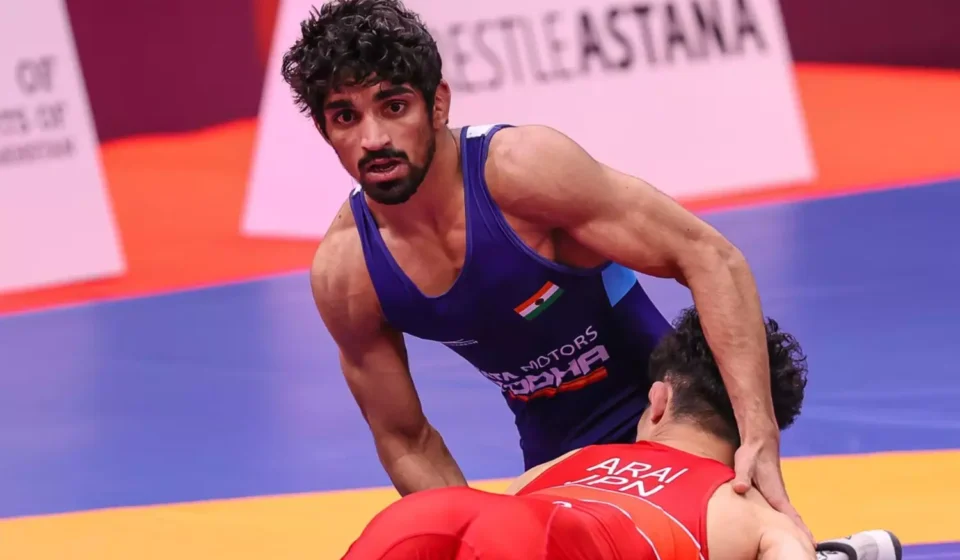
The concluding day of the championships was marked by high expectations as two Indian freestyle wrestlers reached their respective finals. Aman, a celebrated name in Indian wrestling following his bronze medal success at the Paris Olympics, competed in the 61kg freestyle category. Transitioning from his usual 57kg division to the higher 61kg weight class, Aman faced North Korea’s Kwang Myong Kim in a bout that lived up to its billing as a high-scoring thriller.
The match was a tactical battle of attrition, with both wrestlers trading points in quick succession. Aman showcased the agility and technical prowess that earned him Olympic glory, but Kim’s defensive counters and explosive restarts proved decisive. The contest ended 13-10 in favor of the North Korean, leaving Aman with a hard-earned silver. Analysts noted that while Aman’s move to a higher weight category presented physical challenges, his ability to remain competitive at the highest level of the 61kg class bodes well for his versatility in future international meets.
In the 86kg freestyle final, Mukul Dahiya faced a formidable opponent in Iran’s Kamran Ghasempour. The Iranian, a seasoned veteran and multiple-time world champion, utilized his superior reach and strength to control the pace of the match from the opening whistle. Dahiya, who had shown exceptional form during the preliminary rounds and semifinals, struggled to penetrate Ghasempour’s defense. The match concluded with a 7-0 victory for the Iranian, awarding Dahiya the silver medal. Despite the loss, Dahiya’s run to the final is viewed as a significant breakthrough for the young wrestler, establishing him as a legitimate contender in one of wrestling’s most competitive weight divisions.
Dinesh Secures Bronze to Round Out the Tally
India’s final podium finish of the tournament came in the 125kg heavyweight freestyle category. Dinesh, representing India in the largest weight class, delivered a masterclass in power wrestling during his bronze medal match against the home favorite, Arslanbek Turdubekov of Kyrgyzstan.
Facing a vocal local crowd, Dinesh remained composed, utilizing a series of takedowns and leg laces to rack up points. The match ended in a dominant 12-1 technical superiority victory for the Indian, ensuring the contingent finished the tournament on a high note. The victory for Dinesh was particularly significant given the historical difficulty India has faced in producing consistent medalists in the heavyweight freestyle categories, where Central Asian and Iranian wrestlers typically dominate.
A Comprehensive Breakdown of India’s 17-Medal Performance
The 2026 campaign in Bishkek represents one of India’s most balanced performances in recent years. By spreading the medal count across the three primary disciplines—Men’s Freestyle, Women’s Freestyle, and Greco-Roman—the Indian contingent has demonstrated that its training programs are yielding results across the board.
- Men’s Freestyle: This remains the crown jewel of Indian wrestling. With two gold medals, the freestyle specialists proved they could go toe-to-toe with the best from Iran and Japan. The tactical discipline shown in the early rounds allowed India to place multiple wrestlers in the medal rounds.
- Women’s Freestyle: The five-medal haul (one silver, four bronze) reflects a period of transition and growth. While the absence of a gold medal in this category may be a point of review for the coaching staff, the consistency in reaching the podium suggests that the next generation of female wrestlers is narrowing the gap with traditional leaders like Japan and China.
- Greco-Roman: While often overshadowed by the freestyle successes, the Greco-Roman wrestlers contributed vital points and medals to the overall tally. The focus on upper-body strength and parterre defense has seen a marked improvement in this discipline, which has historically been a weaker point for the nation.
Strategic Analysis: The Transition and the "Silver Ceiling"
While the 17-medal total is a cause for celebration, a technical analysis of the tournament highlights a recurring theme: the difficulty of converting final appearances into gold medals. With six silver medals, the Indian coaching staff will likely focus on "final-match psychology" and late-bout conditioning.
The transition of athletes like Aman into different weight categories is a strategic move often seen after an Olympic year. By testing athletes in non-Olympic weight classes (like 61kg), coaches can build strength and technical variety without the grueling weight cuts associated with primary Olympic divisions. Aman’s performance suggests that while the speed is there, the physical strength required to hold off larger opponents in the 61kg class is an area for development.
Furthermore, the encounter between Mukul Dahiya and Kamran Ghasempour highlighted the technical gap that still exists between Indian wrestlers and the elite Iranian school of wrestling. Ghasempour’s ability to shut down Dahiya’s offense entirely indicates a need for more diverse attacking patterns when facing world-class defensive specialists.
Historical Context and Event Significance
Bishkek has become a frequent and welcoming host for Asian wrestling, and the 2026 edition saw a high level of organization and competition. For India, the Asian Championships have historically been a happy hunting ground, but the 2026 edition was particularly vital. Coming two years after the Paris 2024 Olympics and two years before the 2028 Los Angeles Games, this tournament serves as the midpoint of the cycle where new talent is integrated into the senior squad.
Comparatively, India’s performance in 2026 shows an upward trajectory in total medal count compared to the 2024 and 2025 editions. The increased investment in sports science, foreign exposure trips, and the revitalization of domestic leagues has created a more robust pipeline of athletes capable of winning at the continental level.
Official Reactions and Future Outlook
While official statements from the Wrestling Federation of India (WFI) emphasized pride in the athletes’ grit, there is an underlying sentiment that the gold medal count could have been higher. Sources close to the coaching staff suggested that the focus will now shift toward the upcoming World Championships.
"To return with 17 medals from a field as competitive as the Asian Championships is a testament to the hard work of our wrestlers and coaches," an anonymous official noted. "However, we analyzed the finals closely. Losing four or five gold medal matches indicates that we need to refine our strategy in the final three minutes of the bout. Our wrestlers are reaching the podium; now we must ensure they reach the top step."
The performance of the youth prospects in Bishkek also provides a roadmap for the 2028 Olympics. With several veterans moving toward the end of their careers, the emergence of wrestlers like Mukul Dahiya and the continued excellence of Aman ensure that India remains a powerhouse in the sport.
Implications for the Sport in India
The success in Bishkek is expected to further boost the profile of wrestling in India, a sport that has consistently delivered Olympic medals for the country since 2008. The 17-medal haul provides the WFI with significant leverage when negotiating for increased government funding and private sponsorships.
Moreover, the diversity of the medalists—hailing from various states beyond the traditional wrestling hubs of Haryana and Punjab—indicates that the sport is de-centralizing. This geographic expansion is crucial for the long-term sustainability of the sport, ensuring a wider pool of talent and a broader fan base.
As the Indian contingent returns home, the focus will immediately pivot to recovery and preparation for the summer season. The lessons learned on the mats of Bishkek—from the tactical nuances of the 61kg division to the heavyweight dominance of the 125kg class—will be integrated into the national training camps at Patiala and Sonepat.
In conclusion, India’s performance at the 2026 Asian Wrestling Championships was a resounding success in terms of volume and consistency. While the "gold standard" remains the ultimate goal, the 17-medal achievement reinforces India’s status as a top-tier wrestling nation in Asia, setting a solid foundation for the remainder of the Olympic quadrennial. The silver medals of Aman and Mukul Dahiya, alongside the bronze of Dinesh, serve as both a reward for current efforts and a motivation for future adjustments as the road to Los Angeles 2028 begins to take shape.