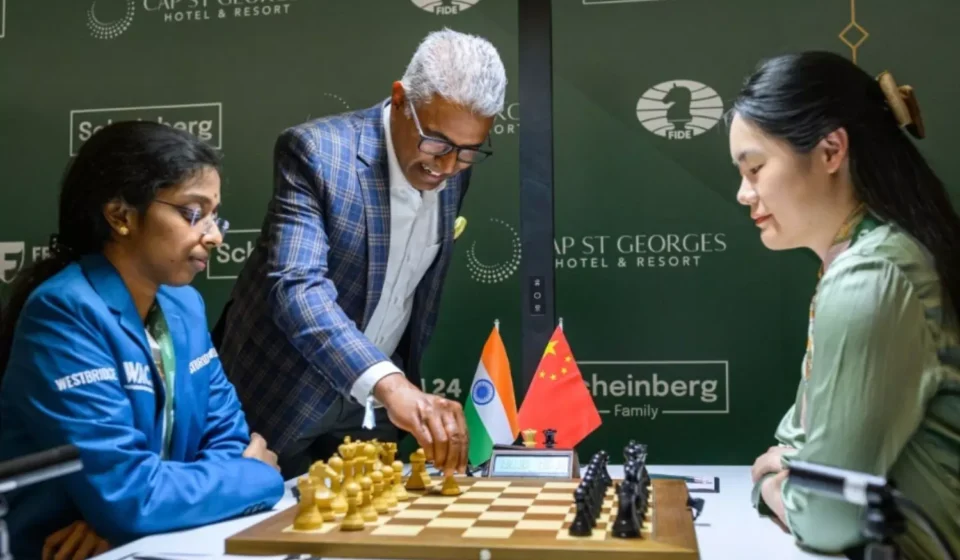
Vaishali Rameshbabu Yields Lead as Zhu Jiner Ignites Title Race in Round 12 of FIDE Candidates Tournament in Cyprus

The landscape of the 2026 FIDE Women’s Candidates Tournament underwent a seismic shift on Sunday as the competition entered its penultimate phase in Cyprus. In a high-stakes Round 12 encounter that redefined the leaderboard, India’s Vaishali Rameshbabu suffered a critical defeat at the hands of China’s Zhu Jiner. This result has effectively dismantled Vaishali’s solo grip on the top spot, forcing a joint lead and setting the stage for a photo finish in the final two rounds of play. While the Women’s section crackled with decisive results and shifting fortunes, the Open section remained a bastion of tactical parity, with all matches ending in draws, leaving the current standings largely intact but the tension palpable.
Women’s Candidates: A Shift at the Summit
The headline of the day was undoubtedly the clash between Vaishali Rameshbabu and Zhu Jiner. Entering the round as the tournament favorite with a slim but significant advantage, Vaishali faced a determined Zhu, who utilized a rigorous tactical approach to dismantle the Indian Grandmaster’s defenses. The game was characterized by Zhu’s superior control of the mid-game transition, where she exploited minor inaccuracies in Vaishali’s positioning to build an insurmountable advantage.
By the time the endgame was reached, Zhu’s precision left Vaishali with no viable path to a draw, forcing a resignation that brought both players level at seven points. This result not only revitalizes Zhu’s championship aspirations but also places immense psychological pressure on Vaishali, who must now navigate the final two rounds without the safety net of a points cushion.
The round was further marked by a significant resurgence from former world champion Tan Zhongyi. Despite a quiet tournament thus far, Tan demonstrated the depth of her experience by defeating India’s Divya Deshmukh. This victory represented Tan’s first full point of the event, a reminder of her enduring class on the global stage. For Deshmukh, the loss was a harsh blow, cementing her position in the bottom tier of the standings with five points and highlighting the steep learning curve of the Candidates cycle.
Meanwhile, Bibisara Assaubayeva continued her steady ascent. By defeating Kateryna Lagno in a grueling battle of attrition, Assaubayeva moved to 6.5 points. She now sits just half a point behind the leaders, positioning herself as a "dark horse" capable of snatching the title should the frontrunners falter in the coming days. The match between Anna Muzychuk and Aleksandra Goryachkina ended in a draw, though not for lack of effort. Muzychuk was noted for playing an exceptional game, generating significant momentum that seemed poised to yield a win, yet Goryachkina’s legendary defensive resilience allowed her to split the point.
Open Section: Technical Precision Leads to Deadlock
In contrast to the volatility of the Women’s section, the Open section of the 2026 Candidates was a study in defensive excellence and "home preparation." All four matches ended in draws, a testament to the incredibly high level of play and the deep theoretical knowledge of the modern elite.
The most anticipated match of the day featured India’s Praggnanandhaa Rameshbabu against Andrey Esipenko. The two young stars entered a sharp, dynamic opening that had clearly been the subject of intensive engine-assisted analysis during their pre-match preparation. What followed was a masterclass in modern chess: a game played with near-perfect precision. Post-game analysis indicated accuracy levels approaching 99% for both players. While the game provided a feast for purists and analysts, it did little to change the standings. Praggnanandhaa remains in seventh place with five points, a position that reflects a solid performance but one that likely removes him from contention for the top spot.
The tournament leader, Javokhir Sindarov, maintained his commanding position by drawing with American heavyweight Hikaru Nakamura. Sindarov, who has been the revelation of the 2026 cycle, currently leads the field with nine points. His ability to hold Nakamura—a player known for his aggressive pursuit of wins in must-win situations—underscores the Uzbek prodigy’s readiness for the world stage.
Anish Giri, currently in second place with seven points, came tantalizingly close to narrowing the gap. In his match against Wei Yi, Giri established a favorable position and looked set to claim a full point. However, Wei Yi’s resourceful defense in a complex endgame denied the Dutchman the victory. The round was rounded out by a draw between Matthias Bluebaum and Fabiano Caruana, leaving the American grandmaster still searching for the late-tournament surge required to challenge Sindarov’s dominance.
Chronology of the Cyprus Candidates: The Path to Round 12
The 2026 FIDE Candidates Tournament in Cyprus has been a journey of fluctuating fortunes. The early rounds in the Women’s section were dominated by Vaishali Rameshbabu, whose aggressive style and preparation saw her take an early lead. However, the middle rounds introduced a period of stabilization where Zhu Jiner and Bibisara Assaubayeva began to chip away at the deficit.
In the Open section, Javokhir Sindarov established himself as the man to beat from the outset. His performance in the first half of the double round-robin was nearly flawless, allowing him to build a two-point lead over Anish Giri. As the tournament moved into the double-digit rounds, the strategy for the chasing pack—Nakamura, Caruana, and Giri—shifted from steady play to high-risk gambles, most of which have been neutralized by the leaders’ defensive solidity.
The transition to Cyprus for the 2026 cycle was a strategic move by FIDE to expand the game’s footprint in the Mediterranean, and the event has been lauded for its world-class facilities and the intense atmosphere it has fostered among the competitors.
Statistical Breakdown and Standings
As it stands after 12 rounds, the competitive landscape is as follows:
Women’s Standings:
- Vaishali Rameshbabu: 7.0 points
- Zhu Jiner: 7.0 points
- Bibisara Assaubayeva: 6.5 points
- Aleksandra Goryachkina: 6.0 points
- Kateryna Lagno: 5.5 points
- Tan Zhongyi: 5.5 points
- Anna Muzychuk: 5.5 points
- Divya Deshmukh: 5.0 points
Open Standings:
- Javokhir Sindarov: 9.0 points
- Anish Giri: 7.0 points
- Hikaru Nakamura: 6.5 points
- Fabiano Caruana: 6.5 points
- Wei Yi: 6.0 points
- Andrey Esipenko: 5.5 points
- Praggnanandhaa Rameshbabu: 5.0 points
- Matthias Bluebaum: 4.5 points
The data reveals a stark difference in the two sections. While the Open section is essentially Sindarov’s to lose—requiring only a draw in the final rounds to likely secure the title—the Women’s section is a three-way sprint between Vaishali, Zhu, and Assaubayeva.
Broader Implications and Expert Analysis
The results of Round 12 carry significant implications for the future of the FIDE World Championship cycle. In the Women’s section, the potential for a tie-break is now a distinct reality. If Vaishali and Zhu remain level through Round 14, the regulations dictate a series of rapid and, if necessary, blitz games to determine the challenger for the Women’s World Championship title.
Observers have noted that the pressure of the "Candidates’ Curse"—the tendency for leaders to falter in the final rounds due to the immense psychological weight of the prize—seemed to affect Vaishali in her loss to Zhu. Conversely, Zhu Jiner’s performance is being hailed as a triumph of nerves. Her ability to "outplay" a leader in a must-win situation is a trait often seen in future world champions.
In the Open section, the conversation centers on the "changing of the guard." Javokhir Sindarov’s nine points in twelve rounds is a historic pace, reminiscent of dominant performances by legends of the game. If he secures the title, he will become one of the youngest challengers in history, signaling a definitive shift toward a new generation of players from Central Asia and India, despite the continued excellence of veterans like Giri and Nakamura.
Looking Ahead: Round 13 Pairings
The penultimate round, scheduled for April 14, will likely determine the final trajectory of the tournament. In the Open section, all eyes will be on the clash between Anish Giri and Javokhir Sindarov. This is Giri’s final realistic opportunity to bridge the two-point gap. A win for Giri would keep the tournament alive until the final day, while a draw or a win for Sindarov would mathematically secure his victory.
In the Women’s section, the pairings are equally explosive. Vaishali Rameshbabu faces a daunting task against the reinvigorated Tan Zhongyi. Tan, now playing without the pressure of the title hunt, could act as a "spoiler." Simultaneously, Zhu Jiner will take on Aleksandra Goryachkina. Goryachkina remains one of the hardest players to defeat in the world, and Zhu will need to find another level of brilliance to maintain her share of the lead.
Round 13 Pairings – April 14:
FIDE Candidates (Open):
- Wei Yi vs. Andrey Esipenko
- Anish Giri vs. Javokhir Sindarov
- Hikaru Nakamura vs. Matthias Bluebaum
- Fabiano Caruana vs. Praggnanandhaa Rameshbabu
FIDE Women’s Candidates:
- Bibisara Assaubayeva vs. Anna Muzychuk
- Kateryna Lagno vs. Divya Deshmukh
- Tan Zhongyi vs. Vaishali Rameshbabu
- Zhu Jiner vs. Aleksandra Goryachkina
As the players head into the final 48 hours of competition, the 2026 Candidates Tournament stands as a testament to the grueling nature of elite chess. In Cyprus, the line between immortality and heartbreak has never been thinner.