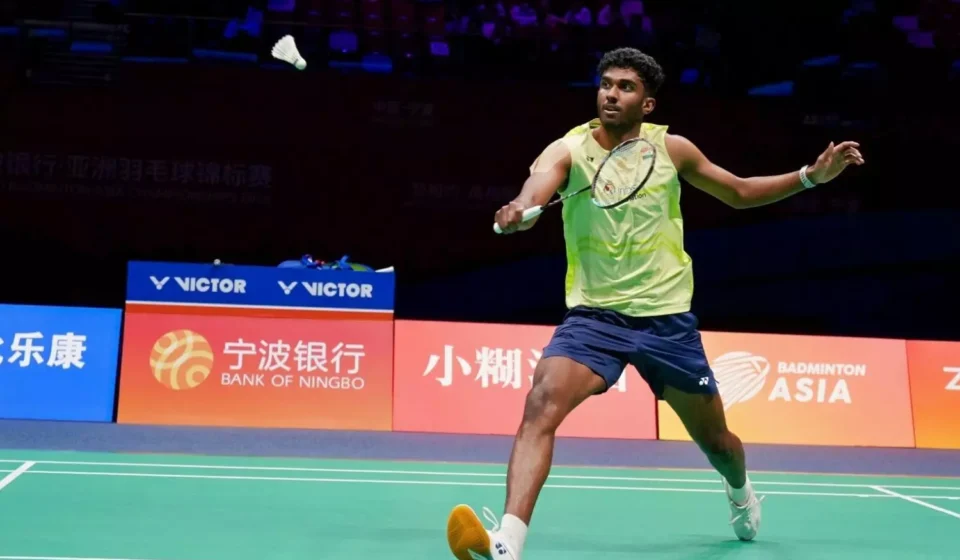
Ayush Shetty Achieves Career High World Number 18 Following Historic Silver Medal Performance at Badminton Asia Championships

The international badminton landscape witnessed a significant shift this week as 20-year-old Indian sensation Ayush Shetty surged into the upper echelons of the sport, securing a career-best world ranking of 18 in the latest Badminton World Federation (BWF) men’s singles standings. This seven-place ascent comes on the heels of a monumental performance at the 2026 Badminton Asia Championships held in China, where Shetty became the first Indian man in over six decades to reach the singles final of the prestigious continental tournament. His silver medal finish not only underscores his individual growth but also signals a revitalized era for Indian men’s singles on the global stage, as he joins Lakshya Sen within the world’s top 20.
A Historic Run in China
The 2026 Badminton Asia Championships will be remembered as the site of Ayush Shetty’s definitive breakthrough. Entering the tournament as a rising prospect, Shetty navigated a challenging draw with poise and tactical maturity that belied his youth. His journey to the podium was characterized by high-intensity rallies and an improved defensive game, culminating in a series of victories against established top-tier opponents.
The defining moment of Shetty’s campaign occurred in the semi-finals, where he faced the formidable Kunlavut Vitidsarn of Thailand. Vitidsarn, the reigning world-class competitor and then-world number one, was the heavy favorite to clinch the title. However, Shetty produced a masterclass in controlled aggression, neutralizing the Thai player’s deception and outlasting him in grueling exchanges to secure a straight-sets victory. This result sent shockwaves through the badminton community, as it not only guaranteed Shetty a medal but also directly influenced the top of the world rankings.
In the final, Shetty faced the local favorite and former world number one, Shi Yu Qi of China. While Shetty fought valiantly, the experience and clinical precision of the Chinese veteran proved too much in the gold medal match. Despite the loss, Shetty’s silver medal ended a 61-year wait for India, making him only the second Indian male shuttler to reach the final of the Badminton Asia Championships since Dinesh Khanna’s historic gold medal triumph in 1965.
Reconfiguring the BWF World Rankings
The fallout from the Badminton Asia Championships has resulted in a dramatic reshuffling of the BWF world rankings. Ayush Shetty’s jump to the 18th position is the most notable move for the Indian contingent. By accumulating significant ranking points from his silver medal finish, Shetty has moved past several seasoned veterans, establishing himself as a mainstay in the elite tier of the sport.
The tournament also had profound implications for the world number one spot. By defeating Kunlavut Vitidsarn in the semi-finals, Shetty inadvertently cleared the path for Shi Yu Qi to reclaim the throne. With his victory over Shetty in the final, Shi Yu Qi earned enough points to dethrone Vitidsarn and return to the world number one position. This ranking volatility highlights the thin margins currently existing at the top of the men’s singles category, where a single tournament can dictate the leadership of the global standings.
For India, the rankings update brings further positive news. Lakshya Sen, despite a premature exit in the first round of the championships, managed to gain one position to sit at world number 11. The presence of both Sen and Shetty in the top 20 provides India with a formidable "one-two punch" in major international team events and individual circuits, a depth that has been a primary goal for the Badminton Association of India (BAI).
The State of Indian Women’s Singles and Doubles
While the spotlight remains firmly on the men’s singles breakthrough, the latest BWF rankings provide a comprehensive overview of India’s standing across other categories. In the women’s singles department, the legendary PV Sindhu remains the highest-ranked Indian, holding steady at the 13th position. Sindhu continues to be the benchmark for consistency in Indian badminton, though the emergence of younger talents suggests a transition phase is underway.
Unnati Hooda and Tanvi Sharma continue their steady climb, ranked 23rd and 35th respectively. Hooda, in particular, has shown flashes of brilliance on the BWF World Tour, and her proximity to the top 20 suggests that she may soon join Sindhu in the elite bracket. The development of these young players is crucial for India’s prospects in the lead-up to the next Olympic cycle and major continental games.
In the men’s doubles category, the powerhouse duo of Satwiksairaj Rankireddy and Chirag Shetty maintained their world number 4 ranking. This stability comes despite their forced withdrawal from the Badminton Asia Championships due to a minor injury. Their ability to retain a top-five spot without competing speaks to the massive point cushion they have built through consistent title wins over the previous twelve months. Their recovery and return to the court remain a top priority for the national coaching staff, as they remain India’s strongest prospects for podium finishes in any top-level competition.
Chronology of Ayush Shetty’s Rise
To understand the magnitude of Shetty’s current ranking, one must look at his trajectory over the past year.
- Early 2025: Shetty was hovering outside the top 50, primarily competing in International Challenge and Super 300 events to garner experience.
- Mid-2025: A series of quarter-final finishes in Super 500 tournaments saw him break into the top 40, earning him direct entries into higher-tier BWF World Tour events.
- Late 2025: Shetty secured his first major podium on the World Tour, which provided the confidence boost necessary to compete against top-10 opponents.
- April 2026: The Badminton Asia Championships served as the catalyst. By reaching the final and defeating the world number one, Shetty earned a massive influx of points, propelling him seven spots up to world number 18.
This steady progression indicates a structured development plan, likely orchestrated by the national coaching setup and personal trainers who have focused on his physical conditioning and mental fortitude.
Analysis: The Implications for Indian Badminton
Ayush Shetty’s rise to world number 18 is more than just a personal milestone; it is a strategic victory for Indian badminton. For years, the burden of expectations in men’s singles was shared by a small group of players including Lakshya Sen, HS Prannoy, and Kidambi Srikanth. Shetty’s emergence adds much-needed depth and longevity to the squad.
From a technical perspective, Shetty’s game is built on a foundation of exceptional court coverage and a versatile attacking repertoire. Analysts have noted his ability to change the pace of a rally mid-point, a tactic that proved particularly effective against Kunlavut Vitidsarn. His performance in China demonstrated that he can maintain high intensity over several days of competition, a prerequisite for success in the grueling BWF calendar.
Furthermore, his success provides a psychological boost to the junior ranks. Seeing a 20-year-old compete on equal footing with legends like Shi Yu Qi validates the training methodologies currently employed at premier institutions like the Pullela Gopichand Badminton Academy and the Prakash Padukone Badminton Academy.
Official Reactions and Future Outlook
While formal statements from the Badminton Association of India have emphasized the collective growth of the team, coaching staff members have privately lauded Shetty’s work ethic. National coaches have pointed out that Shetty’s silver medal is a result of a specific six-month training block focused on "big-match temperament."
"The goal was always to see Ayush break into the top 20 by the middle of 2026," a source close to the coaching camp noted. "To achieve it in April, and in such a prestigious tournament, is ahead of schedule. The focus now shifts to maintaining this ranking and aiming for a top-10 seed, which is vital for favorable draws in the World Championships."
Looking ahead, the road for Ayush Shetty involves defending the points he has gained while seeking titles in the upcoming Super 750 and Super 1000 events. As the world number 18, he will no longer be an underdog; opponents will now analyze his game with the scrutiny reserved for the world’s best. His ability to adapt to this new level of pressure will determine if he can follow in the footsteps of his predecessors and reach the very pinnacle of the sport.
The rise of Ayush Shetty, coupled with the resilience of veterans like PV Sindhu and the dominance of Rankireddy/Shetty, paints a promising picture for Indian badminton. As the BWF circuit moves toward the European and Southeast Asian legs, the international community will be watching closely to see if the young man from India can continue his ascent and perhaps, in the near future, bring home the gold that narrowly eluded him in China.