Generational Shifts in AI-Driven Consumer Decision-Making: How Brands Are Navigating the 2026 Marketing Landscape

The global marketplace is currently undergoing a fundamental transformation that extends far beyond the mere adoption of new digital tools. As of mid-2026, industry data indicates that artificial intelligence is not only reshaping how products are discovered but is fundamentally altering the cognitive processes through which consumers make purchasing decisions. This shift is characterized by a growing reliance on an "AI layer" that sits between the brand and the consumer, acting as an interpreter, filter, and advisor. Recent market analysis reveals that the success of modern brands now depends less on traditional visibility and more on understanding how different age demographics delegate their decision-making power to automated systems.
For the first time in marketing history, five distinct generations—Generation Alpha, Generation Z, Millennials, Generation X, and Baby Boomers—are interacting with the same core technology but maintaining radically different relationships with it. While the underlying algorithms remain consistent, the psychological trust and functional use cases vary significantly across the age spectrum. This divergence has forced a total recalibration of digital strategy, moving away from a "one-size-fits-all" approach toward a high-precision model that accounts for generational nuances in AI interaction.
The Rise of the AI Research Layer
The traditional path to purchase, which once began with a direct search engine query or a visit to a brand’s homepage, has been largely superseded. According to recent consumer reports, over 60% of shoppers now utilize AI-powered tools for the initial stages of product research. This means that before a consumer ever visits a retailer’s website, the brand’s value proposition has already been interpreted, summarized, and ranked by a large language model or a generative search engine.
This "invisible funnel" presents a significant challenge for brand control. Content is being ingested by systems that prioritize relevance and utility over creative flair or brand heritage. If a company’s digital footprint is not optimized for these AI aggregators, they risk being excluded from the consideration set entirely. The level of trust placed in these AI summaries is the primary variable across generations. Younger cohorts tend to view AI as a primary filter for efficiency, while older demographics often use it as a secondary verification tool to cross-reference traditional reviews.
A Demographic Breakdown of AI Integration
To understand the 2026 landscape, analysts point to the specific ways each generation incorporates AI into their daily commerce.
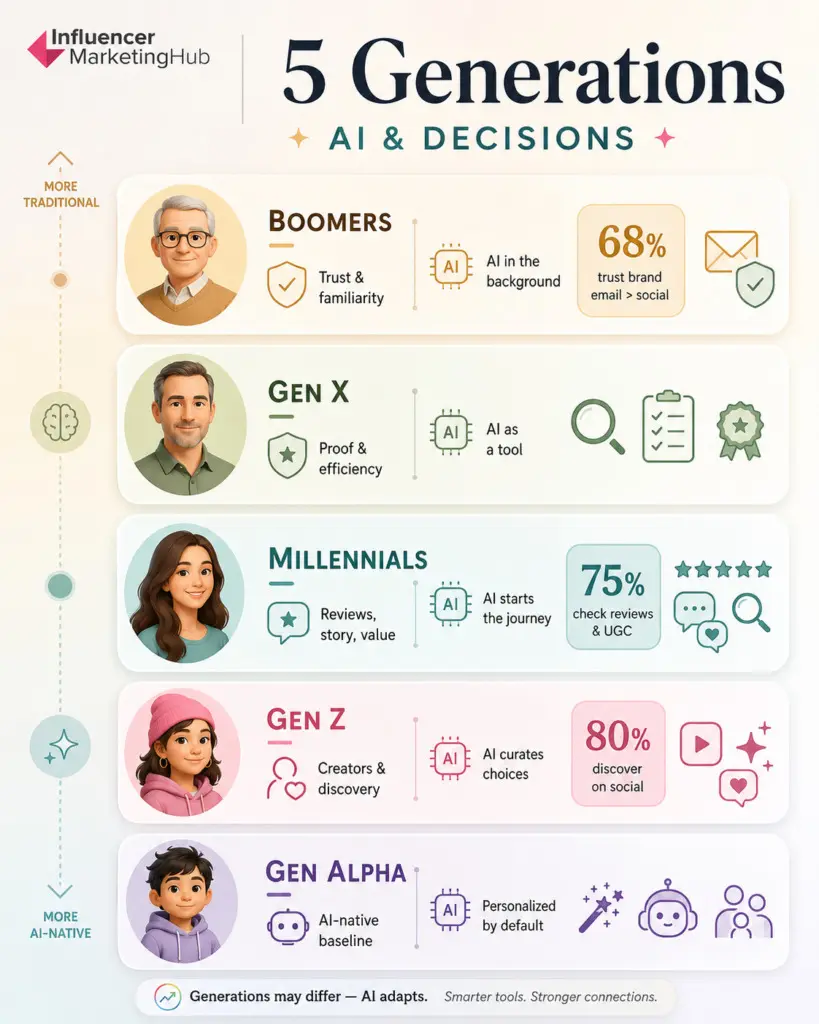
Generation Alpha, the first true AI-native generation, views automated assistance as a standard feature of the internet rather than a separate tool. For this group, discovery is often passive, driven by predictive AI that suggests products within immersive digital environments. They do not "search" in the traditional sense; they interact with agents that curate their world.
Generation Z has largely moved away from legacy search engines. Approximately 40% of this demographic now utilizes social platforms like TikTok and Instagram as their primary search tools. However, the integration of AI into these platforms has changed the nature of social search. AI now powers the "for you" feeds with such precision that discovery and decision-making happen almost simultaneously within the same app. Gen Z relies on AI to surface "authentic" creator content, delegating the task of trend-spotting to the algorithm.
Millennials, often described as the "efficiency generation," use AI primarily to reclaim time. They are the highest adopters of AI-driven comparison tools and automated replenishment services. For a Millennial, the decision-making process is about data-backed optimization. They are more likely to trust an AI that can synthesize thousands of reviews into a concise pros-and-cons list, allowing them to make a "perfect" purchase with minimal manual effort.
Generation X and Baby Boomers maintain a more cautious, utility-based relationship with AI. While adoption rates have increased, these groups are more likely to use AI for specific, high-intent tasks, such as finding the best price for a known commodity or navigating complex customer service issues. Their trust is earned through accuracy and the ability of the AI to lead them back to a human-verified source or a physical retail experience.
The Death of Traditional SEO and the Social Search Pivot
The transition from traditional search engines to a multi-platform discovery model is now complete. The dominance of Google has been challenged by the rise of "Social Search," where the intent is driven by visual proof and community sentiment rather than keyword matching. For brands, this means that the "AI layer" is now active on TikTok, Reddit, and Instagram, indexing video transcripts and user comments to provide real-time answers to consumer queries.
Industry experts note that search no longer lives in a single format. A consumer might see a product on a Connected TV (CTV) ad, research it via a voice-activated AI assistant while cooking, and finally convert through a personalized link in a social feed. This fragmented journey is held together by AI that tracks intent across devices. If a brand’s presence is inconsistent across these touchpoints, the AI agent—which is increasingly making the final recommendation—will perceive a lack of authority, leading to a drop in conversion rates.
The Fragmented Funnel and the Second-Screen Reality
The modern consumer journey is no longer linear. It is a multi-screen, high-distraction experience. Data shows that 87% of consumers are using a second screen, typically a smartphone or tablet, while watching television. This behavior has transformed CTV into a top-of-funnel discovery tool that triggers immediate AI-assisted research on a secondary device.
AI is accelerating the speed at which consumers move through this fragmented funnel. In 2026, the gap between "awareness" and "purchase" has shrunk from days to minutes. For younger generations, the AI layer bypasses the traditional consideration phase by providing "instant trust" through aggregated data. For older generations, the AI layer provides the necessary documentation—manuals, warranty info, and price comparisons—to move them toward a final decision more quickly than manual browsing ever could.
The Resurgence of Experiential Marketing and AI’s Role
Despite the digital-first nature of AI, physical experiences remain a critical driver of purchase intent. Approximately 70% of consumers report that in-person experiences significantly increase their likelihood of buying from a brand. However, the role of AI in this context is that of a "concierge."
AI is now the primary driver of traffic to physical locations. It determines which experiential pop-ups are recommended to which users based on their digital behavior. Once at a physical location, AI-powered tools, such as augmented reality (AR) mirrors or personalized in-store mobile notifications, bridge the gap between the tactile experience and the digital checkout. The brands winning in 2026 are those that use AI to enhance, rather than replace, the physical human connection.
Personalization and the Shift from Generic Incentives
The era of generic mass discounting is effectively over. Consumers in 2026 have become desensitized to "one-size-fits-all" sales, with 75% stating they are more likely to engage with brands that offer hyper-personalized incentives. AI has become the engine behind this precision.
For Gen Z and Millennials, personalization means receiving offers that align with their specific values or aesthetic preferences, often delivered at the exact moment of high intent. For Gen X and Boomers, personalization is more closely tied to loyalty and recognition of past behavior. AI allows brands to tailor not just the discount amount, but the "reason" for the offer, whether it is a reward for a long-term relationship or an invitation to try a product that fits a recently identified life change.
Analysis of Broader Industry Impact
The implications of this AI-driven shift are profound for the corporate structure of marketing departments. The traditional silos between "SEO," "Social," and "Creative" are collapsing. In their place, brands are building "Integrated Intelligence" teams focused on how a brand’s data is perceived by external AI models.
Analysts suggest that "Precision Marketing" is the new baseline. In an environment where AI agents are increasingly making decisions on behalf of humans—such as automated grocery ordering or AI-curated travel itineraries—the brand’s primary job is to ensure its data is "machine-readable" and "algorithmically attractive." This requires a shift from emotional storytelling to a dual-track strategy: one that appeals to human emotion and another that provides the structured data necessary for AI to validate the brand’s claims.
Furthermore, the issue of trust remains the ultimate currency. As AI-generated content saturates the internet, consumers are becoming more discerning. The "AI layer" can be a double-edged sword; while it provides convenience, it also risks creating "filter bubbles" that limit brand discovery. Brands that can maintain transparency about their use of AI while providing genuine, high-quality products will be the ones that survive the volatility of the mid-2020s.
Conclusion: The Future of Decision-Making
As we move toward the latter half of the decade, the question for brands is no longer about the strength of their message, but about the clarity of their presence within the AI ecosystem. Conversion in 2026 is the result of a complex interplay between human psychology and algorithmic logic.
To succeed, organizations must move beyond simply "using AI" to automate tasks. They must instead focus on "AI Orchestration"—understanding how their target audience uses AI to decide, and ensuring the brand is present at every digital and physical touchpoint with accuracy and relevance. The shift from discovery to decision-making marks the next frontier of the digital age, where the most successful brands will be those that master the invisible layer guiding the modern consumer.