Decoding the Evolution of Residential Proxy Standards A Six Dimensional Framework for Marketing Intelligence and Data Integrity

The global residential proxy server market is currently undergoing a period of rapid expansion, with recent industry valuations projecting a rise from $1.92 billion in 2026 to an estimated $3.05 billion by 2031. This growth, representing a compound annual growth rate (CAGR) of 9.7%, is fueled by the escalating demand for high-fidelity data in sectors such as search engine optimization (SEO) monitoring, social media intelligence, and real-time price tracking. As marketing data pipelines become increasingly sophisticated, the infrastructure supporting them—specifically residential proxies—has moved from a niche technical requirement to a cornerstone of enterprise business intelligence.
In the current landscape, every major proxy vendor presents a portfolio of impressive metrics: success rates exceeding 99%, IP pools numbering in the hundreds of millions, and sub-second response times. However, industry analysts and data engineers note that these headline figures often diverge from real-world performance when subjected to the stresses of high-volume marketing workflows. Generic scraping tasks differ significantly from the specialized requirements of social media platform monitoring or competitor ad-library analysis. For instance, social platforms utilize aggressive browser fingerprinting and behavioral analysis to detect non-residential traffic, while competitor price tracking requires precise, ISP-level geographic targeting to ensure the data reflects the correct regional market tier.
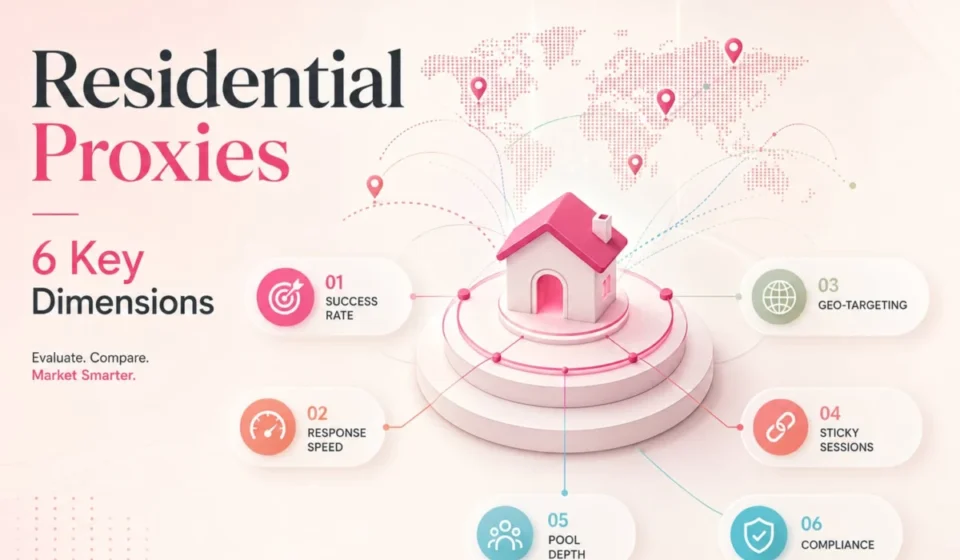
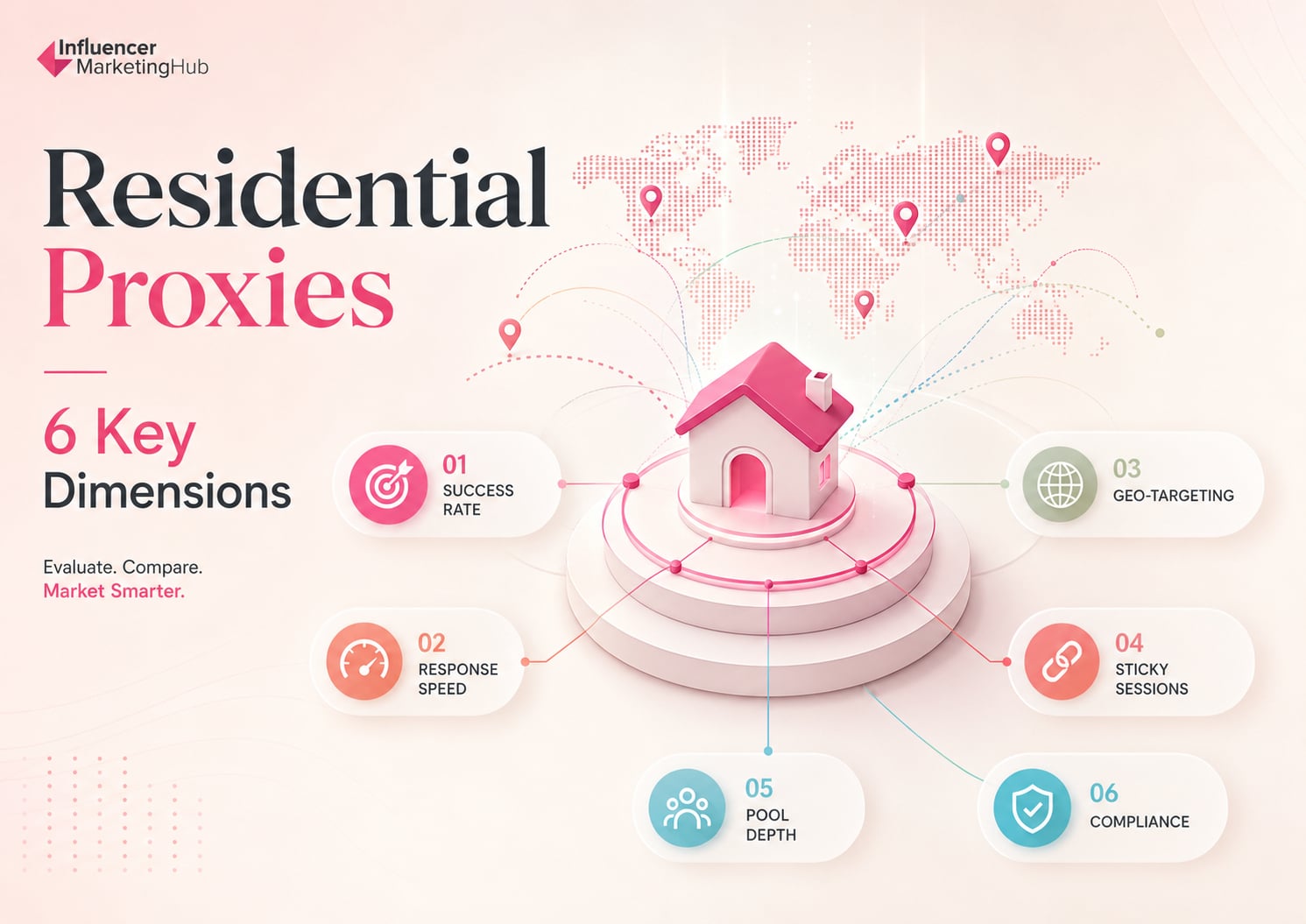
To bridge the gap between vendor specifications and operational reality, a comprehensive six-dimensional framework has emerged as the standard for benchmarking residential proxy performance. This framework evaluates success rates, response times, pool depth, geographic granularity, session stability, and sourcing compliance to provide a holistic view of a provider’s utility in professional environments.
The Evolution of Proxy Infrastructure: From Data Centers to Residential Nodes
To understand the current importance of residential proxies, one must examine the chronology of web scraping and data collection. In the early 2010s, data center proxies were the industry standard. These were fast and inexpensive but easily identifiable because their IP addresses belonged to known server farms. As websites implemented more sophisticated anti-bot measures, such as Akamai, Cloudflare, and PerimeterX, data center IPs were frequently blacklisted.
The shift toward residential proxies—IP addresses assigned by Internet Service Providers (ISPs) to genuine home users—marked a turning point. Because these IPs appear as legitimate household traffic, they are far less likely to be flagged or blocked. By 2020, the market saw a surge in providers offering rotating residential proxies, which automatically switch the user’s IP address to prevent pattern detection. Today, the focus has shifted again, moving beyond mere "anonymity" toward "integrity" and "granularity," where the specific location and stability of the IP are as important as its residential status.
Dimension 1: Success Rates Under High-Volume Workloads
The success rate is perhaps the most critical metric for any data-driven marketing campaign. It measures the percentage of requests that complete without encountering a block, a CAPTCHA, or a timeout. While the professional-grade threshold is generally accepted to be between 95% and 99.9%, the impact of even a 1% failure rate is magnified at scale.
In marketing workflows, a failed request is rarely a minor hiccup. For example, in competitor ad-library scraping, a missed request can lead to a gap in campaign intelligence, potentially causing a brand to miss a competitor’s strategy shift. In influencer marketing, a failed scrape during audience verification can result in inaccurate reach data, leading to poor investment decisions.
Currently, top-tier providers report high baseline figures. Proxy-Seller, for instance, maintains a 99.5% success rate with 99.7% uptime. Similarly, IPRoyal publishes a 99.4% success rate for its rotating residential network. While these vendor-reported numbers are high, third-party benchmarks on "hardened" targets—sites with the most advanced anti-bot protections—often show more conservative results, emphasizing the need for continuous monitoring during active campaigns.
Dimension 2: Response Time and Throughput Dynamics
Speed in a proxy network is defined by two distinct signals: Time to First Byte (TTFB) and total download time. TTFB measures the latency of the proxy server itself—how quickly it can process a request and begin receiving data. Total download time, or throughput, is influenced by the connection speed of the residential peer and the bandwidth of the provider’s backbone.
Latency is a primary concern for real-time applications, such as creator audience verification, where delays can disrupt the user experience or cause session timeouts. Proxy-Seller’s residential network currently averages a response time of approximately 0.35 seconds, operating on a 1 Gbps channel. In contrast, many established enterprise networks report advertised averages in the 0.5 to 0.8-second range. For marketing teams, the goal is to find a provider that maintains these speeds even when the number of concurrent requests scales into the thousands.
Dimension 3: Pool Size and the Reality of IP Freshness
A common marketing tactic among proxy vendors is the promotion of massive IP pools, sometimes exceeding 100 million addresses. However, independent research conducted in 2024 and 2025 suggests that headline pool numbers often diverge from the number of "unique" IPs actually available during a specific workload.
The industry now categorizes pool depth into three practical thresholds:
- Tier 1 (Enterprise Global): Pools exceeding 10 million unique monthly IPs, suitable for worldwide market research.
- Tier 2 (Targeted Mid-Market): Pools between 1 million and 10 million IPs, ideal for regional SEO and price monitoring.
- Tier 3 (Niche/Specialized): Smaller pools focused on specific ISPs or cities.
While Bright Data operates one of the largest disclosed pools at over 400 million IPs, providers like Proxy-Seller offer approximately 47 million IPs across 220+ locations. For many marketing teams, the "freshness" of the rotation—how often a new, unflagged IP enters the pool—is more vital than the raw total, as it prevents the reuse of IPs that have already been flagged by target platforms.
Dimension 4: Geographic Granularity and Localized Intelligence
The ability to target traffic at a granular level—by country, region, city, or even ISP—is what separates the best residential proxies from basic services. This is particularly crucial for "Localized Pricing Intelligence." A pricing bot that cannot target a specific city may pull data from the wrong pricing tier, leading to a strategy based on incorrect market assumptions.
| Targeting Level | Marketing Consequence of Mismatch |
|---|---|
| Country | Influencer reach verified against the wrong national segment. |
| Region/State | Regional pricing data pulled from an incorrect pricing band. |
| City | Wrong creative variant loaded; local ad placement data skewed. |
| ISP | Carrier-specific content (like mobile-only ads) remains invisible. |
Proxy-Seller currently supports targeting down to the ISP level, with internal testing showing an IP location mismatch rate of less than 0.1%. While other providers like Oxylabs offer robust country and city targeting, ISP-level granularity is not always a standard self-serve feature, often requiring manual configuration or enterprise-level contracts.
Dimension 5: Session Stability and the Rise of Sticky Sessions
In data collection, there is a fundamental split between "rotating" and "sticky" sessions. Rotating sessions, where a new IP is assigned for every request, are ideal for broad discovery scrapes. However, marketing tasks such as login flows or day-over-day competitor tracking require session stability.
A "sticky session" or static residential proxy allows a marketer to maintain the same IP address for a set duration. If a session breaks mid-workflow—such as during an account verification process—it can trigger fraud detection systems and lead to account bans.
Current market standards for session duration vary significantly. Proxy-Seller supports sticky sessions averaging 6 to 8 hours, with a maximum of 24 hours. This is highly competitive compared to providers like SOAX, which typically cap residential sticky sessions at 60 minutes. For long-term monitoring of creator accounts or sustained brand-safety checks, these longer durations are essential to avoid triggering security protocols.
Dimension 6: Ethical Sourcing and Procurement Compliance
As the proxy industry matures, ethical sourcing has shifted from a moral consideration to a significant business risk. Agencies and enterprises now face legal and reputational consequences if their data is collected via "dirty" IPs—addresses sourced through malware, botnets, or without user consent.
Modern procurement standards require providers to demonstrate compliance with several key criteria:
- Opt-in Transparency: Ensuring residential peers are aware their bandwidth is being used and are compensated (e.g., through SDK integrations in apps).
- KYC (Know Your Customer): Vetting clients to prevent the proxy network from being used for malicious activities.
- GDPR/CCPA Compliance: Ensuring that the collection of data through these IPs does not violate regional privacy laws.
Established providers including Bright Data, Oxylabs, IPRoyal, and Proxy-Seller now provide documented compliance frameworks upon request. For agencies, using a vetted provider is a safeguard against the "downstream" legal risks of data scraping.
Analysis of Implications: The Future of Marketing Data
The move toward these six dimensions reflects a broader professionalization of the web data industry. As artificial intelligence and machine learning models become more prevalent, the demand for "clean" and "accurate" training data will only increase. Proxies are no longer just tools for bypassing blocks; they are the sensors through which companies perceive the digital market.
The primary implication for marketing agencies is a shift in cost-benefit analysis. While cheaper, less reliable proxy providers may reduce initial overhead, the "hidden costs" of low success rates—re-running failed jobs, dealing with inaccurate data, and the risk of account bans—frequently outweigh the savings. Consequently, the industry is seeing a consolidation of usage toward providers that can guarantee high performance across all six dimensions of the framework.
Conclusion and Market Outlook
The residential proxy market is no longer a "Wild West" of unverified claims. The transition toward a $3 billion valuation by 2031 is being built on a foundation of technical transparency and ethical accountability. For marketing professionals, the path forward involves moving beyond headline numbers and adopting a rigorous benchmarking process.
By evaluating success rates under load, measuring true latency, verifying pool freshness, demanding ISP-level granularity, ensuring session stability, and insisting on ethical sourcing, organizations can secure the high-quality data necessary to compete in an increasingly automated landscape. As anti-scraping technologies continue to evolve, the "best" residential proxies will be those that offer not just the most IPs, but the most reliable and compliant access to the global web.