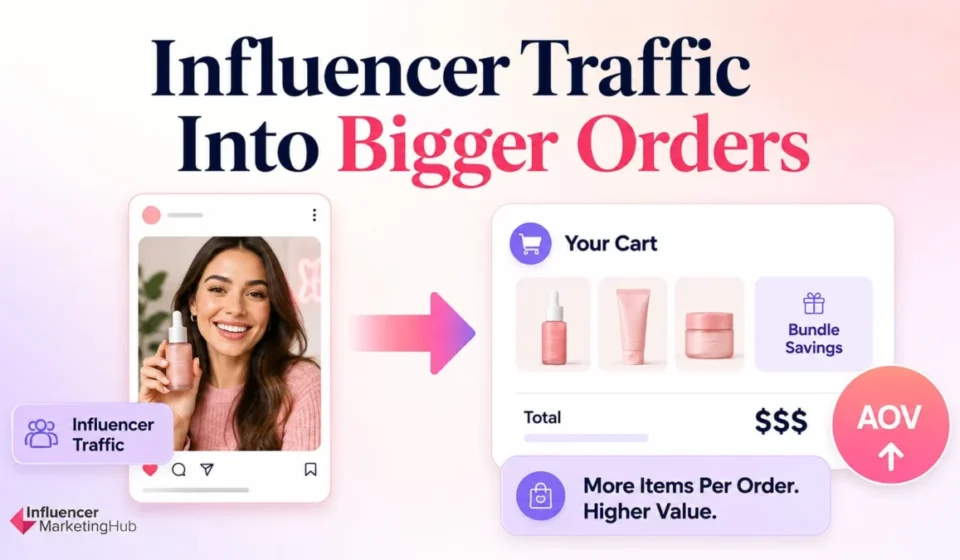
Maximizing E-commerce Revenue Through Strategic Influencer Marketing and Average Order Value Optimization

The landscape of digital retail has undergone a fundamental shift as brands move beyond the era of vanity metrics toward a more sophisticated focus on high-value customer acquisition and long-term profitability. While influencer marketing has traditionally been evaluated through the lens of reach, engagement, and click-through rates, e-commerce professionals are increasingly identifying a critical disconnect: the gap between a successful content campaign and a commercially viable transaction. For modern e-commerce brands, the primary challenge is no longer just generating traffic, but rather optimizing the Average Order Value (AOV) of influencer-referred customers. A creator may successfully drive thousands of visitors to a site, yet if those visitors purchase only a single low-margin item, the campaign’s return on investment (ROI) remains precarious. To solve this, brands are re-engineering the entire customer journey, from the initial social media touchpoint to the post-purchase retargeting sequence.
The Evolution of Influencer Commerce: A Chronology of Strategy
The integration of influencers into the e-commerce funnel has evolved through several distinct stages over the past decade. Understanding this timeline is essential for contextualizing the current industry emphasis on AOV.
- 2010–2015: The Awareness Era. Early influencer marketing was largely experimental. Brands focused on "shout-outs" and broad reach, often gifting products to bloggers and early Instagram adopters. Measurement was limited to likes and comments, with little direct correlation to sales data.
- 2016–2019: The Affiliate and Tracking Era. The introduction of trackable discount codes and UTM parameters allowed brands to attribute specific sales to individual creators. This period saw the rise of the "link in bio" culture, though the landing experiences remained generic, often leading customers to homepages rather than specific product sets.
- 2020–2022: The Pandemic-Driven E-commerce Boom. With physical retail restricted, influencer marketing became a primary acquisition channel. This era forced brands to professionalize their operations, leading to the rise of specialized platforms that manage creator relationships and automate payouts.
- 2023–Present: The Optimization and Profitability Era. As the cost of customer acquisition (CAC) via traditional paid social ads (Meta, Google) has climbed, brands have pivoted toward maximizing the value of every visitor. The current focus is on "performance-based creator partnerships," where the goal is to increase the basket size of every referred shopper.
Bridging the Narrative Gap in the Customer Journey
One of the most significant hurdles in modern influencer campaigns is the "narrative gap"—the psychological friction a customer feels when they move from a creator’s highly personalized content to a brand’s sterile, generic product page. Industry data suggests that conversion rates and order values drop significantly when the post-click experience does not mirror the pre-click promise.
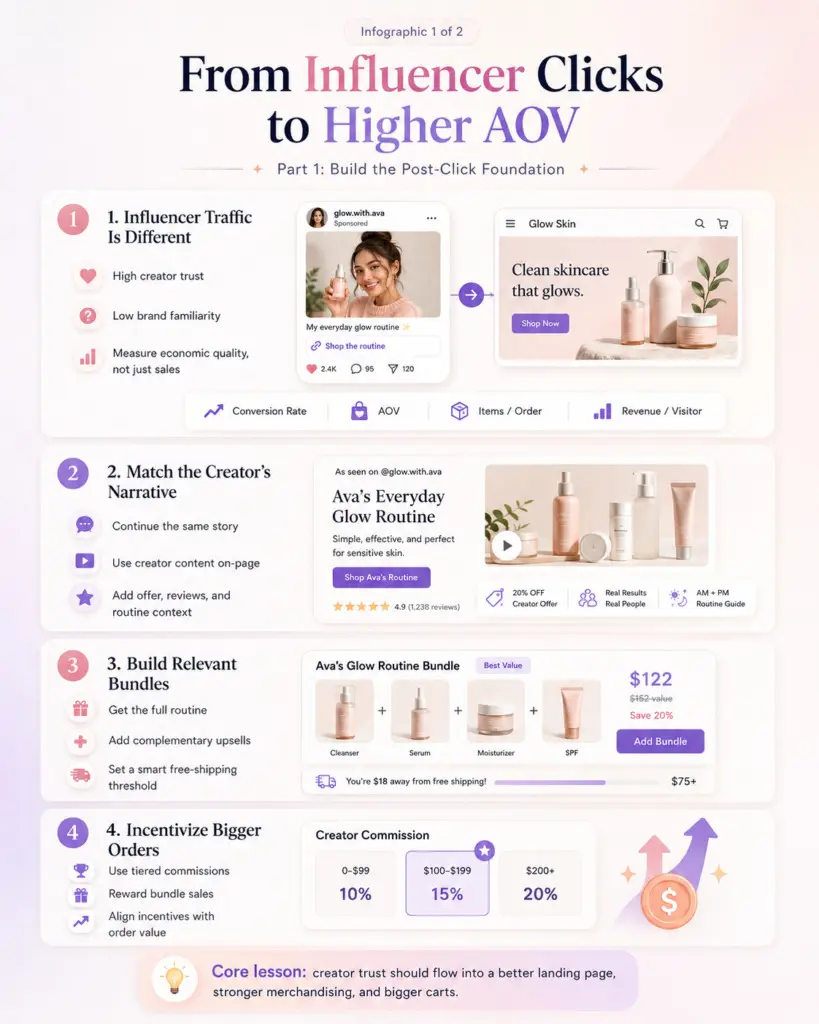
For instance, if a lifestyle influencer demonstrates a comprehensive morning routine involving five different products, but the link leads the consumer to a single product page for a cleanser, the momentum is lost. The consumer is forced to manually search for the other items, increasing the likelihood of cart abandonment. To mitigate this, leading retailers are now deploying dedicated "Creator Landing Pages." These pages often feature the influencer’s likeness (subject to usage rights), a curated list of the specific products mentioned, and even embedded video content that reiterates the use case. By maintaining narrative continuity, brands can effectively transition the trust built by the creator into a higher-value transaction.
The Role of Strategic Bundling in Increasing AOV
Data from e-commerce analytics platforms indicates that influencer-referred traffic is uniquely susceptible to bundling. Unlike "cold" traffic from search engines, which is often looking for a specific solution to a problem, influencer audiences are often buying into an aesthetic, a routine, or a lifestyle.
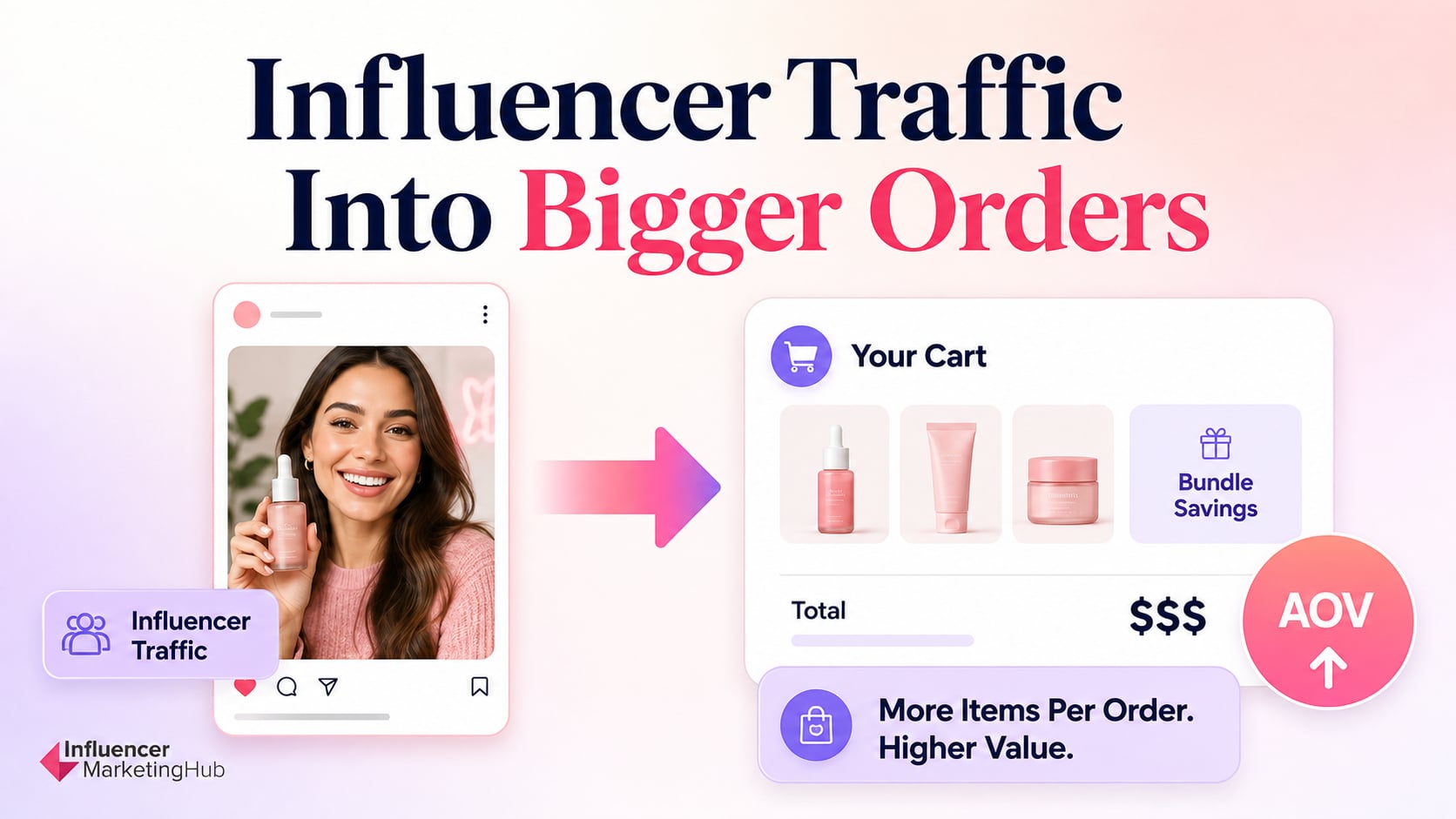
Market analysis shows that "Routine-Based Bundling" can increase AOV by as much as 30% compared to individual product sales. Brands are increasingly utilizing tools like Shopify-integrated apps to create dynamic bundles specifically for creator campaigns. These strategies include:
- The "Get the Look" Bundle: Common in fashion and home decor, this allows customers to buy an entire outfit or room set with one click.
- The "Complete Routine" Set: Frequently used in the skincare and supplement industries to group complementary products that work together.
- Tiered Discounts: Offering "Buy More, Save More" incentives specifically for influencer audiences (e.g., 10% off one item, 20% off three or more).
By aligning the merchandising strategy with the creator’s content, brands reduce the "choice overload" that often leads to lower order values.
Incentivizing Revenue Quality Through Commission Structures
The shift toward AOV optimization is also changing how creators are compensated. Traditionally, influencers were paid either a flat fee for a post or a flat percentage (e.g., 10%) of any resulting sale. However, these models do not always incentivize the creator to promote higher-value items or bundles.
Forward-thinking brands are now implementing tiered commission structures that reward revenue quality. Under these models, a creator might earn a base commission on all sales, but receive a "bonus" or a higher percentage if the customer’s order exceeds a certain dollar threshold. For example, a brand might offer a 12% commission on orders under $75, but increase that to 18% for any order over $150. This encourages creators to spend more time explaining the benefits of purchasing a full set rather than just a single "hero" product.
Supporting Data: The Economic Impact of High-Value Referrals
To understand the necessity of this shift, one must look at the comparative metrics between influencer traffic and traditional paid media. According to recent industry reports, while influencer-referred traffic may sometimes have a lower initial conversion rate than retargeting ads, the "Trust Factor" often results in a higher Customer Lifetime Value (CLV).
| Metric | Influencer Traffic (Optimized) | Paid Search (Standard) |
|---|---|---|
| Average Order Value | $85 – $110 | $60 – $75 |
| Items Per Order | 2.4 | 1.6 |
| New Customer Rate | 75% | 40% |
| 30-Day Retention | 22% | 15% |
The data suggests that when the post-click experience is optimized for AOV, influencer marketing becomes one of the most efficient ways to acquire high-value, loyal customers. The objective is to move beyond the "one-off purchase" and toward a comprehensive brand introduction.
Post-Click Retargeting and Lifecycle Marketing
The conclusion of an influencer’s social media post does not mark the end of the campaign’s potential. Analysts emphasize that a significant portion of influencer-driven revenue occurs in the days and weeks following the initial click. Many consumers "window shop" through an influencer link but do not convert immediately.
Effective e-commerce strategies now involve segmenting these visitors using creator-specific UTM parameters. This allows the brand to serve retargeting ads that feature the same influencer or the same product routine the customer originally viewed. Furthermore, capturing email or SMS leads on the creator-specific landing page allows for automated follow-up sequences. These sequences can provide additional social proof, answer frequently asked questions, and offer "AOV-boosting" recommendations tailored to the original point of interest.
Industry Implications and the Future of Performance Influencing
The shift toward AOV-centric influencer marketing has broader implications for the creator economy. As brands become more data-driven, the "middle class" of micro-influencers—those with 10,000 to 50,000 highly engaged followers—is seeing increased demand. These creators often have a more intimate relationship with their audience, making their recommendations for "full routines" or "bundles" more persuasive than those of mega-celebrities.
Furthermore, the demand for transparency and attribution is leading to a consolidation of the tech stack. Brands are looking for end-to-end solutions that can track a customer from an Instagram Story through to a specific bundle purchase and eventually into a repeat-purchase cycle.
Conclusion: A Holistic Approach to Influence
For e-commerce marketers, the path forward is clear: influencer marketing must be treated as a comprehensive acquisition channel rather than a mere top-of-funnel awareness tool. Success in this new paradigm requires a synergy between creative content and rigorous e-commerce merchandising.
By focusing on Average Order Value, brands can offset the rising costs of digital advertising and build a more sustainable growth model. This involves not only selecting the right creators but also meticulously designing the landing pages, bundling products for relevance, aligning commission incentives, and maintaining the "trust signal" through the entire lifecycle of the customer. When these elements are combined, influencer marketing transcends simple "clicks" and becomes a powerful engine for high-value revenue generation.