How to Hire a Shopify Plus Agency A Strategic Guide for High-Growth E-commerce Brands

The selection of a Shopify Plus agency represents one of the most significant capital expenditure decisions for high-growth direct-to-consumer (DTC) and business-to-business (B2B) brands. Within the rapidly evolving e-commerce landscape, where Shopify currently powers approximately 10% of all e-commerce in the United States, the transition to the enterprise-level Shopify Plus tier is often viewed as a prerequisite for scaling. However, industry data suggests that technical debt and failed migrations remain a pervasive risk. Jay Neyer, CEO of Lantern Sol and a veteran of over 500 Shopify builds, notes that a substantial portion of agency work involves "rescue projects"—rehabilitating stores left unfinished or dysfunctional by previous firms. The cost of a poor hiring decision extends far beyond the initial retainer; it encompasses lost growth momentum, technical instability during peak periods like Black Friday, and the significant expense of cleaning up legacy code.
The Economic Threshold: Determining the Necessity of Shopify Plus
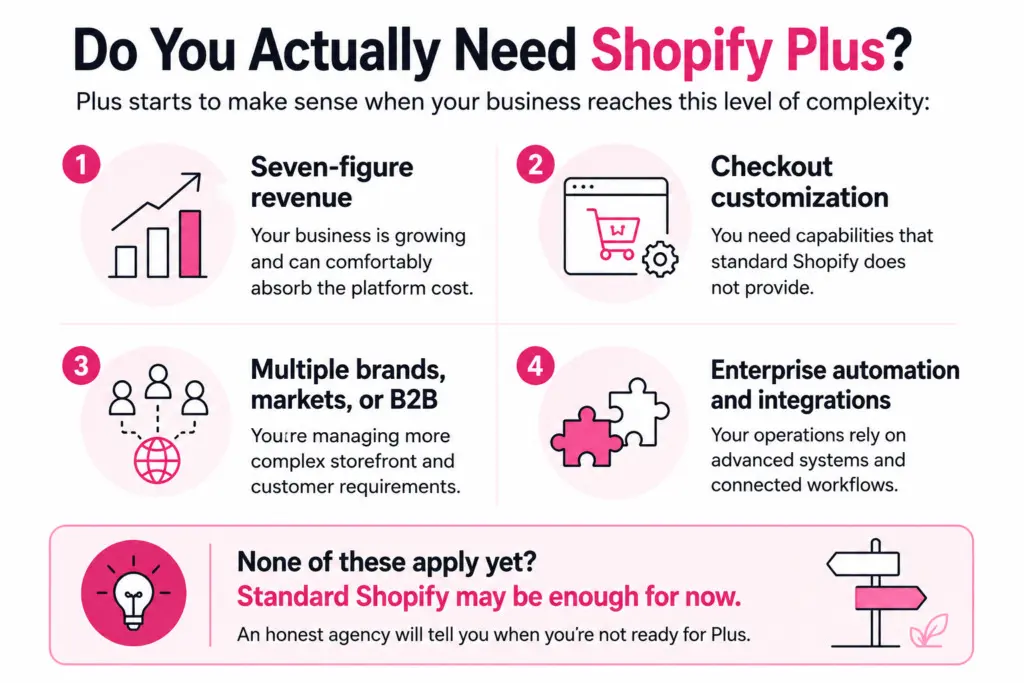
Before initiating an agency search, a brand must perform a rigorous cost-benefit analysis to determine if the Shopify Plus upgrade is financially justifiable. While standard Shopify plans are accessible for small to mid-market businesses, Shopify Plus is designed for high-volume merchants. The entry-level cost for Shopify Plus begins at approximately $2,000 per month, a significant jump from the $39 to $399 range of standard plans. For businesses exceeding $800,000 in monthly revenue, the pricing shifts to a platform fee of 0.25% of monthly GMV (Gross Merchandise Volume), capped at a maximum of $40,000 per month.
Industry experts identify four primary indicators that a brand is ready for the enterprise tier. First is the requirement for advanced checkout customization. Unlike standard plans, Shopify Plus allows merchants to utilize Shopify Functions and the Checkout Extensibility framework to modify the logic of the checkout process, offering personalized discounts, custom shipping rules, and integrated loyalty programs. Second is the need for internationalization. Plus allows for the creation of up to nine expansion stores, enabling brands to localize currency, language, and inventory for different global markets under a single contract. Third is high-volume automation; tools like Shopify Flow and Launchpad allow teams to automate backend workflows and schedule flash sales, reducing manual labor. Finally, the emergence of complex B2B requirements—such as wholesale price lists, net-payment terms, and company profiles—often necessitates the native B2B features exclusive to Shopify Plus.
The Technical Landscape: Defining Agency Competencies
The term "agency" encompasses a broad spectrum of service providers, ranging from creative-focused boutiques to high-end engineering firms. For a Shopify Plus migration or build, a brand requires a partner capable of unified strategy, design, and engineering. A comprehensive Shopify Plus agency must demonstrate proficiency in several critical areas. This includes UI/UX design optimized for conversion, data migration from legacy platforms (such as Magento, BigCommerce, or Salesforce Commerce Cloud), and complex systems integration.
Modern e-commerce infrastructure often requires the store to communicate seamlessly with Enterprise Resource Planning (ERP) systems like NetSuite or Microsoft Dynamics, Warehouse Management Systems (WMS), and Customer Relationship Management (CRM) tools. Furthermore, the rise of "headless commerce"—decoupling the frontend presentation layer from the backend commerce engine using technologies like Shopify Hydrogen and Oxygen—has introduced a new layer of technical complexity. Brands must distinguish between "marketing agencies" that focus on traffic acquisition and "development agencies" that focus on technical architecture. While both are necessary for growth, a failure in the underlying technical build will neutralize any marketing investment by depressing conversion rates and increasing site latency.
A Six-Point Framework for Agency Vetting
To mitigate the risk of project failure, industry leaders recommend a standardized vetting process. This framework prioritizes verifiable technical performance over aesthetic appeal.
1. Verification of Plus-Specific Experience
Shopify Plus is architecturally distinct from standard Shopify. Agencies must demonstrate a track record of handling "Plus-specific" features, such as Shopify Scripts (now transitioning to Functions) and advanced API usage. Prospective clients should inquire about the agency’s experience with high-concurrency events. An agency that primarily works with small-scale themes may lack the expertise to build a checkout process that remains stable during a product drop generating thousands of orders per minute.
2. Evidence-Based Performance Metrics
Case studies serve as a starting point, but direct client references are the gold standard for verification. Analysts recommend contacting at least three former or current clients of a similar revenue scale. Key questions should focus on whether the project stayed within the initial budget, the accuracy of the delivery timeline, and the measurable impact on performance metrics such as Page Load Speed (LCP), Conversion Rate (CR), and Average Order Value (AOV).
3. Technical Depth and Problem Solving
During the interview phase, brands should present a specific technical challenge—such as a complex inventory sync or a unique subscription model—to gauge the agency’s problem-solving capabilities. A sophisticated partner will discuss the trade-offs between different architectural approaches, such as the use of public apps versus custom-built private apps.
4. Project Management and Personnel Transparency
A common industry grievance is the "bait and switch," where senior partners lead the sales pitch, but junior developers execute the actual work. Contracts should specify the primary point of contact and the seniority level of the engineering team assigned to the account. Transparency regarding the project management methodology (e.g., Agile, Scrum, or Waterfall) is also essential for maintaining alignment on deliverables.
5. Pricing Structural Integrity
Shopify Plus builds are rarely inexpensive, with professional migrations typically ranging from $50,000 to over $250,000 depending on complexity. Brands should seek clear definitions of "in-scope" versus "out-of-scope" work. Fixed-fee models provide budget certainty, while time-and-materials models offer flexibility for evolving requirements. The presence of a "change order" protocol is a sign of a disciplined agency.
6. Strategic Pushback and Consultation
The most valuable agencies act as strategic consultants rather than mere order-takers. An agency that agrees with every client request without analyzing its impact on site performance or long-term maintainability is a liability. High-performing partners provide "strategic pushback," advising against features that may increase technical debt or degrade the user experience.
Identifying Red Flags in the Selection Process
The history of e-commerce is littered with failed digital transformations. Many of these failures can be traced back to early warning signs during the agency selection process. A primary red flag is the lack of a specialized portfolio. An agency that claims to be an expert in every platform (Magento, WooCommerce, Shopify, Wix) is often a generalist that lacks the deep technical knowledge required for the nuances of Shopify Plus.
Vague project scoping is another significant risk factor. If an agency cannot provide a detailed breakdown of the migration phases—discovery, design, development, UAT (User Acceptance Testing), and launch—the project is likely to suffer from "scope creep" and budget overruns. Additionally, the absence of a post-launch support plan is a critical oversight. E-commerce sites are dynamic environments; without a dedicated period for bug fixes and performance monitoring following a "go-live" event, brands are left vulnerable to technical glitches during the crucial first weeks of operation.
The Timeline and Chronology of a Professional Migration
A realistic timeline for a Shopify Plus migration is significantly longer than many founders anticipate. While a basic theme setup can be completed quickly, a full enterprise migration typically follows a 90-day to 120-day cycle:
- Phase 1: Discovery and Audit (Weeks 1-3): Analysis of current data structures, SEO equity, and third-party integrations.
- Phase 2: Architecture and Design (Weeks 4-6): Wireframing and UI design, focusing on mobile-first optimization and accessibility (ADA compliance).
- Phase 3: Development and Integration (Weeks 7-12): Backend engineering, custom app development, and the wiring of ERP/WMS systems.
- Phase 4: Data Migration and Testing (Weeks 13-15): Transfer of customer, product, and order history, followed by rigorous load testing and QA.
- Phase 5: Launch and Hyper-care (Week 16+): Controlled rollout and 24/7 monitoring to ensure stability.
Broader Implications: The Future of Enterprise E-commerce
As the e-commerce market matures, the role of the Shopify Plus agency is shifting from a "builder" to a "growth partner." The emergence of Artificial Intelligence (AI) in commerce—ranging from AI-driven product recommendations to automated customer service—requires agencies to stay at the forefront of technological shifts. Furthermore, as privacy regulations like GDPR and CCPA become more stringent, agencies must ensure that the technical architecture of the store prioritizes data security and compliance.
The decision to hire a Shopify Plus agency is ultimately a decision about risk management. In an era where a single hour of downtime on Black Friday can result in millions of dollars in lost revenue, the "cheapest" option is often the most expensive in the long run. Brands that prioritize technical rigor, verifiable track records, and strategic alignment in their agency partners are those most likely to successfully navigate the transition from a growing business to a global enterprise. By following a disciplined vetting process, founders and e-commerce directors can ensure that their move to Shopify Plus serves as a foundation for scalable, sustainable growth rather than a costly technical detour.