Bitcoin Reclaims Critical 200-Day Moving Average as Technical Indicators Signal End of Crypto Market Dead Zone

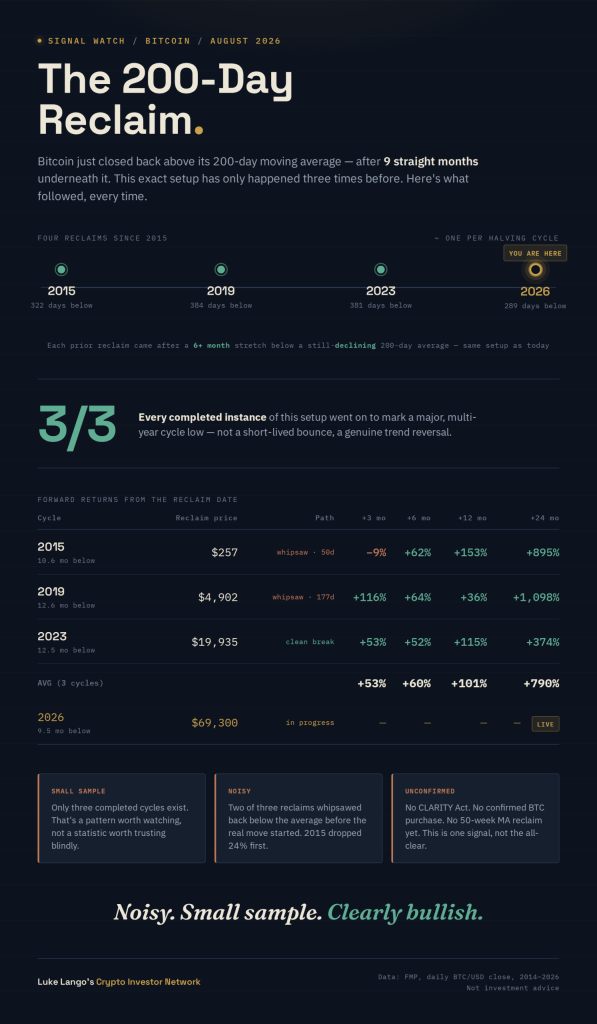
The digital asset market reached a significant technical inflection point last week as Bitcoin successfully reclaimed its 200-day moving average, a development that historical data suggests could mark the end of the post-halving "dead zone." This technical recovery, occurring for the first time since a "death cross" formed in late 2025, aligns with several macroeconomic and political catalysts that have injected fresh liquidity and optimism into the cryptocurrency ecosystem. Market analysts are closely monitoring this reclaim, noting that in the three previous instances where Bitcoin spent more than six months below a declining 200-day average before breaking back above it, the move signaled a definitive, multi-year cycle bottom rather than a temporary relief rally.
Technical Analysis of the 200-Day Moving Average Reclaim
On Wednesday, Bitcoin closed above its 200-day moving average (DMA), a metric widely regarded by institutional traders as a primary gauge of long-term trend health. This reclaim followed a period of sustained bearish pressure that began in November 2025. The significance of the 200-DMA lies in its ability to filter out short-term volatility and highlight the broader trajectory of the asset.
Quantitative analysis of Bitcoin’s trading history reveals that this specific setup—a reclaim of the 200-DMA after a six-month hiatus—has occurred only three times prior: in 2015, 2019, and 2023. In each of these historical precedents, the reclaim served as the foundation for a genuine trend reversal. However, analysts urge caution, noting that while the long-term outlook is bullish, the path is rarely linear. In 2015, for example, Bitcoin experienced a 24% "whipsaw" drawdown back below the average before the primary bull market took hold.
Currently, the 200-DMA is situated around the $69,000 level and is still slightly declining. Technical experts suggest that for this breakout to be considered structural rather than momentum-driven, the price must successfully retest and hold this level as support. A failure to maintain the $69,000 floor would indicate that the recent surge was fueled primarily by short-position liquidations rather than sustained spot buying.
Macroeconomic Drivers and the Short Squeeze Phenomenon
The catalyst for the recent price surge was not limited to technical factors; significant shifts in fiscal policy and market mechanics played a pivotal role. On August 19, Treasury Secretary Bessent announced a doubling of long-term bond buybacks, increasing the scale from $2 billion to at least $4 billion per operation. This move, aimed at stabilizing the Treasury market, had the secondary effect of loosening global liquidity conditions.
The announcement triggered a massive short squeeze in the crypto markets. Approximately $3 billion in short positions were liquidated within a 48-hour window as Bitcoin ripped through the $69,000 resistance level and pushed toward $75,000. While news from the political sphere provided the narrative for the rally, the liquidation of over-leveraged bearish bets provided the necessary mechanical force to propel the price through major technical hurdles.

Political and Regulatory Developments
The rally has been further bolstered by an evolving political landscape that is increasingly accommodating toward digital assets. A high-profile summit held at the White House on August 19 featured prominent crypto executives and administration officials. During the proceedings, President Trump signaled that his administration is "considering" sizable purchases of Bitcoin and other digital assets to serve as a strategic reserve.
While the rhetoric regarding a Strategic Bitcoin Reserve has remained consistent since the executive order of March 2025, the market’s reaction suggests a growing belief in the eventual implementation of such a policy. However, fundamental analysts point out that no formal budget authorization or timeline has been established, and the "budget-neutral constraint" remains a significant legislative hurdle.
On the regulatory front, the Commodity Futures Trading Commission (CFTC) recently convened its newly formed Innovation Advisory Committee. The 35-member committee includes CEOs from industry giants such as Coinbase, Robinhood, Polymarket, and Kalshi. The meeting focused on creating a compliant framework for offshore derivatives, with specific mention of bringing platforms like Hyperliquid onshore. Such moves are seen as essential for providing the institutional-grade infrastructure required for the next phase of market adoption.
The CLARITY Act and Legislative Timeline
Central to the fundamental bull case is the potential passage of the CLARITY Act. The Senate is scheduled to hold a cloture vote on the legislation on September 15. The Act seeks to provide a comprehensive regulatory framework for digital assets, clarifying the jurisdictional boundaries between the SEC and the CFTC and establishing clear guidelines for stablecoin issuers.
Current reports indicate that the vote remains highly contested. The legislation requires 60 votes to pass, and proponents are reportedly six Democratic votes short of a filibuster-proof majority. The passage of the CLARITY Act would represent a "fundamental signal" of market maturity, providing the legal certainty that many institutional investors have cited as a prerequisite for large-scale capital allocation.
Historical Context: The Halving Cycle and the Dead Zone
The current market behavior aligns closely with the "halving-cycle" model, which tracks Bitcoin’s price performance relative to its quadrennial halving events. The April 19, 2024, halving ushered in what analysts call the "interhalving dead zone," a period where the initial excitement of the supply cut fades, and the market waits for demand-side catalysts to materialize.
Comparing the current cycle to those of 2016 and 2020 shows that the 2024–2027 cycle has tracked lower on a normalized basis. This is consistent with the behavior of a maturing asset class; as Bitcoin’s market capitalization reaches the multi-trillion-dollar range, the percentage gains required to move the needle are significantly higher than in its early years.
The halving-cycle chart projects a potential cycle bottom in mid-to-late October 2026, followed by a robust recovery into 2027. If the recent 200-DMA reclaim holds, it would suggest that the market is moving out of the "dead zone" ahead of schedule, potentially front-running the historical recovery timeline.
Critical Thresholds and Confirmation Levels
Despite the encouraging technical signs, market veterans are waiting for further confirmation before declaring the bear market officially over. There is a "ladder of confirmation" that Bitcoin must climb to invalidate the remaining bearish arguments:
- The Structural Retest: Bitcoin must hold the $69,000 level during a period of cooling volatility. This would prove that the reclaim was not merely a "fakeout" driven by the short squeeze.
- The Support Cluster: A move above $85,000 is required to reclaim the support cluster formed in late 2025. This zone ($84,684–$86,537) acted as a pivot point before the breakdown in January.
- The 50-Week Moving Average: Reclaiming the 50-week moving average, currently situated near $82,000, is considered the "all-clear" signal by many trend-following funds.
Broader Economic Shifts: The XPANSE Thesis
The shift in the crypto market is occurring alongside broader transformations in the technology and industrial sectors. Analysts are increasingly focusing on the potential for "civilization-scale" wealth shifts, specifically regarding the future of Elon Musk’s corporate empire.
The "XPANSE" thesis suggests that Musk may be laying the groundwork for a historic merger between Tesla (TSLA) and SpaceX (SPCX). Such a consolidation would create a singular entity with unparalleled capabilities in artificial intelligence, autonomous transport, and aerospace infrastructure. Industry experts point to the increasing operational overlap between the two companies—ranging from the use of Tesla’s battery technology in SpaceX rockets to the integration of Starlink satellites with Tesla’s Full Self-Driving (FSD) neural networks.
Wall Street analysts and venture capital veterans have noted that a combined entity would likely dwarf the individual valuations of PayPal, Tesla, and SpaceX. While this remains speculative, the potential for such a merger represents the type of structural shift that investors are monitoring as they look beyond the current crypto cycle.
Conclusion and Market Outlook
The reclaim of the 200-day moving average represents the first piece of "real evidence" that the crypto market’s period of stagnation is ending. While the fundamental landscape requires further legislative and fiscal clarity—specifically regarding the CLARITY Act and the Strategic Bitcoin Reserve—the technical foundation is strengthening.
Investors are advised to remain objective, distinguishing between short-term momentum and structural trend reversals. The combination of increased Treasury liquidity, a more favorable regulatory environment, and historical cycle patterns points toward a shifting tide. As the market moves out of the dead zone, the focus shifts to the successful defense of newly reclaimed support levels and the broader macroeconomic environment that will dictate the pace of the next expansionary phase.