

The Paradox of Record Earnings and Market Contraction
The recent volatility in the semiconductor space is characterized by a "beat-and-drop" phenomenon, where companies report earnings that exceed analyst expectations only to see their share prices decline sharply. This trend was most visible in the performance of Taiwan Semiconductor Manufacturing Co. (TSMC), often considered the primary barometer for global AI demand. In its second-quarter report, TSMC revealed a 36% year-over-year revenue increase to $40.20 billion, with net income surging by 77%. Furthermore, the company’s management revised its full-year revenue growth outlook upward to over 40%. Despite these robust figures, the stock experienced a 5% sell-off immediately following the announcement.
This pattern extended to other industry leaders. Samsung Electronics reported a staggering 15-fold increase in operating profit, yet its shares declined by approximately 8%. Similarly, ASML, the Dutch giant that maintains a monopoly on the extreme ultraviolet (EUV) lithography machines required to make the world’s most advanced chips, saw its stock drop 5% after its earnings release. The disconnect between operational excellence and market valuation suggests that investors are no longer focused on current profitability, but are instead preoccupied with the "capex-taker" problem.
Analyzing the Capex-Taker Constraint and the Hyperscaler Influence
The "capex-taker" problem refers to the structural position of supply-chain companies within the broader technology ecosystem. Firms like TSMC, ASML, and Samsung operate based on capital expenditure (capex) decisions made by their largest customers—primarily the "hyperscalers" such as Alphabet (Google), Microsoft, Meta, and Amazon. Because semiconductor manufacturers build capacity against orders placed months or even years in advance, they provide high visibility into current and near-term demand but offer limited insight into the spending intentions of big tech firms for 2027 and beyond.
Market analysts, including Luke Lango, editor of Innovation Investor, suggest that the current bear market in semiconductors is not a reflection of failing demand today, but a crisis of confidence regarding the "outer years" of the AI buildout. The central question facing the market is whether the massive investments currently being funneled into AI data centers will continue at the same trajectory once the initial infrastructure is in place. Until the demand-side leaders—the hyperscalers—confirm their long-term commitment to these spending levels, the semiconductor sector may remain under pressure.

Chronology of the AI Market Transition
The transition from an AI-driven bull market to the current period of uncertainty has unfolded rapidly over the final weeks of July 2024. The following timeline outlines the key events:
- Early July 2024: The Philadelphia Semiconductor Index reaches a cycle high, fueled by optimism surrounding the integration of generative AI across enterprise software.
- Mid-July 2024: ASML and TSMC release second-quarter earnings. Despite record revenues and increased guidance, institutional selling begins, signaling a shift in market psychology.
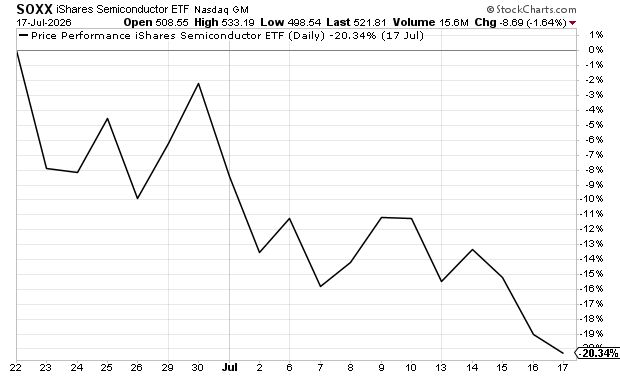
- July 19, 2024: The SOXX ETF officially dips into bear market territory, falling 20% from its recent highs during intraday trading.
- Late July 2024: Market focus shifts toward the upcoming earnings reports of Alphabet, Microsoft, Meta, and Amazon. Analysts identify these reports as the "demand-side confirmation" needed to stabilize the tech sector.
The market is currently awaiting specific answers regarding whether these tech giants see a clear return on investment (ROI) from their AI spending, whether they intend to increase their 2025 budgets, and if their internal roadmaps for 2027-2028 remain unchanged.
Sector Rotation: The Resurgence of Oil Refiners
As capital exits the volatile semiconductor space, it has increasingly sought refuge in the energy sector, specifically among oil refiners. Veteran trader Jonathan Rose of Masters in Trading Live has identified a significant trend in "crack spreads"—the pricing difference between a barrel of crude oil and the petroleum products refined from it. The crack spread serves as the primary indicator of a refiner’s profit margin.
Recent data shows a violent and rapid expansion in these spreads, which has historically served as a leading indicator for stock price appreciation in the refining industry. Over the last thirty days, several prominent refiners have seen substantial gains:
- CVR Energy (CVI): Surged 67%
- PBF Energy (PBF): Increased 38%
- HF Sinclair (DINO): Rose 25%
- Phillips 66 (PSX): Gained 24%
This rotation suggests that institutional investors are moving toward "real-economy" assets with tangible cash flows and expanding margins, contrasting with the speculative growth valuations seen in the tech sector. The strength of the move in refining margins indicates that despite broader economic concerns, demand for fuel and industrial petroleum products remains resilient.
Defensive Positioning via Dividend Achievers
In addition to the energy sector, defensive "blue-chip" equities have seen a resurgence. Brian Hunt, editor of Money & Megatrends, notes that the Invesco Dividend Achievers ETF (PFM) recently reached a new all-time high, even as the AI trade faltered. This ETF tracks companies that have increased their annual dividend payments for at least ten consecutive years.
The constituents of this index include some of the most stable corporations in the global economy, such as Johnson & Johnson, Visa, Coca-Cola, Procter & Gamble, ExxonMobil, and Walmart. These firms are often referred to as "Dividend Achievers" because their business models have proven capable of weathering recessions, inflationary periods, and global supply chain disruptions. The flight to these stocks represents a "flight to quality," where investors prioritize capital preservation and consistent income over the high-beta volatility of the technology sector.
Broader Market Implications and Future Outlook
The current market environment is a reminder that financial markets rarely move as a single, monolithic entity. The "sloshing" of capital between sectors—from AI infrastructure to oil refiners and then to defensive dividend payers—illustrates the constant search for value and safety.
The immediate future of the AI bull market likely hinges on the earnings calls of the four major hyperscalers scheduled for the final week of July 2024. If Google, Microsoft, Meta, and Amazon provide definitive evidence that AI spending is translating into revenue growth or operational efficiency, the semiconductor bear market may be short-lived. A confirmation of durable spending plans for 2027 and 2028 would likely trigger a sharp recovery rally in firms like TSMC and ASML, which are currently trading at lower valuation multiples than they were earlier in the year.
However, if these companies signal a plateau in capital expenditure or express caution regarding the pace of AI monetization, the rotation into energy and defensive blue chips could accelerate. For the broader market, the health of the "Dividend Achievers" and the energy sector provides a necessary cushion, suggesting that while the leadership of the market may be changing, the underlying appetite for equity investment remains intact. Investors are currently navigating a transition from a market driven by "momentum and promise" to one focused on "margins and sustainability." The outcome of the upcoming earnings season will determine whether the AI narrative remains the dominant theme for the remainder of the decade or if the market is entering a more diversified, value-oriented phase.