Apple Unveils MacBook Pro with Groundbreaking PROLED XDR Display, Tandem OLED Technology, and Touchscreen Integration

Apple has officially launched its latest MacBook Pro lineup, headlined by a revolutionary new model featuring a PROLED XDR Display with tandem OLED technology. This cutting-edge display, coupled with an integrated touchscreen, the intuitive Dynamic Island, and a refined, lighter design, marks a significant evolution for the MacBook Pro. The new PROLED XDR models will coexist with the established Liquid Retina XDR variants, which were first introduced in March 2026. Both generations of MacBook Pro are powered by the potent M5 Pro and M5 Max chips, ensuring that performance remains a cornerstone across the product line.
The introduction of the PROLED XDR display comes with a premium, with these new models starting at $400 more than their Liquid Retina XDR counterparts for equivalent configurations. The 14-inch MacBook Pro with the M5 Pro chip now begins at $2,499 for the Liquid Retina XDR version and $2,899 for the PROLED XDR model. For the larger 16-inch variant, pricing starts at $2,999 and $3,399, respectively. While core specifications such as chip options, memory capacities, and battery life remain consistent between the two display technologies, the decision for consumers will largely hinge on the perceived value of the advanced display technology, the novel touch interaction, and the subtle improvements in portability.
A Deep Dive into Display Technology: Liquid Retina XDR vs. PROLED XDR
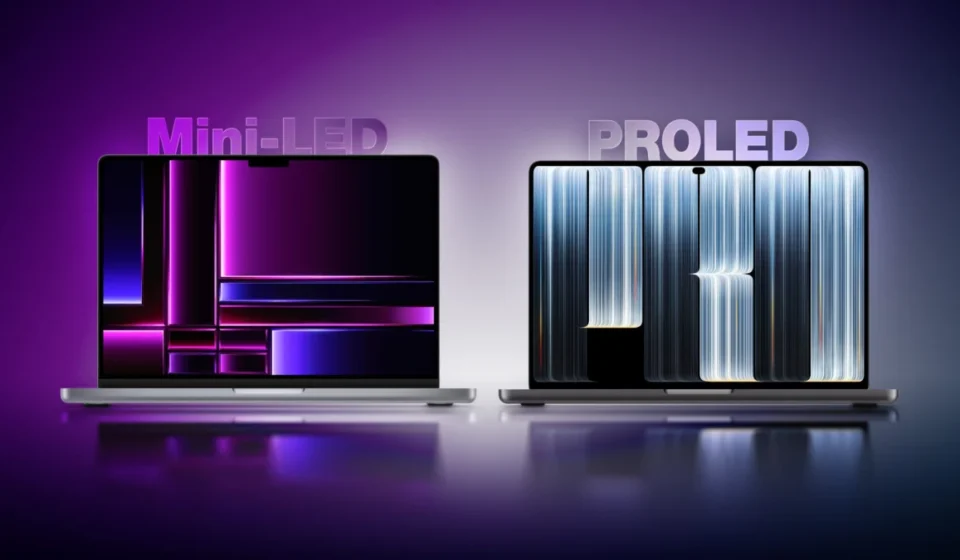
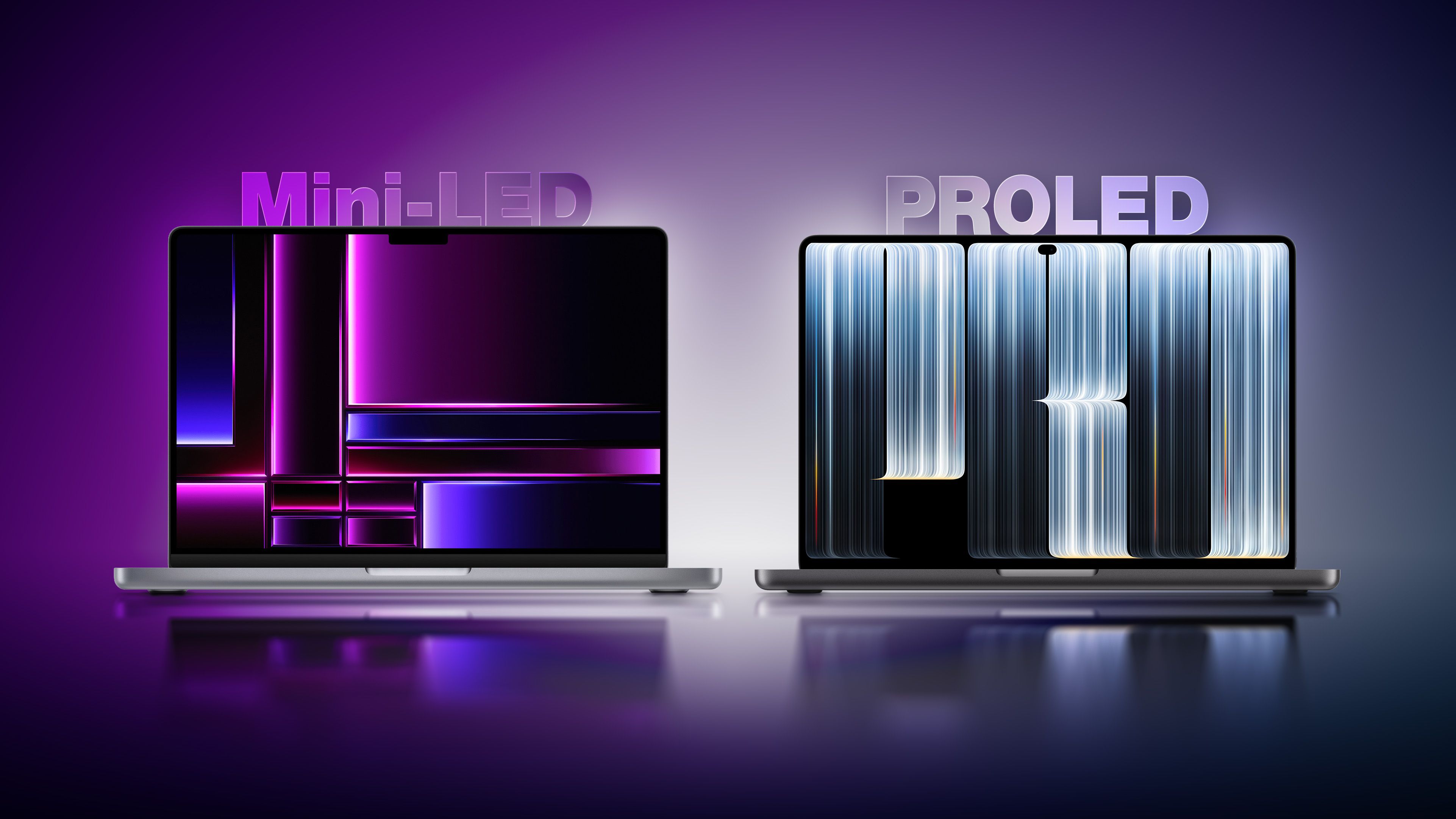
The most striking differentiation between the new MacBook Pro models lies in their display technology. Apple’s Liquid Retina XDR, a sophisticated Mini-LED-backlit LCD, employs local dimming through zone-based backlighting to achieve impressive contrast ratios and HDR brightness. In contrast, the new PROLED XDR display revolutionizes visual fidelity with tandem OLED technology. This architecture utilizes two layers of self-illuminating pixels, enabling individual pixel control for unparalleled contrast and true blacks.
Key Display Specifications:
| Feature | Liquid Retina XDR (MacBook Pro) | PROLED XDR (MacBook Pro) |
|---|---|---|
| Technology | Mini-LED-backlit LCD with local dimming | Tandem OLED with two self-illuminating pixel layers |
| Illumination | Zone-based backlighting | Individual pixel illumination |
| Processing | N/A | Dedicated display engine, compensating for content, temperature, environment, and pixel usage |
| Contrast Ratio | 1,000,000:1 | 10,000,000:1 |
| Peak HDR Brightness | Up to 1,600 nits | Up to 2,000 nits |
| SDR Brightness | Up to 1,000 nits (outdoor) | Up to 1,000 nits (sustained full-screen), 2,000 nits (peak outdoor) |
| Color Gamut | P3 wide color gamut | P3 and Adobe RGB wide color gamuts |
| 14-inch Resolution | 3024 x 1964 | 3024 x 1986 |
| 16-inch Resolution | 3456 x 2234 | 3472 x 2266 |
| Design Elements | Wider display borders, camera notch | Slimmer borders, smaller camera cutout with Dynamic Island |
| Display Corners | Rounded top, square bottom | Rounded corners on all four sides |
| Surface Treatment | Standard or optional nano-texture | Anti-reflective, oleophobic coating, optional nano-texture cover glass |
| Touch Integration | N/A | Multi-Touch sensor integrated into the display panel |
While both display technologies offer up to 1,000 nits of sustained full-screen HDR brightness, the PROLED XDR’s higher peak brightness of 2,000 nits promises more impactful highlights in HDR content. Both models maintain a minimum brightness of 1 nit, feature True Tone technology, support a billion colors, and offer a pixel density of 254 pixels per inch.
Enhanced Color Workflows and Reference Modes
The PROLED XDR display introduces expanded capabilities for creative professionals through its enhanced color workflows and reference modes. While the Liquid Retina XDR models already provide robust options for various professional applications, the new display broadens this spectrum.
Reference Mode Differences:
| Feature | Liquid Retina XDR (MacBook Pro) | PROLED XDR (MacBook Pro) |
|---|---|---|
| Primary Display Mode | Apple XDR Display (P3-1600 nits) | Apple XDR Display (P3-2000 nits), Apple XDR Display (P3 + Adobe RGB-2000 nits) |
| Design and Print | Design and Print (P3-D50) | Design and Print (P3-D50), Design and Print (Adobe RGB-D50) |
| Photography | Photography (P3-D65) | Photography (P3-D65), Photography (Adobe RGB-D65), HDR Photography (P3-D65) |
| Medical Imaging | N/A | Medical Imaging (DICOM-350 nits) for non-diagnostic review, Medical Imaging (DICOM-600 nits) for non-diagnostic review |
| Color Consistency | N/A | Apple Color Matching Function (CMF) 2026 for visual consistency with iPhone 18 Pro and Studio Display XDR |
Both MacBook Pro generations continue to support reference modes for HDR video, broadcast television, digital cinema, and sRGB workflows, and both are compatible with Pro Display Calibrator. The addition of Adobe RGB support and specialized medical imaging modes on the PROLED XDR models directly addresses the needs of a broader range of professional users, potentially streamlining color-critical workflows and reducing the reliance on external reference monitors.
A Lighter, Sleeker Design: Dimensions and Materials
Apple has not only enhanced the display technology but also refined the physical design of the MacBook Pro. The PROLED XDR models are noticeably lighter, with a more substantial weight reduction compared to the incremental changes in thickness.
Dimensional and Weight Comparison:
| Dimension | Model | Liquid Retina XDR | PROLED XDR | Reduction (%) |
|---|---|---|---|---|
| 14-inch Height | 1.55 cm | 1.50 cm | 3.2% | |
| 14-inch Width | 31.26 cm | 31.08 cm | 0.6% | |
| 14-inch Depth | 22.12 cm | 21.63 cm | 2.2% | |
| 14-inch M5 Pro Weight | 1.60 kg | 1.38 kg | 13.8% | |
| 14-inch M5 Max Weight | 1.62 kg | 1.40 kg | 13.6% | |
| 16-inch Height | 1.68 cm | 1.60 cm | 4.8% | |
| 16-inch Width | 35.57 cm | 35.55 cm | 0.1% | |
| 16-inch Depth | 24.81 cm | 24.42 cm | 1.6% | |
| 16-inch M5 Pro Weight | 2.14 kg | 1.82 kg | 15.0% | |
| 16-inch M5 Max Weight | 2.15 kg | 1.84 kg | 14.4% |
These design refinements extend to the internal architecture. The PROLED XDR MacBook Pros feature a redesigned hinge engineered for enhanced stability during touchscreen use. The thermal architecture has also been re-engineered to better dissipate heat away from the display, ensuring sustained performance from the M5 Pro and M5 Max chips. A subtle yet notable aesthetic change is the illuminated rear Apple logo on the PROLED XDR models, a departure from the non-illuminated logo on the Liquid Retina XDR versions.
In terms of environmental considerations, the PROLED XDR models showcase Apple’s continued commitment to sustainability. They boast 55% recycled content, an increase from the 45% found in the Liquid Retina XDR models. A significant milestone is the use of 100% recycled tantalum in multiple capacitors, a first for Apple products.
Advancements in Audio and Camera Systems
The audio and camera systems have also received notable upgrades in the PROLED XDR MacBook Pro. The redesigned woofers deliver 50% deeper bass, providing a richer and more immersive audio experience. The new tweeter design optimizes sound dispersion for improved clarity. Furthermore, dedicated audio tuning for closed-lid use with an external display enhances versatility for professionals who frequently connect to external monitors.
The 12MP Center Stage camera, a staple of recent MacBook Pro generations, benefits from advanced video stabilization in the PROLED XDR models. This enhancement is particularly beneficial during touchscreen use, helping to mitigate camera shake and produce a smoother video feed. While the core camera resolution and computational video features remain, the improved stabilization adds a layer of polish for video conferencing and content creation.
Expanded Storage and Connectivity Options
For users with demanding storage needs, the PROLED XDR MacBook Pro with the M5 Max chip now offers an expanded internal storage option of up to 16TB, a significant leap from the previous 8TB maximum. This addresses a critical requirement for professionals working with large datasets, high-resolution video, or extensive creative projects.
External display support also sees a modest upgrade. The M5 Pro chip now supports three external 4K displays at up to 165Hz, an increase from 144Hz. Similarly, the M5 Max chip supports four external 4K displays at up to 165Hz. A new feature for professionals is the inclusion of Genlock, which synchronizes display refresh rates with camera capture, crucial for broadcast and high-end video production workflows.
Battery capacity sees a minor adjustment, with the 14-inch PROLED XDR model featuring a slightly larger 72.6Wh battery compared to the 72.4Wh of its Liquid Retina XDR counterpart. However, this does not translate to increased endurance. The 16-inch M5 Max PROLED XDR model now recommends a higher 94W charging brick, up from 70W, likely to support sustained performance under heavy loads.
The Touchscreen Revolution: Integrated Multi-Touch and Dynamic Island
The integration of a Multi-Touch sensor directly into the PROLED XDR display panel is a transformative feature. This approach reduces latency and bulk compared to layered touch solutions, offering a more responsive and seamless touch experience. macOS has been updated to translate onscreen touches into clicks for existing applications, ensuring compatibility. New touch-specific interactions and gesture APIs allow for more intuitive control, including double-tapping to fill screens and flicking to tile windows.
Complementing the touchscreen is the Dynamic Island, a feature that debuted on iPhones and is now making its way to the MacBook Pro. This interactive area at the top of the display dynamically adapts to display alerts, notifications, and ongoing activities such as music playback, phone calls, and AirDrop requests. It also serves as a hub for Siri AI when available and enabled, integrating Spotlight search. This fusion of touch and dynamic information display promises a more fluid and engaging user interface.
Pricing and Availability: A Premium for Innovation
The new MacBook Pro models with PROLED XDR displays are positioned as premium offerings. The $400 starting price premium is applied across equivalent screen sizes and chip configurations.
U.S. Starting Prices:
| Configuration | Liquid Retina XDR | PROLED XDR |
|---|---|---|
| 14-inch M5 Pro | $2,499 | $2,899 |
| 16-inch M5 Pro | $2,999 | $3,399 |
| 14-inch M5 Max | $4,099 | $4,499 |
| 16-inch M5 Max | $4,399 | $4,799 |
The Liquid Retina XDR models remain available in Apple’s lineup. Current pricing reflects increases since their March 2026 introduction, meaning the initial launch-price premium for PROLED is somewhat exaggerated when comparing current figures. The PROLED XDR models officially launched on November 6, 2026, following the March 11, 2026, release of the Liquid Retina XDR variants.
Is It Worth the Upgrade? An Analysis for Consumers
For existing owners of M5 Pro and M5 Max MacBook Pros, a compelling reason to upgrade is not immediately apparent based solely on processing power. Both display generations share the same M5 Pro and M5 Max chips, meaning equivalent configurations will offer identical computational performance. Maximum memory capacity and battery life have also not seen significant increases.
However, specific user segments stand to benefit significantly. Professionals requiring the advanced capabilities of the OLED display, such as the expanded color gamut (Adobe RGB support), specialized reference modes for photography and design, or the substantial 16TB storage option on M5 Max models, will find strong justifications for an upgrade. The genlock feature is another critical addition for high-end video professionals.
The touchscreen is a notable enhancement, though its standalone appeal for justifying an immediate upgrade from a recent MacBook Pro is debatable for most users. The reduced weight, particularly in the 16-inch models, may appeal to frequent travelers, but it remains a secondary consideration for the majority of users given the incremental nature of the change.
The upgrade case becomes stronger for users transitioning from older MacBook Pro generations (M1, M2, or M3). For these users, the performance leap offered by the M5 series chips, combined with the new display technologies and design, presents a more substantial leap forward, especially if their current machine is struggling with demanding tasks or lacks sufficient memory or storage.
Looking ahead, users who are not in immediate need of the latest advancements might consider waiting. Reports suggest that M7 Pro and M7 Max models are anticipated for late 2027, potentially offering a significant chip upgrade alongside the new display and design elements introduced in this generation.
Making the Choice: Which MacBook Pro is Right for You?
For consumers in the market for a new MacBook Pro and for whom the $400 premium is manageable, the PROLED XDR model emerges as the more compelling choice, particularly if the built-in display will be a primary interface. The OLED panel itself is the core differentiator, offering superior visual fidelity. The addition of touch input, the refined design with reduced weight, and the enhanced audio system contribute to a more premium and versatile user experience. Professionals whose workflows demand the advanced display and production capabilities will find the PROLED XDR model to be the clear leader.
The Liquid Retina XDR model remains a sensible option, especially when available through discounts that create a significant cost saving. It is a particularly good choice for users who predominantly work with external monitors. However, it is important to acknowledge that this model is based on a five-year-old design paradigm. Nevertheless, it can still be the superior purchase if the savings allow users to configure their MacBook Pro with the memory or chip specifications that best suit their specific workload. The decision ultimately balances immediate technological advantages against long-term value and budget considerations.