
Elon Musk and SpaceX Pivot Toward Orbital Artificial Intelligence with Planned 2027 Starmind Satellite Launch and Strategic Supplier Partnerships

Space Exploration Technologies Corp., the aerospace manufacturer commonly known as SpaceX, has officially set a target for the final quarter of 2027 to launch its inaugural "Starmind" artificial intelligence satellite. This initiative represents a fundamental shift in the architecture of the global AI industry, moving high-performance computing from terrestrial data centers into Earth’s orbit. According to industry reports and strategic filings, the project will integrate advanced processing hardware from Nvidia Corp., marking a significant collaboration between the world’s leading AI chipmaker and the dominant private space enterprise.
This strategic pivot comes at a time when the infrastructure requirements for artificial intelligence are reaching a critical threshold on Earth. As large language models and generative AI applications proliferate, the demand for electricity, cooling water, and physical real estate has surged, leading to regulatory and logistical bottlenecks. By transitioning a portion of AI compute capacity to space, the Musk-led empire seeks to bypass these terrestrial constraints while creating a new ecosystem of specialized suppliers.
Historical Precedent: The Shift to Offshore Frontiers
The move to space-based AI mirrors historical shifts in the energy sector, specifically the transition from land-based to offshore oil drilling. In 1947, Kerr-McGee Oil Industries successfully completed the Kermac No. 16 well nearly 10 miles off the coast of Louisiana. At the time, the concept of drilling for oil out of sight of land was viewed with skepticism by traditional industry players. However, the success of Kermac No. 16 proved that moving operations into more challenging environments could unlock immense resources.
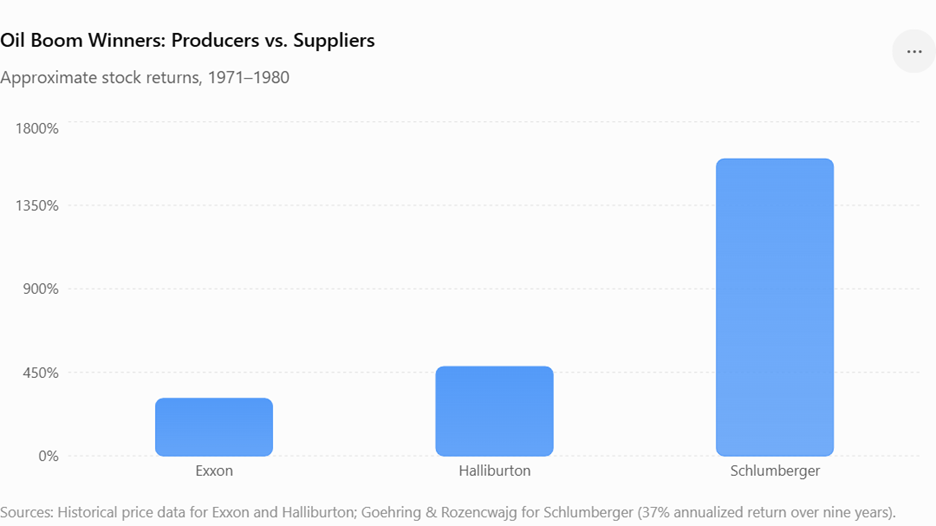
History shows that while the primary "pioneers" like Kerr-McGee or Exxon captured significant market share, the secondary market of suppliers often saw even more dramatic growth. During the oil boom of the 1970s, while ExxonMobil Corp. (XOM) shares rose by approximately 300%, companies that provided the essential infrastructure for offshore operations saw higher relative gains. Halliburton Co. (HAL), which supplied drilling equipment and services, saw its stock rise nearly 500% in the same period. Similarly, Schlumberger Ltd. (SLB), which specialized in sophisticated oilfield technology, achieved a compounded annual growth rate of roughly 37% between 1971 and 1980, effectively turning a $1 investment into $17.
Market analysts suggest that the "orbital AI" frontier will follow a similar trajectory. While SpaceX and xAI—Musk’s dedicated artificial intelligence firm—are the visible leaders, the underlying infrastructure will depend on a specialized supply chain capable of producing hardware that can withstand the rigors of the space environment.
The Economic and Logistical Imperative for Space-Based AI
The primary driver for moving AI into orbit is the escalating resource cost of terrestrial data centers. Current projections indicate that AI data centers could consume as much as 9% of total United States electricity generation by 2030, up from roughly 4% today. Furthermore, the cooling requirements for high-density GPU clusters are immense; a large data center can consume millions of gallons of water daily.

Space offers several unique advantages that address these challenges:
- Uninterrupted Solar Energy: Above the Earth’s atmosphere, solar panels are not subject to weather patterns, day-night cycles (in specific orbits), or atmospheric filtration. This allows for significantly higher energy density collection than terrestrial solar farms.
- Thermal Management: While vacuum cooling presents engineering challenges, the vastness of space provides a unique environment for radiant heat dissipation, provided the satellite architecture is properly designed.
- Real Estate and Regulation: Orbital slots do not face the same local zoning laws, "Not In My Backyard" (NIMBY) protests, or land-use taxes that currently slow the construction of massive data center campuses in Northern Virginia, Texas, or Arizona.
- Edge Computing for Satellite Data: Currently, Earth-imaging and surveillance satellites must transmit massive amounts of raw data to ground stations for processing. This creates latency and consumes bandwidth. By placing AI "on the edge" in orbit, satellites can analyze data in real-time, transmitting only the relevant insights or actionable intelligence back to Earth.
Technical Challenges and the Specialized Supply Chain
Launching AI hardware into space is not as simple as placing a standard server rack into a rocket fairing. The environment of Low Earth Orbit (LEO) presents three primary obstacles: radiation, thermal extremes, and the physical stress of launch.
Radiation-hardened electronics are essential because high-energy particles in space can cause "bit flips" or permanent hardware damage to standard silicon wafers. This creates a high-barrier-to-entry market for companies like Microchip Technology Inc. (MCHP), which specializes in "rad-hard" components designed for long-term reliability in harsh environments.
Furthermore, power systems in space must be more efficient and robust than their terrestrial counterparts. Redwire Corp. (RDW), a company that has already provided solar arrays for the International Space Station (ISS), is frequently cited by analysts as a critical player in the power-generation segment of this new industry. As AI satellites require kilowatts rather than watts, the demand for advanced deployable solar structures is expected to scale exponentially.
The logistics of deployment also favor established launch providers and satellite bus manufacturers. Rocket Lab USA Inc. (RKLB) has emerged as a key competitor and potential partner in this space, offering both launch services and satellite components. Additionally, Planet Labs PBC (PL) represents the demand side of this equation; as an operator of a massive Earth-imaging constellation, Planet Labs stands to benefit significantly from onboard AI that can process images of wildfires, military movements, or agricultural changes instantaneously.
Timeline and Strategic Milestones
The roadmap for the "Starmind" project and the broader integration of Musk’s AI empire involves several key dates that investors and industry observers are monitoring closely.
- September 2024: Industry analysts have identified September 24 as a significant date for SpaceX, potentially involving regulatory filings or a major milestone for the Starship launch system. Starship is viewed as the "enabler" for orbital AI, as its massive payload capacity and low cost-per-kilogram are necessary to make heavy AI satellites economically viable.
- Late 2024 – 2025: Increased testing of Nvidia’s Blackwell architecture in simulated space environments.
- 2026: Launch of prototype "edge-compute" nodes on Starlink satellites to test software integration between xAI’s models and SpaceX’s orbital network.
- Q4 2027: The scheduled launch of the first dedicated Starmind AI satellite.
Market Analysis: The "Vertical AI" Strategy
Senior Investment Analyst Luke Lango of InvestorPlace has characterized Musk’s approach as a "Vertical AI Masterplan." This strategy involves the total integration of the AI stack, from the silicon level (Nvidia/Tesla chips) to the training data (X/Twitter) to the compute infrastructure (SpaceX/Starlink) and finally to the end-use applications (Tesla FSD, Optimus robots, and xAI’s Grok).
Lango notes that while Musk’s direct companies are private (with the exception of Tesla), the publicly traded suppliers often provide a more accessible way for the broader market to participate in this technological shift. "The biggest gains stand to be made outside of Elon’s direct orbit," Lango stated in a recent briefing. He pointed to historical examples where companies like Advanced Micro Devices (AMD) and Palantir Technologies (PLTR) saw massive appreciation as they became integral to the broader AI and defense infrastructure.
The upcoming "Vertical AI" workshop, scheduled for Wednesday, September 9, is expected to provide more granular detail on the specific bottlenecks in this plan and the companies positioned to solve them. Analysts suggest that the workshop will focus on the "check-writers"—the large-cap firms that must spend billions on infrastructure—and the "check-collectors"—the smaller, specialized firms that hold the patents and manufacturing capabilities for space-grade hardware.
Broader Implications and Geopolitical Context
The transition to orbital AI has implications beyond the financial markets; it is also a matter of national security and geopolitical competition. The ability to process intelligence in orbit gives a nation a significant "decision advantage" in military conflicts. If a satellite constellation can detect a missile launch and calculate its trajectory without waiting for a ground-link, the response time is cut from minutes to seconds.
Consequently, the U.S. Department of Defense and the Space Force have shown increasing interest in "proliferated LEO" architectures that incorporate AI. The SpaceX Starmind project may eventually serve dual-purpose roles, providing commercial AI services while also supporting government contracts for high-speed orbital data processing.
As the industry moves toward the 2027 launch target, the focus will remain on the reliability of the hardware and the cost-effectiveness of the Starship launch platform. If Musk can successfully replicate the cost-efficiency of offshore oil drilling in the realm of orbital computing, the 2027 Starmind launch may be remembered as the moment the AI industry truly broke free from its terrestrial limits.