Google Pixel 10a Benchmarks Reveal Performance Stagnation, Raise Long-Term Viability Questions

The newly released Google Pixel 10a has entered the competitive mid-range smartphone market with a notable divergence from its predecessors’ established hardware strategy. Unlike previous "a" series iterations that typically featured the flagship processor from the preceding year, the Pixel 10a is powered by the Tensor G4, the same chip found in last year’s Pixel 9a. This decision means the device foregoes the anticipated Tensor G5, which powers Google’s latest flagship Pixel 10, sparking immediate discussions among industry analysts and consumers regarding its performance ceiling and long-term relevance. While the Tensor G4 remains a capable processor for daily tasks, its inclusion raises questions about Google’s commitment to delivering incremental performance upgrades in its budget-friendly lineup, particularly in light of its ambitious seven-year software update promise.
The Pixel ‘a’ Series and Google’s Custom Silicon Journey
Google’s "a" series smartphones have historically carved out a significant niche by offering the core Pixel experience—excellent cameras, intuitive software, and robust AI features—at a more accessible price point. A key component of this strategy has been the strategic deployment of Google’s custom-designed Tensor processors. Introduced with the Pixel 6 in 2021, the Tensor chip family was developed by Google to optimize its Android operating system and AI capabilities, distinguishing Pixel phones from competitors largely reliant on Qualcomm Snapdragon or MediaTek Dimensity silicon.
The original Tensor G1 debuted with the Pixel 6 and subsequently powered the Pixel 6a. Following this pattern, the Tensor G2, which launched with the Pixel 7, found its way into the Pixel 7a. The Tensor G3, introduced with the Pixel 8, then powered the Pixel 8a. This predictable chronology established an expectation: the "a" series device would inherit the previous year’s flagship Tensor chip, offering a balance of performance, features, and cost savings.
However, the Pixel 10a breaks this established rhythm. While the Pixel 9a, launched in the preceding year, correctly adopted the Tensor G3, the Pixel 10a’s decision to utilize the Tensor G4 instead of the newer Tensor G5 marks a departure. The G4 was the flagship chip for the Pixel 9 series, and its reuse in the 10a signifies a deliberate choice by Google, possibly driven by factors such as cost optimization, supply chain considerations, or a re-evaluation of performance needs for the mid-range segment. This move suggests that for the Pixel 10a, raw performance uplift was not a primary design objective, or that Google found the G4 sufficient for its intended experience at the target price.
Performance Benchmarks: A Detailed Examination
To objectively assess the Pixel 10a’s performance, independent testing through industry-standard benchmarks provides crucial data. Two key benchmarks, GeekBench 6 for CPU performance and 3DMark Wild Life Extreme for sustained GPU performance and thermal management, offer insights into the device’s capabilities.
GeekBench 6 CPU Performance:
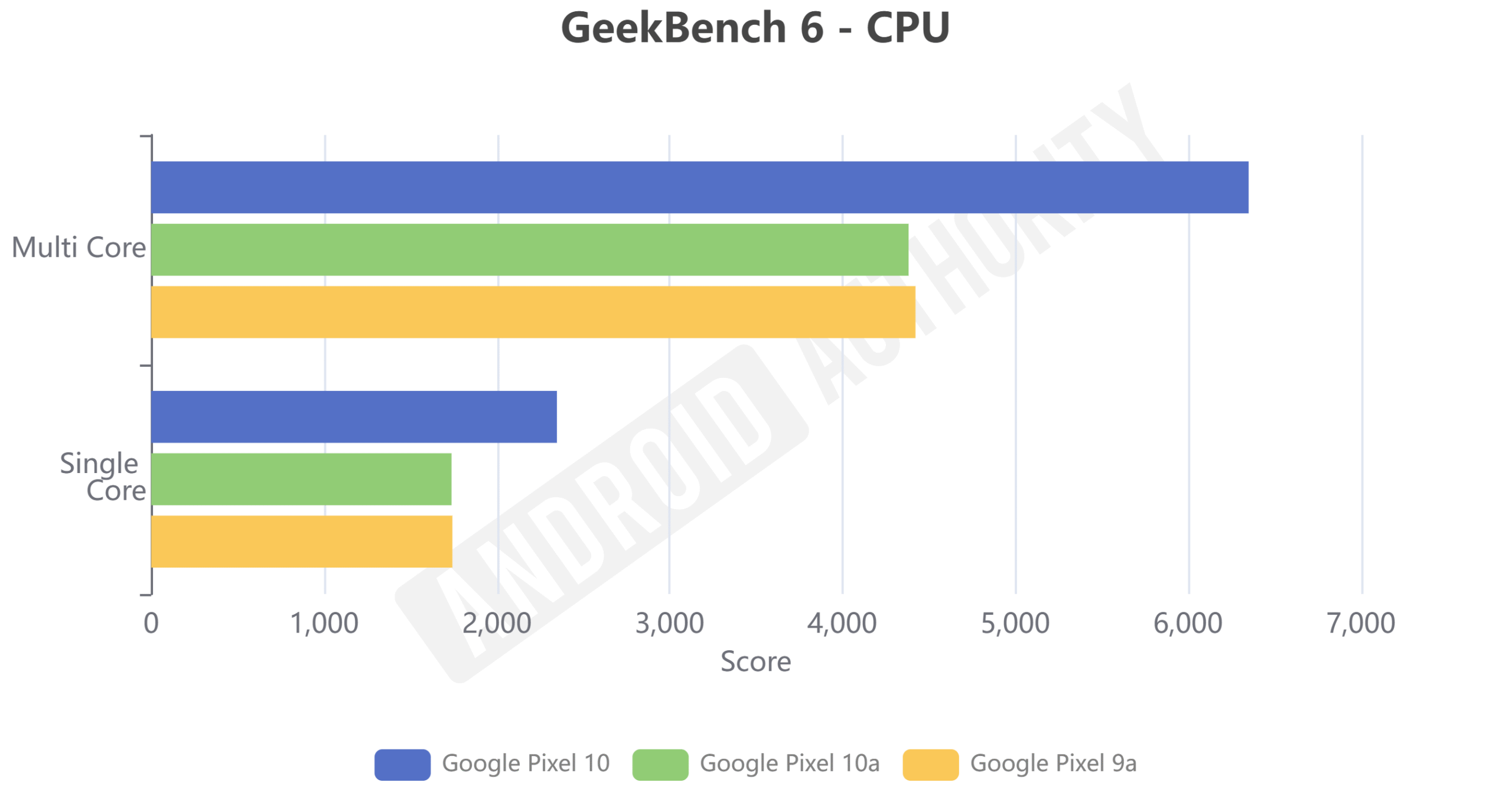
The GeekBench 6 CPU test measures a processor’s single-core and multi-core computational abilities, reflecting how well a device handles everyday tasks, application launches, and multi-tasking. Our tests revealed that the Pixel 10a, equipped with the Tensor G4, produced results largely indistinguishable from its predecessor, the Pixel 9a, which also uses the Tensor G4. Both devices scored within the margin of error of each other for both single-core and multi-core operations. This finding unequivocally confirms that, from a pure CPU performance standpoint, the Pixel 10a offers no tangible upgrade over the Pixel 9a.
When positioned against other devices in the market, the Tensor G4’s CPU performance generally aligns with that of devices like Samsung’s Galaxy S23 FE, released in 2023. While the S23 FE utilized either a Snapdragon 8 Gen 1 or an Exynos 2200 depending on the region – both of which were flagship chips for their respective years – the G4’s scores place it firmly in the upper mid-range to lower-flagship tier of processors from the previous generation. For a smartphone retailing at approximately $500, this level of CPU power is certainly respectable for typical daily usage, including web browsing, social media, email, and most productivity applications. However, it also highlights a growing gap between Google’s mid-range "a" series and the cutting-edge performance offered by current flagship devices from Apple, Qualcomm, and even Google’s own Pixel 10 (powered by the Tensor G5).
3DMark Wild Life Extreme Stress Test: Thermal Management Insights:
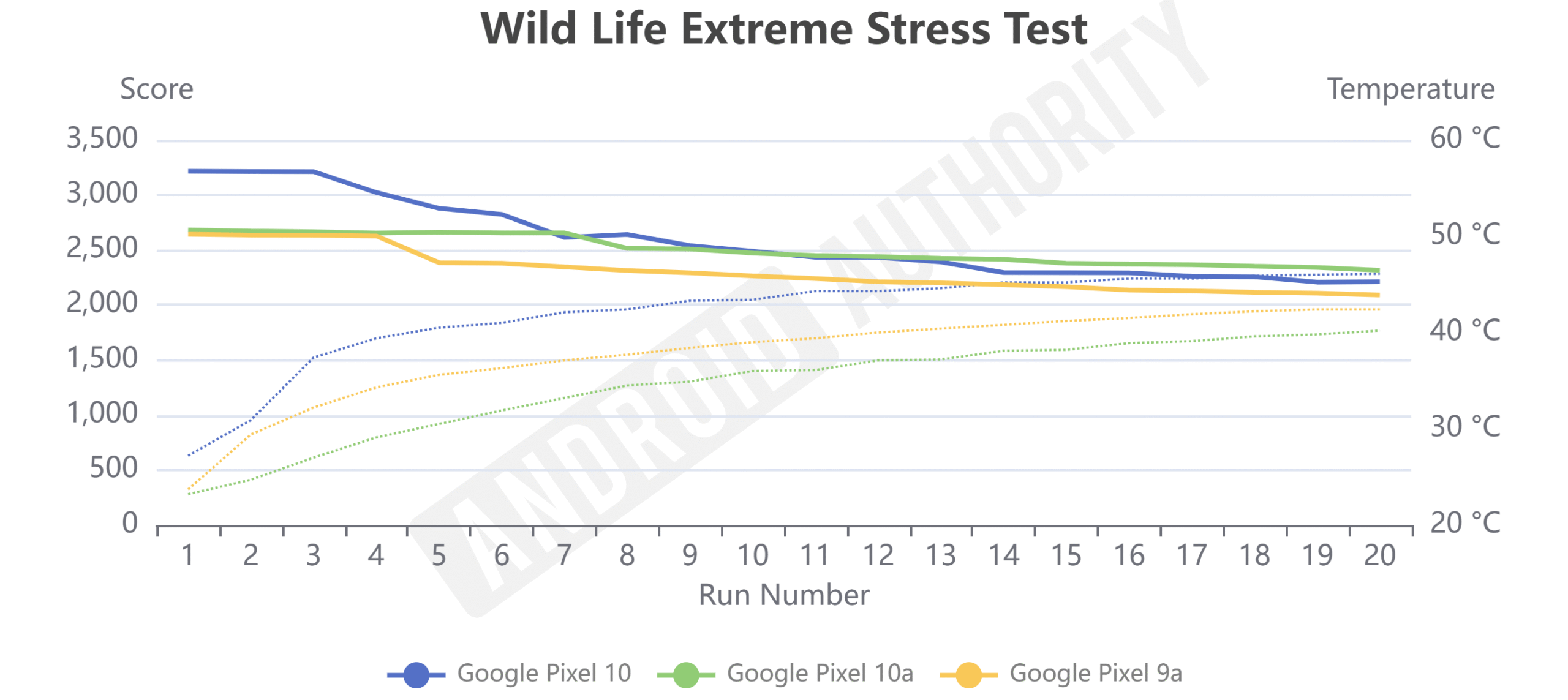
While raw CPU power showed stagnation, the Pixel 10a demonstrated an interesting advantage in sustained performance under heavy load, particularly in thermal management. The 3DMark Wild Life Extreme stress test pushes the device’s GPU to its limits over an extended period, simulating demanding gaming scenarios and measuring both peak performance and how well the device maintains that performance without throttling due to heat.
Initial performance metrics for the Pixel 10a in this test started on par with the Pixel 9a and, as expected, lagged behind the more powerful Pixel 10 (with its Tensor G5). However, as the multi-minute test progressed, the Pixel 10a exhibited superior thermal regulation. It maintained lower operating temperatures throughout the test, taking a full seven minutes before showing any significant dip in performance due to thermal throttling. In contrast, the Pixel 9a began to throttle back its performance earlier in the test, indicating a less efficient heat dissipation system or less optimized software control. This sustained performance advantage meant that, by the later stages of the stress test, the Pixel 10a was effectively competing with the more expensive Pixel 10 in terms of maintained frame rates, a surprising outcome given their initial performance disparity.
The practical implications of this thermal improvement are significant, particularly for mobile gamers or users running graphically intensive applications for extended periods. While the Pixel 10 will undoubtedly offer a performance lead for shorter, less demanding gaming sessions, the Pixel 10a’s enhanced thermal stability suggests it could provide a more consistent and comfortable experience during longer playtimes. This could be particularly relevant for emulating classic games, which often place sustained, rather than peak, demands on a device’s GPU. It’s important to note that these tests are conducted under controlled room temperatures, and real-world conditions (e.g., warmer environments, use of protective cases, or charging during gameplay) could introduce additional variables affecting thermal performance. Nevertheless, this represents a subtle but meaningful win for the Pixel 10a, offering a more comfortable user experience and potentially better longevity under heavy loads compared to its direct predecessor.
Google’s Strategic Positioning and the AI Imperative
The decision to reuse the Tensor G4 in the Pixel 10a, despite the availability of the G5, can be interpreted through several strategic lenses. One primary driver is likely cost optimization. Integrating an older, well-understood chip into a new device can lead to significant savings in manufacturing, research and development, and supply chain management. These savings can then be passed on to consumers, helping Google maintain the Pixel "a" series’ competitive pricing in a fiercely contested mid-range market.
Another factor is Google’s overarching focus on Artificial Intelligence (AI) capabilities. The Tensor chips are designed with powerful Neural Processing Units (NPUs) specifically tailored to accelerate Google’s on-device AI features, such as advanced computational photography, real-time language processing, and personalized user experiences. The Tensor G4, while not the absolute latest, still boasts formidable AI processing capabilities. Google may believe that the incremental AI performance gains from the G5 would not justify the increased cost for the "a" series, particularly given that many of its marquee AI features are already well-supported by the G4. The company has consistently emphasized the software and AI experience as central to the Pixel identity, suggesting that a slightly older, yet highly optimized, chip can still deliver these experiences effectively.
Furthermore, the improved thermal performance observed in the 3DMark stress test could indicate that Google has refined the integration of the Tensor G4 within the Pixel 10a’s hardware. This could involve better internal cooling solutions, more efficient power management, or software optimizations that allow the G4 to operate more stably under load. If Google’s priority was not necessarily peak performance but rather consistent, reliable performance and user comfort, then reusing a well-understood chip and optimizing its thermal profile makes strategic sense.
The Seven-Year Software Update Promise: A Hardware Challenge
Perhaps the most significant implication of the Pixel 10a’s hardware choice, however, revolves around Google’s ambitious promise of seven years of Android operating system and security updates. This commitment, first introduced with the Pixel 8 series, aims to provide unparalleled longevity for Pixel devices, theoretically allowing users to keep their phones for much longer.
The challenge for the Pixel 10a is stark: how will a processor that is essentially "last year’s" at launch, and effectively two years behind the cutting edge by the time it reaches consumers, cope with the demands of an evolving mobile operating system and increasingly complex applications seven years down the line? By 2031, the Tensor G4 will be a decade old in terms of its core architecture. While current performance is adequate for most tasks, the trajectory of mobile software and AI integration suggests that future Android versions and applications will likely be more demanding.
Some existing Pixel users have already reported that their flagship handsets, even with newer Tensor chips, can feel sluggish after just a year or two of heavy use. This raises legitimate concerns about the Pixel 10a’s ability to maintain a smooth and responsive user experience throughout its promised seven-year lifespan. While software optimization can do much to mitigate hardware limitations, there comes a point where the underlying silicon simply cannot keep pace with the demands of modern software. This situation places the onus on Google to deliver exceptional software optimization for the G4 over a very long period, a task that will test the limits of its engineering capabilities. For consumers considering the Pixel 10a as a long-term investment, the expectation of using it for the full seven years might be unrealistic if performance is a key criterion.
Competitive Landscape and Alternatives
In the sub-$600 market segment, the Pixel 10a faces stiff competition. When compared against similarly priced rivals such as the Samsung Galaxy A56 5G, the Nothing Phone 4a Pro, or the Moto G Stylus (2025), the Tensor G4 generally holds its own, often outperforming these devices, particularly in demanding tasks like gaming. These competitors typically utilize mid-range Qualcomm Snapdragon or MediaTek Dimensity chips, which, while capable, may not offer the same raw computational grunt or specialized AI acceleration as the Tensor G4.
However, the picture changes when considering slightly more expensive alternatives that offer a significant leap in performance for a relatively small increase in price. Devices like the OnePlus 13R (or the even newer OnePlus 15R) and the Samsung Galaxy S25 FE often feature chips that are closer to flagship-tier performance, sometimes even surpassing Google’s Tensor G5, let alone the G4. These phones, while perhaps costing $100-$200 more than the Pixel 10a, provide a demonstrably higher performance ceiling that could offer better longevity for users prioritizing raw power and demanding applications. For instance, the S25 FE might leverage a flagship chip from two years prior, but that chip is often a higher-tier component than the G4, providing a stronger foundation for future software demands.
The choice for consumers, therefore, becomes a nuanced trade-off. The Pixel 10a offers Google’s renowned camera prowess, a clean Android experience, and deep AI integration, alongside the promise of extensive software support, all for a compelling price. Yet, those seeking top-tier performance on a budget, strong enough to comfortably last for a significant portion of the seven-year update cycle, might find better value in these slightly pricier, performance-focused alternatives. The central concern is not just that the Pixel 10a uses the Tensor G4, but that for a modest financial increment, consumers can acquire phones that offer a performance profile much closer to a current flagship, thereby potentially offering a more satisfying experience over the long haul.
In conclusion, the Google Pixel 10a presents a mixed bag in terms of performance. While its reuse of the Tensor G4 processor means no raw CPU upgrade over its predecessor, it still delivers a solid experience for most daily tasks and continues to leverage Google’s robust AI features and camera system at a competitive price. The surprising improvement in thermal management for sustained workloads is a welcome addition, potentially enhancing the gaming experience. However, the decision to forego the latest Tensor G5 and effectively stagnate performance raises significant questions about the device’s ability to live up to Google’s ambitious seven-year software update promise, especially when more powerful alternatives exist at slightly higher price points. The Pixel 10a remains a compelling mid-range offering for those prioritizing Google’s ecosystem and camera, but performance-conscious users seeking long-term viability might need to weigh their options carefully.