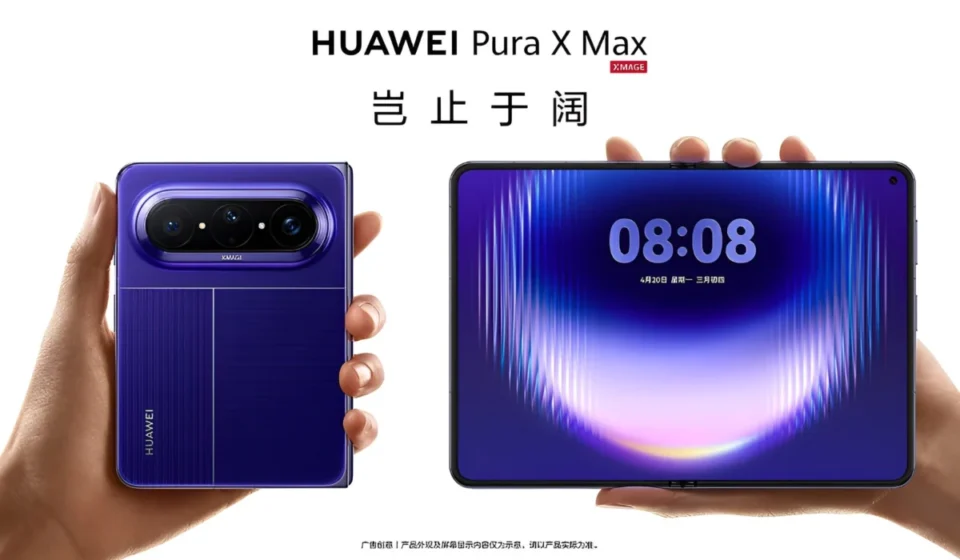

Huawei has officially revealed a wide-format foldable phone, a device that immediately draws parallels with ongoing speculation surrounding the rumored iPhone Fold. The unreleased foldable iPhone has found an unofficial contender in the Huawei Pura X Max, a device for which Huawei has initiated official teasing campaigns ahead of its scheduled China launch on April 20. Promotional materials released by the company showcase an unusually broad foldable design, presenting a form factor that more closely resembles a compact tablet when unfolded, diverging from the taller, narrower profiles that have become prevalent in the foldable market.
The Pura X Max: A Bold New Foldable Paradigm
The official imagery released by Huawei depicts the Pura X Max in a range of colors including blue, white, black, and orange. Its design is characterized by a decidedly boxy, passport-like aesthetic, complemented by a prominent triple rear camera array. This expansive foldable format, which offers a wider canvas than typical foldables, is a design language that has largely been confined to rumors and speculation concerning future devices from major players like Apple and Samsung.

This distinctive aspect ratio is precisely where the comparison to the anticipated iPhone Fold becomes most pronounced. Recent CAD renders and industry whispers regarding Apple’s inaugural foldable device have also hinted at a similarly wide design, in contrast to the more conventional vertical folds seen in Samsung’s Galaxy Z Flip and Z Fold series. Huawei’s apparent preemptive move with the Pura X Max suggests a strategic decision to embrace a broader display. This wider aspect ratio is anticipated to enhance user experiences in activities such as reading, multitasking, video consumption, and gaming, by minimizing the need for awkward screen adjustments and offering a more natural viewing experience. When unfolded, the wider main screen effectively transforms the device into a compact, tablet-like display, promising a more immersive and functional interface.
Strategic Timing and Market Positioning
The Pura X Max’s emergence is particularly noteworthy given the speculative nature of its potential rival. While the iPhone Fold remains a subject of ongoing online conjecture, with many reports likely stemming from speculative renders and supply chain chatter, Huawei has presented a tangible product. The company has not only provided official visual representations of the Pura X Max but has also confirmed a launch date, effectively showcasing a design that appears to address the evolving question of optimal foldable form factors before Apple has officially entered the market. This strategic timing allows Huawei to capture immediate attention and potentially set a new benchmark for foldable device design, leveraging the tangible reality of its product against the abstract anticipation of a competitor’s offering.

The foldable smartphone market, though still nascent, has seen a steady stream of innovation and a gradual exploration of different form factors. Initial foldables, like the Samsung Galaxy Fold, established the book-style folding mechanism, offering a large, tablet-like screen when opened. Subsequent iterations, such as the Galaxy Z Flip series, introduced the clamshell design, prioritizing portability and a more traditional smartphone experience when closed. However, the market has largely gravitated towards the taller, narrower aspect ratio for the inner display, a design choice that has raised questions about optimal screen real estate for productivity and media consumption.
Huawei’s decision to pursue a wider form factor for the Pura X Max can be seen as a direct response to these user experience considerations. By offering a display that more closely resembles a standard smartphone screen when unfolded, the Pura X Max aims to provide a more seamless transition for users accustomed to traditional handset interfaces. This approach could prove particularly advantageous for multitasking, allowing users to comfortably view and interact with multiple applications side-by-side without the constraints of a cramped aspect ratio. Furthermore, for media consumption, a wider screen generally offers a more immersive viewing experience, bringing it closer to the proportions of conventional displays used for movies and television shows.

The implications of this design choice extend to application compatibility and user interface design. Developers may find it easier to adapt their applications for a wider screen, potentially leading to a richer and more intuitive user experience across a broader range of software. This could also encourage innovation in how applications are designed for foldable devices, moving beyond simple adaptations of existing mobile interfaces to explore new possibilities offered by the expansive and flexible displays.
The Competitive Landscape and Future Implications
The unveiling of the Huawei Pura X Max occurs within a dynamic and rapidly evolving foldable smartphone market. Samsung has long been a dominant player, consistently refining its Galaxy Z Fold and Z Flip lines. However, the market is becoming increasingly competitive, with other manufacturers like Motorola, Google, and now potentially Apple, entering the fray with their own unique approaches to foldable technology.

Apple’s rumored entry into the foldable space, tentatively dubbed the iPhone Fold, has been the subject of intense speculation for years. While details remain scarce, consistent leaks and patent filings suggest a departure from the conventional book-style fold, leaning towards a wider form factor, much like the Pura X Max. If these rumors prove accurate, the Pura X Max could be seen as a preemptive strike, offering a tangible product that embodies a design direction that Apple might also be pursuing. This could create an interesting dynamic where Huawei, despite facing certain market limitations, is setting a precedent for future foldable designs that even the tech giant might be considering.
The broader implications of Huawei’s move extend beyond immediate competitive pressures. The Pura X Max’s wider aspect ratio could influence the design trajectory of future foldable devices across the industry. If Huawei’s approach proves successful in terms of user adoption and market reception, it could encourage other manufacturers to explore similar wide-format designs, potentially leading to a diversification of foldable form factors. This could, in turn, foster greater innovation and competition, ultimately benefiting consumers with a wider array of choices and more refined user experiences.

Furthermore, the development of such devices highlights the ongoing advancements in display technology, hinge mechanisms, and battery efficiency, all of which are critical for the success of foldable smartphones. As these technologies mature, we can expect to see foldables become more durable, more powerful, and more accessible to a wider consumer base. Huawei’s continued investment in this segment, even amidst geopolitical challenges, underscores the company’s commitment to pushing the boundaries of mobile technology and its ambition to remain a significant player in the global smartphone market. The Pura X Max, with its distinctive design and timely introduction, is a clear testament to this ongoing pursuit of innovation. The anticipation surrounding its official launch on April 20 will undoubtedly be closely watched by industry analysts, competitors, and consumers alike, as it signals a potential shift in the established norms of foldable smartphone design.