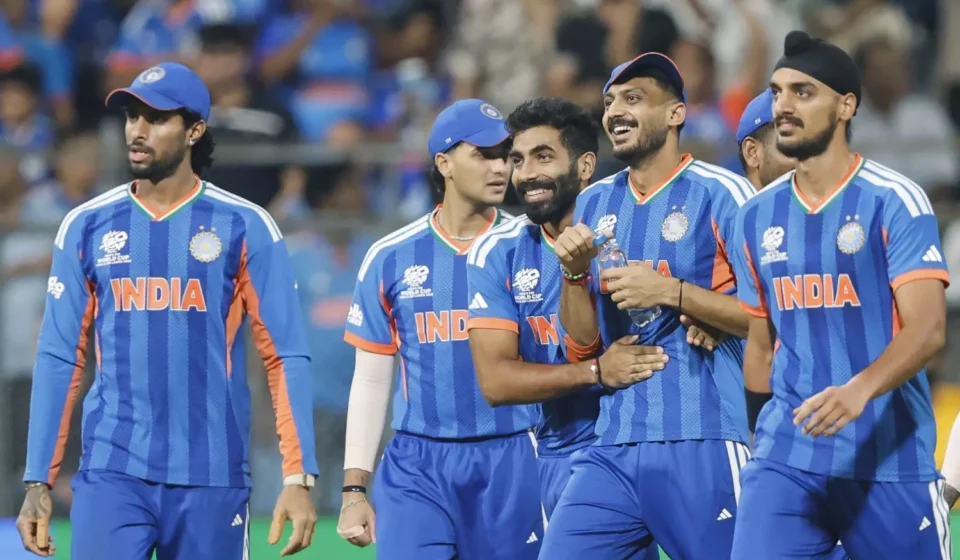
India Secures Thrilling Seven Run Victory Over England to Reach 2026 ICC Men’s World Cup Final at Wankhede Stadium

The reigning champions India survived a stunning lone-warrior onslaught from England’s Jacob Bethell to secure a seven-run victory on Thursday, booking their place in the 2026 ICC Men’s World Cup Final. In a high-octane encounter at the iconic Wankhede Stadium in Mumbai, the hosts successfully defended a massive total of 253 in a match that pushed the boundaries of modern white-ball cricket. Despite a record-breaking century from Bethell, India’s disciplined death bowling and a dominant first-innings performance with the bat ensured the Men in Blue remain on track to defend their global crown.
The First Innings: India’s Batting Powerhouse Sets the Stage
After winning the toss and electing to bat first under the lights of Mumbai, India’s intent was clear from the opening delivery. On a pitch known for its true bounce and high-scoring nature, the Indian top order capitalized on the powerplay restrictions to dismantle the English bowling attack.
Sanju Samson, continuing his scintillating form, anchored the innings with a masterclass in power-hitting. Samson, who had scored a half-century in the previous match, notched his second consecutive fifty, eventually finishing with 89 runs off just 42 deliveries. His innings was characterized by a blend of classical timing and raw power, as he cleared the ropes seven times and found the boundary on eight occasions. Samson’s ability to manipulate the field forced England’s captain, Harry Brook, to frequently rotate his bowlers, though few found an answer to his aggressive approach.
The platform was further solidified by Ishan Kishan, who provided a brisk 39, and Shivam Dube, whose 43 runs in the middle overs ensured that India did not lose momentum during the transition phase. The pair’s ability to rotate strike and hit boundaries at will kept the run rate well above 12 per over. Towards the business end of the innings, Hardik Pandya (27) and Tilak Varma (21) played vital cameos, pushing the total to a mammoth 253/7. This score set a formidable target for England, requiring them to maintain a run rate of 12.7 per over from the outset.
England’s Response: The Early Collapse and Bethell’s Heroics
England’s pursuit of 254 began in disastrous fashion. The visitors lost their explosive opener Phil Salt and skipper Harry Brook within the first five overs, leaving the chase in tatters at 38-2. The Indian pace attack, led by Jasprit Bumrah, exploited the early swing available under the lights, putting England on the back foot immediately.
However, the arrival of Jacob Bethell changed the complexion of the game. The 22-year-old southpaw, walking into a high-pressure situation, played what many analysts are calling the innings of the tournament. Bethell took the attack to the Indian spinners and seamers alike, scoring a magnificent 105 off 48 balls. His century, reached in just 45 deliveries, stands as the second-fastest in the history of the World Cup, trailing only behind the all-time record.
Bethell’s knock included eight boundaries and seven sixes, many of which were struck with a clean swing of the bat that left the Mumbai crowd in stunned silence. As long as Bethell was at the crease, the required run rate remained within reach, and England appeared to be cruising toward a historic upset. His partnership with the lower-middle order kept the scoreboard ticking, turning a seemingly impossible chase into a last-over thriller.
The Turning Point: Defensive Excellence in the Death Overs
The match reached its crescendo in the final two overs. With England needing 39 runs from the final 12 deliveries, the responsibility fell on the shoulders of Hardik Pandya and Shivam Dube.
Pandya, bowling the 19th over, delivered a tactical masterclass. Despite the pressure, he conceded only nine runs and claimed the crucial wicket of Sam Curran, who had been providing valuable support to Bethell. Pandya’s ability to mix his lengths and use the wide yorker effectively left England needing 30 runs off the final six balls.
The final over was entrusted to Shivam Dube. While Bethell continued to swing for the fences, the pressure finally told. In a desperate attempt to retain the strike and find the boundary, Bethell was run out following a sharp piece of fielding by the Indian inner-ring defenders. His departure effectively ended England’s hopes, as the remaining tailenders could not bridge the gap. India breathed a collective sigh of relief as the final ball was delivered, securing a seven-run win and a spot in the championship match.
Statistical Summary and Bowling Analysis
In a game where the average economy rate hovered around 12.5 runs per over, the performance of Jasprit Bumrah stood out as the deciding factor. Bumrah finished with figures of 1-33 in his four-over quota, a remarkable feat given that nearly every other bowler on both sides conceded more than 10 runs per over. His dismissal of Harry Brook early in the innings prevented England from establishing a stable foundation.
Key Match Statistics:
- India Total: 253/7 (20 Overs)
- England Total: 246/x (20 Overs)
- Top Scorer (India): Sanju Samson (89 off 42)
- Top Scorer (England): Jacob Bethell (105 off 48)
- Best Bowling (India): Jasprit Bumrah (1-33), Hardik Pandya (2-38)
- Fastest Century: Jacob Bethell (45 balls)
The data highlights a significant trend in the 2026 tournament: the increasing irrelevance of "safe" totals. India’s 253 was nearly chased down, underscoring the evolution of batting techniques and the impact of the short boundaries at Wankhede.
Official Reactions and Player of the Match
Sanju Samson was awarded the Player of the Match for his blistering 89, but the wicketkeeper-batsman was quick to deflect the praise toward his bowling unit. During the post-match presentation, Samson emphasized the role of Jasprit Bumrah in navigating the team through the English storm.
"All credit goes to Jasprit Bumrah," Samson stated. "He is a world-class bowler, a once-in-a-generation talent, and that’s what he delivered today. This award should actually go to him. If we didn’t bowl the way we did in the death overs, I would not be standing here. All credit goes to the bowlers for how they backed themselves in these tough, high-scoring conditions."
Hardik Pandya also received praise for his composure during the penultimate over. Team management noted that Pandya’s experience in the Indian Premier League (IPL) and previous ICC knockouts played a vital role in his ability to restrict England when the momentum was firmly in their favor.
On the English side, captain Harry Brook expressed pride in his team’s fightback despite the loss. "To get that close to 250 is a testament to the talent we have, especially Jacob [Bethell]. It’s a tough pill to swallow, but we showed that we can compete with the best even when our backs are against the wall," Brook said in the post-match press conference.
Historical Context and Path to the Final
The victory at Wankhede adds another chapter to the storied rivalry between India and England in ICC events. As the defending champions, India entered the 2026 tournament with immense pressure to replicate their previous success. Their journey to the final has been marked by a dominant group stage and a resilient knockout performance, showcasing the depth of their talent pool.
The 2026 World Cup has been characterized by record-breaking scores, with the Wankhede pitch once again proving to be a "graveyard for bowlers." The match between India and England will likely be remembered for Bethell’s century, which has cemented his status as one of the rising stars of international cricket.
Broader Implications and Analysis
India’s progression to the final has significant implications for the sport’s landscape. As the commercial and competitive powerhouse of cricket, an Indian appearance in the final ensures record-breaking viewership and engagement. For the team itself, the win validates the aggressive "new era" blueprint adopted by the coaching staff, which prioritizes high strike rates and fearless batting from the first ball.
However, the narrow margin of victory also serves as a warning. The fact that England came within seven runs of chasing 254 suggests that India’s bowling attack, barring Bumrah and Pandya, may need to tighten their execution ahead of the final. The reliance on Bumrah to stem the flow of runs is a recurring theme that opposing teams will look to exploit by targeting the other end of the pitch.
For England, the loss marks the end of a transitional phase. With young players like Bethell and Brook leading the charge, the future of English white-ball cricket appears secure, even if they fell short of the ultimate prize on this occasion.
Conclusion
As India prepares for the 2026 ICC Men’s World Cup Final, the momentum from this victory will be invaluable. The team has shown they can post massive totals and, perhaps more importantly, hold their nerve when faced with an extraordinary individual performance from the opposition. On Thursday night in Mumbai, the "Wankhede Roar" was at its loudest, celebrating a team that refused to buckle under pressure, moving one step closer to defending their world title.