Indian Cyclists Shatter National Records and Secure Silver Medal at the 2026 Asian Track Cycling Championships

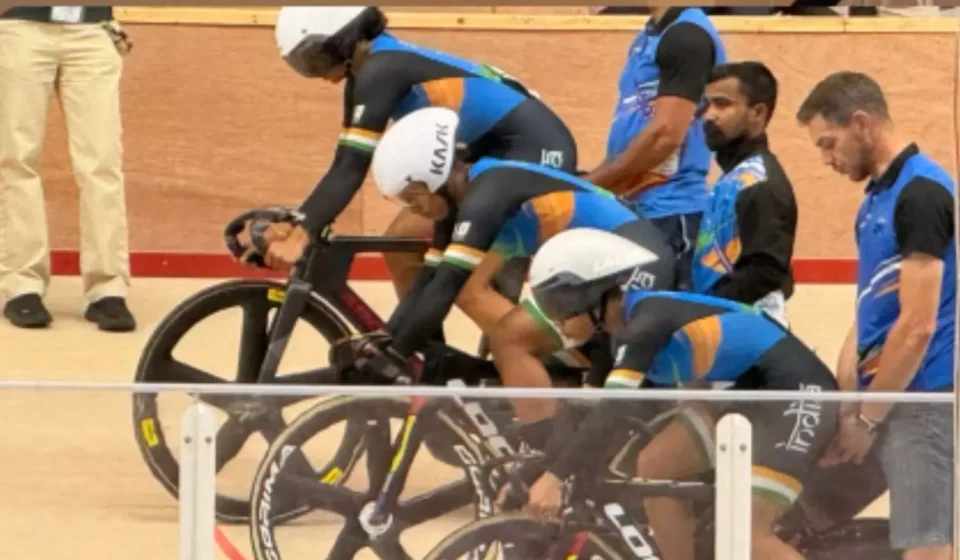
The 2026 Asian Track Cycling Championships witnessed a landmark day for Indian cycling as the national contingent delivered a series of record-breaking performances, headlined by two new national records in the women’s elite categories and a silver medal in the junior division. On a day characterized by intense competition and high-velocity racing, the Indian women’s elite sprint and pursuit teams redefined the country’s benchmarks, signaling a significant shift in India’s competitive standing within the continental cycling landscape. Although the elite sprint team faced a premature exit from the gold medal race, the statistical milestones achieved at the velodrome underscore the rapid technical progression of the national program.
The Indian women’s elite sprint team, featuring the trio of Triyasha Paul, Keerti Rangaswamy, and Celestina, entered the first round with high expectations following a rigorous preparation cycle. Competing against a formidable Malaysian squad, the Indian trio clocked a collective time of 49.525 seconds. This performance officially established a new Indian national record, surpassing the previous best and demonstrating the increasing power output of the nation’s top sprinters. Despite the historic timing, the Indian side was unable to overcome the Malaysian team, which produced an exceptional 48.086 seconds to advance to the gold medal final. The result highlighted the razor-thin margins at the elite level of Asian track cycling, where national records do not always guarantee podium finishes against the continent’s traditional powerhouses.
Technical Breakdown of the Record-Breaking Sprint
The internal metrics of the sprint performance provide a clearer picture of the team’s current form. Triyasha Paul emerged as the standout performer in terms of raw speed, navigating her lap in a blistering 14.716 seconds. Her explosive start provided the necessary momentum for the middle segment, where Keerti Rangaswamy maintained a competitive pace, registering a lap time of 15.309 seconds. The final leg was anchored by Celestina, who crossed the line with a lap time of 19.500 seconds to seal the record-breaking total of 49.525 seconds.
While the loss to Malaysia—a difference of 1.439 seconds—prevented the team from contending for the top two spots, the improvement in individual split times is a metric that the Cycling Federation of India (CFI) is expected to view as a success. Technical analysts noted that the synchronization between the riders during the "man-one" to "man-two" transition was significantly smoother than in previous international outings, contributing to the reduction in the overall clocking.
Endurance Excellence: The Women’s Elite Pursuit Record
Parallel to the success in the sprint events, the Indian women’s elite pursuit team demonstrated remarkable endurance and tactical discipline. The quartet of Swasti Singh, Harshita Jakhar, Pooja Danole, and Meenakshi Rohilla delivered a cohesive performance in the 4,000-meter event, stopping the clock at 4:37.645 seconds. This timing set a new national record for the team pursuit, a discipline that requires not only individual strength but an intricate understanding of slipstreaming and pacing strategies.
The team pursuit record is particularly significant as it reflects the growing depth in India’s endurance cycling pool. Swasti Singh and Meenakshi Rohilla, both veterans of the international circuit, provided the necessary experience to guide younger talents like Pooja Danole and Harshita Jakhar. The 4:37.645 mark is a substantial improvement over previous years, suggesting that the specialized training camps held at the Indira Gandhi Indoor Stadium in New Delhi and international exposure tours are yielding tangible results. In the team pursuit, maintaining a consistent gap between riders and managing the "pulls" at the front of the line are critical; the record-breaking run on Wednesday suggested a higher level of aerodynamic efficiency and collective fitness than previously seen from an Indian squad.
Junior Contingent Claims Silver Medal
The momentum generated by the elite teams was matched by the junior athletes, who provided the first podium finish of the day for the Indian delegation. The Indian women’s junior sprint team, composed of Namita Violet, Aabha Soman, and Thabitha S, secured a silver medal with a final timing of 52.817 seconds. Their performance was a testament to the grassroots development programs that have been prioritized by the national sporting bodies over the last quadrennial.
The silver medal in the junior category is a vital indicator of the "pipeline" talent available for future elite transitions. Namita Violet’s performance, in particular, has drawn praise from scouts, as her ability to handle the pressure of a continental final suggests a high ceiling for professional growth. By securing silver, the junior team has ensured that India remains a visible threat in the age-group categories, which often serve as a precursor to success at the Asian Games and Commonwealth Games.
Chronology of the Day’s Events
The day’s proceedings began with the qualifying rounds for the team pursuit, where the Indian quartet established a steady rhythm early on. By the halfway mark of the 4km race, the team was already tracking ahead of the previous national record pace. As the final two laps commenced, Meenakshi Rohilla took a long pull at the front to ensure the momentum didn’t flag, resulting in the 4:37.645 finish.
Following the pursuit, the focus shifted to the high-intensity team sprint. The Indian elite women took to the track in the first round against Malaysia. The atmosphere was electric as Triyasha Paul exploded out of the gate. However, the Malaysian team, benefitting from a slightly more efficient second lap, began to pull away. While India’s 49.525s was a milestone for the country, Malaysia’s sub-49 performance was the gold standard of the heat.
The evening session concluded with the junior finals, where Namita Violet, Aabha Soman, and Thabitha S faced off against a strong field. Their silver-medal run was the result of a disciplined three-lap effort that saw them hold off challenges from several other Southeast Asian nations to claim their spot on the podium.
Analysis of Implications and Future Outlook
The setting of two national records in a single day at the 2026 Asian Track Cycling Championships is not merely a statistical anomaly; it is an indication of India’s burgeoning stature in a sport traditionally dominated by Japan, China, and South Korea. The records indicate that the "speed gap" between Indian cyclists and the top-tier Asian competitors is narrowing. For years, Indian cyclists struggled to break the 50-second barrier in the women’s team sprint; doing so on the continental stage confirms that the power-based training protocols implemented by the coaching staff are effective.
From a strategic standpoint, these results are critical for Olympic qualification points. While a national record does not always equate to a medal, the points accumulated through high-ranking finishes and record-breaking times contribute to the overall UCI (Union Cycliste Internationale) rankings. These rankings determine eligibility for the World Championships and, ultimately, the Olympic Games.
The performance of the pursuit team is equally vital. The team pursuit is often considered the "blue riband" event of track cycling endurance, and a sub-4:38 timing places India in a competitive bracket for the upcoming Asian Games. If the team can continue to shave seconds off this time through improved aerodynamic equipment and better pacing technology, a podium finish at the next major multi-sport event becomes a realistic objective.
Inferred Reactions and Official Support
While official statements from the Cycling Federation of India are expected following the conclusion of the championships, the mood within the camp is reportedly one of "cautious optimism." Sources close to the coaching staff indicate that while the records are celebrated, the primary focus remains on converting these timings into medals at the elite level. The exit against Malaysia in the sprint serves as a reminder of the work required to reach the very top of the Asian podium.
The success seen on Wednesday is also a validation of the support provided by the Ministry of Youth Affairs and Sports through the Target Olympic Podium Scheme (TOPS). Increased funding for high-performance bicycles, wind-tunnel testing, and international coaching has allowed Indian riders to compete on more level footing regarding equipment. The use of carbon-fiber frames and specialized disc wheels, which were once a rarity for Indian squads, is now standard, contributing directly to the record-breaking times seen in the 2026 championships.
Conclusion of the Day’s Impact
As the 2026 Asian Track Cycling Championships continue, the Indian contingent has sent a clear message to its continental rivals. The dual national records in the women’s elite sprint and pursuit, combined with the junior silver medal, represent one of the most successful single days in the history of Indian track cycling. The focus now shifts to the individual events, where Triyasha Paul and Swasti Singh are expected to compete in the 500m time trial and the individual pursuit, respectively.
With the benchmark now set at 49.525s for the sprint and 4:37.645s for the pursuit, the Indian cycling program has established a new floor for its expectations. The challenge moving forward will be to maintain this trajectory of improvement, ensuring that by the time the next major international cycle begins, these national records are not just milestones of progress, but the foundation for consistent podium success on the global stage.