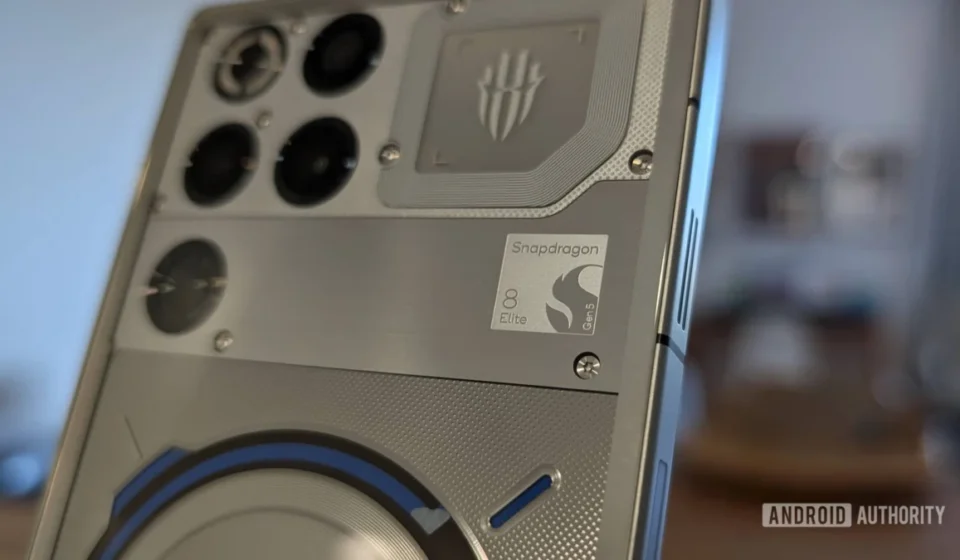
New leak suggests Qualcomm’s next Snapdragon 8 Elite could take it to the extreme, literally

The fiercely competitive landscape of the mobile processor industry is once again abuzz with anticipation as both Qualcomm and MediaTek prepare to unveil their next-generation flagship chipsets. Expected to drive the most advanced smartphones of 2026, the Qualcomm Snapdragon 8 Elite Gen 6 series and the MediaTek Dimensity 9600 Pro are slated to introduce significant advancements across the board, particularly in raw processing power, graphical capabilities, and power efficiency. Recent leaks, primarily from the reputable Digital Chat Station (DCS) on Weibo, offer an early glimpse into the core configurations, unprecedented clock speeds, and manufacturing processes of these highly anticipated silicon powerhouses, suggesting a new era of mobile performance is on the horizon.
Qualcomm’s Next-Gen Powerhouse: The Snapdragon 8 Elite Extreme Gen 6
Qualcomm, a long-standing titan in the mobile chipset arena, appears ready to push the boundaries of smartphone processing with its upcoming top-tier offering. According to DCS, the chip, previously rumored as the Snapdragon 8 Elite Gen 6 Pro, may adopt the more evocative — albeit somewhat verbose — moniker: Snapdragon 8 Elite Extreme Gen 6. This new naming convention could signal Qualcomm’s intent to distinguish a truly premium, ultra-high-performance variant from its standard flagship line, potentially catering to specialized gaming phones or devices requiring maximum computational grunt. The model number for this formidable chip is reportedly SM8975.
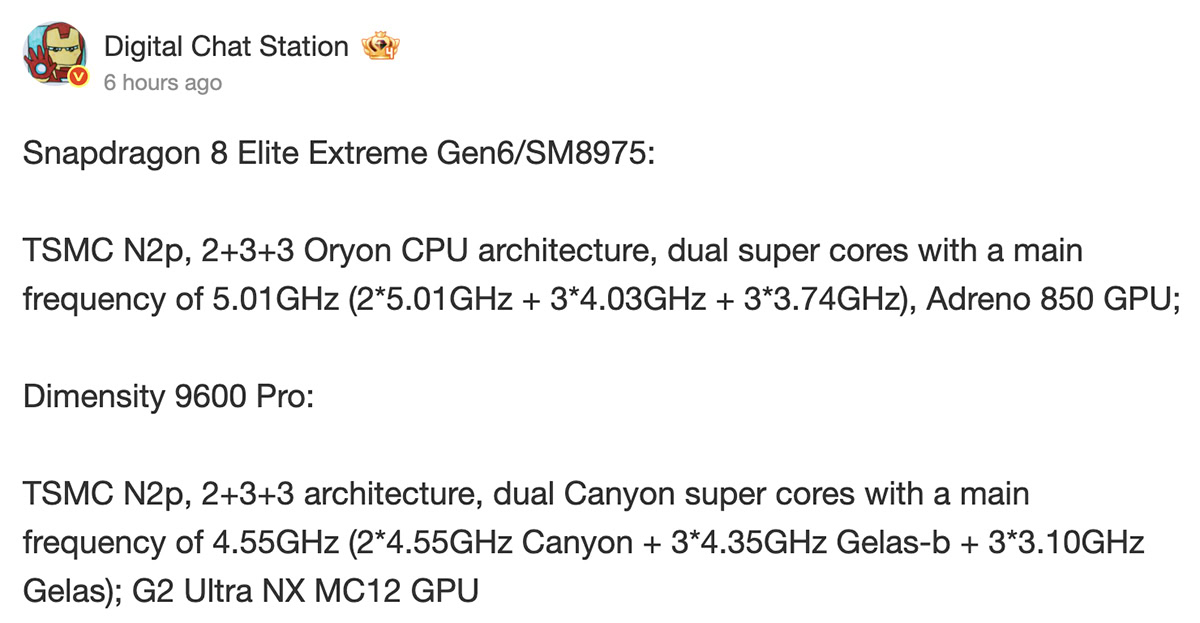
The most striking detail to emerge from the leak concerns the processor’s clock speed. The Snapdragon 8 Elite Extreme Gen 6 is projected to shatter the 5GHz barrier for smartphone chipsets, a significant milestone in mobile computing. The octa-core processor is said to feature an advanced 2+3+3 core arrangement: two prime cores clocked at an astounding 5.01GHz, three performance cores operating at 4.03GHz, and three efficiency cores running at 3.74GHz. This configuration represents an aggressive push for raw speed, aiming to deliver unparalleled single-threaded and multi-threaded performance.
Historically, clock speed increases in mobile processors have been carefully balanced against power consumption and thermal management. Crossing the 5GHz threshold indicates a remarkable engineering feat, likely achieved through significant architectural enhancements and the adoption of cutting-edge manufacturing processes. Previous generations, such as the Snapdragon 8 Gen 3 and Gen 4, have steadily increased clock speeds, with prime cores typically hovering in the 3.0-3.3GHz range for the former and potentially reaching higher for the latter, but 5GHz represents a generational leap that could fundamentally alter the performance ceiling of mobile devices. The prime cores are almost certainly based on ARM’s latest high-performance designs, potentially custom-tuned versions of a future Cortex-X series, while the performance and efficiency cores would likely leverage the next iterations of Cortex-A7xx and Cortex-A5xx series, respectively.
Complementing this formidable CPU is the new Adreno 850 GPU. Earlier leaks have indicated that this graphics processor will come with six "GPU slices," suggesting a modular and highly scalable design. This architecture implies a substantial boost in graphics rendering capabilities, crucial for high-fidelity mobile gaming, augmented reality (AR) experiences, and demanding visual applications. Adreno GPUs have consistently set benchmarks for graphical performance in the Android ecosystem, often outperforming competitors in complex rendering tasks and power efficiency for sustained gaming sessions. The six-slice configuration would allow for parallel processing of graphical workloads, leading to smoother frame rates and more detailed visual environments. Furthermore, enhanced GPU capabilities are increasingly vital for on-device AI processing, particularly in areas like image recognition, computational photography, and real-time language processing.
The Manufacturing Edge: TSMC’s 2nm Process
A critical enabler for the Snapdragon 8 Elite Extreme Gen 6’s ambitious clock speeds and overall performance is its manufacturing process. Both the Qualcomm and MediaTek flagship chips are expected to be fabricated using TSMC’s state-of-the-art 2nm process technology. The shift from current 3nm nodes (like TSMC’s N3E used for some current-gen chips) to 2nm represents a significant leap in semiconductor manufacturing.
The "nm" (nanometer) designation refers to the size of transistors and the distance between them on a chip. A smaller process node allows for more transistors to be packed into the same area, leading to increased computational power and improved energy efficiency. TSMC’s 2nm process, often referred to by its internal designation, is anticipated to deliver substantial improvements in power, performance, and area (PPA) over its 3nm predecessors. Industry estimates suggest that 2nm could offer a 10-15% speed increase at the same power, or a 25-30% power reduction at the same speed, compared to 3nm. It also typically allows for a higher transistor density, enabling more complex and powerful designs within a constrained physical footprint.
TSMC has long been at the forefront of advanced semiconductor manufacturing, consistently delivering cutting-edge process nodes that power the world’s leading consumer electronics. The adoption of 2nm for these flagship mobile chips underscores the intense race for technological supremacy and the significant investments both Qualcomm and MediaTek are making to leverage the latest foundry innovations. This transition to 2nm is not merely an incremental upgrade; it represents a foundational shift that will enable unprecedented levels of integration and efficiency in mobile silicon, paving the way for more powerful and feature-rich smartphones.
MediaTek’s Challenger: The Dimensity 9600 Pro
Not to be outdone, MediaTek, which has aggressively challenged Qualcomm’s dominance in the premium segment in recent years, is also gearing up with its own formidable contender: the Dimensity 9600 Pro. This chip is also slated to be an octa-core processor manufactured using TSMC’s advanced 2nm process, signaling MediaTek’s commitment to competing at the absolute pinnacle of mobile performance.
According to the same DCS leak, the Dimensity 9600 Pro will feature a distinct core configuration and clock speed hierarchy. It is expected to utilize two "Canyon" cores clocked at 4.55GHz, three "Gelas-b" performance cores at 4.35GHz, and three "Gelas" efficiency cores at 3.10GHz. While MediaTek often customizes ARM’s core designs, "Canyon" and "Gelas" are likely internal codenames for their implementations of future Cortex-X, Cortex-A7xx, and Cortex-A5xx cores. The 4.55GHz prime core clock speed, while slightly lower than Qualcomm’s rumored 5.01GHz, still represents a significant leap and places it firmly in the ultra-high-performance category.
MediaTek’s Dimensity series has been instrumental in the company’s resurgence in the high-end smartphone market. With chips like the Dimensity 9000, 9200, 9300, and 9500, MediaTek has consistently delivered competitive performance, often at a more attractive price point for smartphone manufacturers. This strategy has allowed them to capture significant market share, especially in key Asian markets. The Dimensity 9600 Pro, built on a 2nm process with aggressive clock speeds, indicates MediaTek’s intent to not only maintain but potentially expand its presence in the premium flagship space.
For graphics processing, the Dimensity 9600 Pro is reportedly equipped with the ARM Mali G2 Ultra NX MC12 GPU. ARM’s Mali GPUs have seen continuous improvements in recent generations, focusing on better power efficiency and feature sets, including ray tracing capabilities. The "MC12" designation typically refers to the number of shader cores or clusters, indicating a powerful configuration. While Adreno has often held a lead in raw gaming performance, Mali GPUs have been closing the gap, offering robust performance for a wide range of mobile applications. The G2 Ultra NX series is expected to bring further enhancements in computational graphics, potentially rivaling or even surpassing previous Adreno generations in specific benchmarks or real-world scenarios.
Early Performance Benchmarks: A Grain of Salt
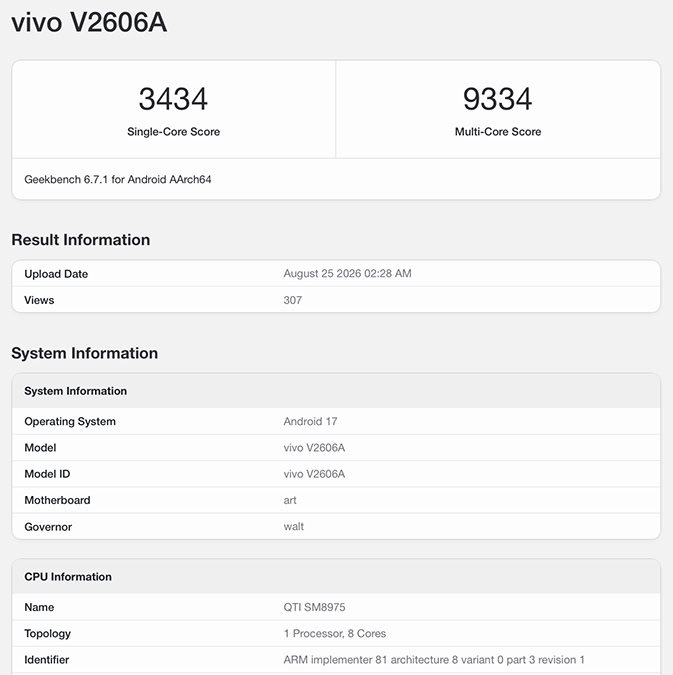
While the leaked specifications paint a picture of extraordinary performance, early benchmark results offer a more tempered view, albeit one that comes with significant caveats. The Snapdragon 8 Elite Extreme Gen 6, identified as SM8975, was recently spotted on Geekbench 6 (via NotebookCheck). The listing showed a single-core score of 3,434 points and a multi-core score of 9,334 points. Similarly, the Dimensity 9600 Pro’s Geekbench 6 run recorded a single-core score of 2,653 points and a multi-core score of 7,516 points.
At first glance, these scores appear underwhelming when compared to current-generation flagship chips like the Snapdragon 8 Elite Gen 5 or the Dimensity 9500, which typically achieve higher scores. For instance, the Snapdragon 8 Elite Gen 5 often registers single-core scores exceeding 2,200-2,300 and multi-core scores around 7,000-7,500 in Geekbench 6, while the Dimensity 9500 generally scores above 2,100 single-core and 6,500 multi-core. However, it is paramount to emphasize that these early benchmark results, particularly from pre-production devices and firmware, should be interpreted with a substantial pinch of salt.
There are several reasons why early benchmark scores can be misleading. Pre-production silicon often runs on unoptimized software and drivers, meaning the full potential of the hardware is not yet unlocked. Thermal management solutions in early prototypes may also not be finalized, leading to premature thermal throttling during sustained workloads, which artificially depresses scores. Furthermore, the testing environment or the specific device used for benchmarking might not be representative of final consumer products. As such, these initial scores are indicative of raw, unoptimized hardware performance rather than a definitive measure of the final product’s capabilities. Industry analysts expect significant improvements in benchmark performance once these chips are integrated into retail devices with mature software stacks and optimized cooling systems. Typically, a new flagship generation aims for a 15-25% improvement in CPU performance and a 20-30% improvement in GPU performance over its predecessor. The leaked clock speeds strongly suggest that the final, optimized performance will align with or exceed these generational expectations.
The Battle for Flagship Dominance: Market Context and Competition
The impending launches of the Snapdragon 8 Elite Extreme Gen 6 and the Dimensity 9600 Pro mark the intensification of the long-standing rivalry between Qualcomm and MediaTek. For years, Qualcomm’s Snapdragon series has been the de facto choice for premium Android flagships, particularly in Western markets, owing to its consistent performance leadership, robust modem technology, and strong ecosystem support. Brands like Samsung (outside of Exynos regions), Xiaomi, OnePlus, and Asus have historically relied on Snapdragon for their top-tier offerings.
MediaTek, however, has made significant strides in recent years. After a period focusing on mid-range and budget chipsets, the company strategically re-entered the high-end market with its Dimensity series. By focusing on competitive performance, advanced features, and aggressive pricing, MediaTek has successfully positioned its Dimensity chips as viable alternatives to Snapdragon, particularly gaining traction with Chinese OEMs like Vivo, Oppo, and Xiaomi in various regions. The adoption of TSMC’s 2nm process for both upcoming chips underscores the parity in manufacturing technology that MediaTek has achieved, allowing them to compete head-to-head on a fundamental hardware level.
This heightened competition is beneficial for consumers and the industry at large. It forces both companies to innovate more rapidly, pushing the boundaries of performance and efficiency. Smartphone manufacturers will have compelling options from both vendors, potentially leading to more diverse product offerings and competitive pricing in the flagship segment. The choice between Snapdragon and Dimensity often comes down to specific optimizations, modem performance, and the unique features each platform offers, beyond just raw CPU/GPU power. For instance, Qualcomm’s integration of advanced AI engines and dedicated security hardware remains a strong selling point for many OEMs.
Broader Implications for the Mobile Ecosystem
The introduction of these 2nm flagship chipsets with record-breaking clock speeds carries profound implications for the entire mobile ecosystem.
Firstly, Enhanced User Experience will be a direct outcome. Everyday tasks will become even smoother and more instantaneous. App launch times, multitasking, and web browsing will benefit from the raw CPU power. High-fidelity mobile gaming will reach new levels of realism and fluidity, with higher frame rates and more complex graphical effects. Applications leveraging augmented reality (AR) and virtual reality (VR) on mobile will see significant performance boosts, making these experiences more immersive and responsive.
Secondly, Power Efficiency and Battery Life are critical. While higher clock speeds might suggest increased power consumption, the transition to the 2nm manufacturing process is specifically designed to improve efficiency. This means that despite the substantial performance gains, new flagship phones might still offer comparable or even improved battery life compared to their predecessors. The balance between raw power and efficient operation is a constant challenge for chip designers, and 2nm is expected to be a key enabler in this regard.
Thirdly, The Role of On-Device AI will continue to expand. Both Qualcomm and MediaTek are heavily investing in neural processing units (NPUs) and AI acceleration. The enhanced computational power of these new chips will facilitate more sophisticated on-device AI capabilities, enabling advancements in areas such as computational photography (e.g., real-time image processing, advanced bokeh effects, low-light enhancements), natural language processing, predictive text, voice assistants, and personalized user experiences. This on-device AI reduces reliance on cloud processing, improving privacy, speed, and efficiency.
Finally, these chipsets will dictate the Future Trends in Smartphone Hardware. Their capabilities will enable OEMs to integrate more advanced camera sensors, higher refresh rate displays, faster storage technologies, and more robust connectivity options (like advanced 5G and Wi-Fi standards). The intense competition will drive innovation not just in silicon, but across the entire smartphone design paradigm, leading to more powerful, versatile, and intelligent devices for consumers.
Anticipated Launch and Device Availability
The official unveiling of these groundbreaking chipsets is anticipated in the coming months. Qualcomm is traditionally expected to announce its new Snapdragon 8 Elite Gen 6 series, including the Elite Extreme variant, at its annual Snapdragon Summit, typically held in late October or early November. This event serves as the primary platform for Qualcomm to detail its latest mobile platforms and outline its technological roadmap.
MediaTek is also expected to follow a similar timeline, potentially announcing the Dimensity 9600 Pro in November, aligning with the launch timeline of the Dimensity 9500 last year. This synchronized release schedule ensures that both companies have their flagship offerings ready for the next wave of smartphone releases, which typically begin in late 2025 and extend throughout 2026.
Following their announcements, the first smartphones featuring these new processors are expected to hit the market in early 2026. Historically, Chinese manufacturers like Xiaomi, OnePlus, and Vivo are often among the first to integrate Qualcomm’s latest Snapdragon chips, while many Asian brands quickly adopt MediaTek’s Dimensity platforms. Industry analysts predict a rapid adoption cycle, with these 2nm chips quickly becoming the standard for premium Android devices, setting new benchmarks for performance and user experience in the year ahead.