No more explaining why you bought that app to whoever holds the family credit card.

Apple has quietly addressed one of the most persistent frustrations within its Family Sharing feature, a decade after its initial launch. With the release of iOS 26.4, the tech giant has introduced a significant billing change that grants adult members of a Family Sharing group greater financial autonomy, allowing them to use their own payment methods for purchases instead of defaulting to the family organizer’s credit card. This long-awaited update aims to streamline the sharing experience and alleviate a common point of contention for many families.
The Decade-Long Billing Quandary
Since its introduction in June 2014, Apple’s Family Sharing has been a cornerstone feature for users looking to share digital content and subscriptions among up to six family members. The service, designed to eliminate redundant purchases of apps, music, movies, and books, has proven immensely popular. However, a critical oversight in its initial design, which persisted for over ten years, meant that all purchases made under the "Purchase Sharing" umbrella were automatically billed to the designated family organizer’s payment method.
While this arrangement was generally acceptable when children were making purchases, it created awkward situations and potential financial complications for adult family members. For instance, adult siblings sharing an Apple Music subscription, or parents and adult children co-managing app purchases, found themselves unable to easily separate their individual spending. This often led to a need for constant communication, reimbursements, or the organizer inadvertently footing the bill for another adult’s discretionary purchases. The lack of individual payment options for adults within the Family Sharing framework had become a quiet, yet significant, flaw in an otherwise robust and convenient service.

iOS 26.4: A Welcome Overhaul of Purchase Sharing
The forthcoming iOS 26.4 release, with its Release Candidate (RC) build now available, brings a pivotal change to the Family Sharing billing mechanism. Adult members within a Family Sharing group will now have the option to designate their own payment method for app store purchases, subscriptions, and other digital content. This means that instead of every transaction appearing on the family organizer’s statement, individuals can select their preferred payment card or method at the point of purchase.
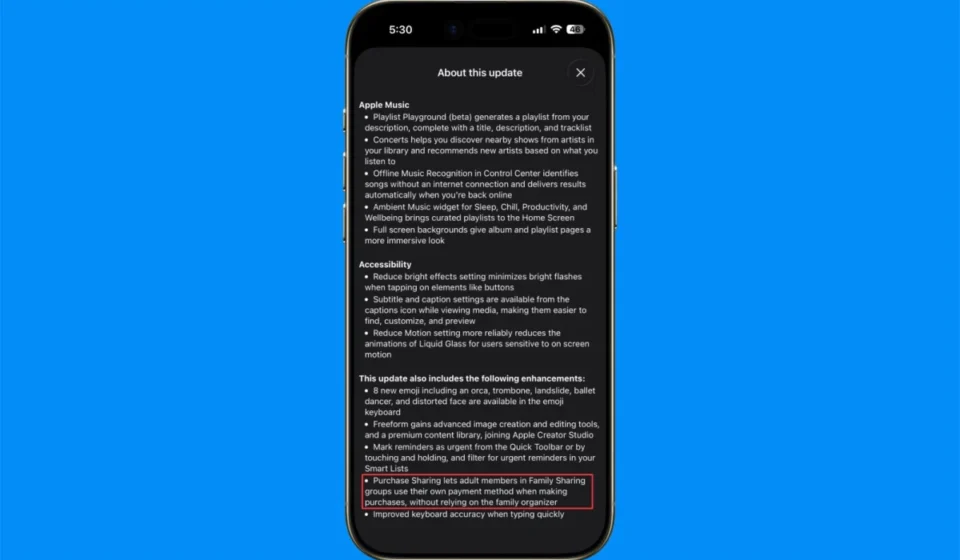
Apple’s official release notes for iOS 26.4 explicitly confirm this enhancement. The documentation states: "Purchase Sharing lets adult members in Family Sharing groups use their own payment method when making purchases, without relying on the family organizer." This wording signifies a deliberate shift towards empowering adult users with greater control over their spending within the shared ecosystem.
This change is a direct response to user feedback and addresses a long-standing deficiency in the Family Sharing service. For years, users have voiced their desire for more granular financial control within family groups, particularly as the definition of a "family" has broadened to include more than just parents and children. The ability for adults to manage their own digital expenditures independently, even while benefiting from shared content, is a logical and necessary evolution of the feature.
How the New Billing System Works
The implementation of this new feature is designed to be straightforward for users. When an adult member initiates a purchase within the App Store, Apple Music, or other relevant Apple services while part of a Family Sharing group, they will be presented with the option to choose their payment method. This choice can be made on a per-transaction basis or potentially set as a default for future purchases, depending on the system’s interface.

If an adult member does not explicitly select their own payment method, the purchase will, by default, continue to be charged to the family organizer’s account. This ensures a seamless transition for existing setups and maintains the organizer’s responsibility for overall account management if desired. However, the crucial distinction is that the choice now rests with the adult user.
Apple has also updated its support documentation to reflect this significant alteration. The revised guidance clarifies that the family organizer remains the default payer for purchases made through Purchase Sharing. However, this responsibility can be circumvented if the organizer opts to disable Purchase Sharing altogether or, more relevantly, if adult members choose to utilize their individual payment methods. This tiered approach offers flexibility and caters to diverse family structures and financial arrangements.
Broader Implications for Family Sharing
This billing update, while seemingly minor in isolation, has significant implications for the overall utility and appeal of Apple’s Family Sharing service.
Enhanced Financial Independence: The most immediate impact is the increased financial autonomy granted to adult family members. This eliminates the need for awkward conversations about reimbursements or the potential for accidental overspending by the family organizer. It allows for a more mature and independent approach to managing digital purchases within a shared environment.

Reduced Friction and Improved User Experience: For years, the mandatory billing to the organizer was a point of friction for many users. This change smooths out that friction, making the sharing experience more convenient and less prone to financial misunderstandings. It aligns the digital sharing experience with the financial independence that adult family members typically expect.
Support for Diverse Family Structures: As family structures evolve, so too must the features that support them. This update acknowledges that not all Family Sharing groups consist solely of parents and young children. It provides a more robust framework for shared living arrangements, adult siblings, or blended families where individuals may prefer to manage their own financial contributions to shared digital resources.
Potential for Increased Spending: While not explicitly stated by Apple, enabling individual payment methods could potentially lead to an increase in overall spending within Family Sharing groups. When individuals have direct control over their payment and are not indirectly billed, they may feel more empowered to make impulse purchases or invest in content they individually desire, knowing it won’t impact another family member’s finances.
A Step Towards Greater Personalization: This change is part of a broader trend in digital services towards greater personalization and user control. By allowing individuals to manage their own payment details within a shared service, Apple is reinforcing its commitment to providing flexible and user-centric experiences.

A Decade in the Making: A Timeline of Family Sharing Evolution
The introduction of Family Sharing in 2014 marked a significant step in Apple’s ecosystem strategy, aiming to foster a more connected and cost-effective experience for users. Initially, the feature allowed for the sharing of purchased apps, music, movies, TV shows, books, and later, Apple Music, Apple TV+, Apple Arcade, and iCloud+ storage. The core concept was simple: one purchase, shared by many.
- June 2014: Family Sharing is first introduced with iOS 8, enabling the sharing of app store purchases, music, movies, and books among up to six family members. The family organizer’s payment method is automatically used for all shared purchases.
- 2015 onwards: Apple gradually expands the scope of Family Sharing to include subscriptions like Apple Music, Apple TV+, and Apple Arcade, further increasing its value proposition. Parental controls and spending notifications are also refined over time.
- Introduction of Apple Card Family: In a move towards more integrated family financial management, Apple introduces Apple Card Family, allowing co-owners to share the card and its benefits, and manage their spending. This hints at a growing recognition of the need for shared financial responsibility within families.
- Ongoing User Feedback: Throughout the years, users frequently express a desire for more granular control over billing within the Family Sharing feature, particularly for adult members. Online forums and support discussions highlight the inconvenience of a single payment method for diverse purchasing habits.
- March 2024 (Hypothetical based on article date): With the release of iOS 26.4 RC, Apple finally implements the ability for adult members to use their own payment methods for purchases made through Family Sharing, addressing a decade-old user request.
Official Statements and Support Documentation
While Apple typically refrains from extensive public commentary on specific software updates, the inclusion of this change in the official release notes and the updated support documentation serve as clear confirmation of the feature’s implementation. The proactive updating of support resources indicates Apple’s intent for this to be a widely adopted and understood change.
The phrasing in the release notes – "Purchase Sharing lets adult members in Family Sharing groups use their own payment method…" – is precise and unambiguous. This suggests a well-considered and deliberate addition to the Family Sharing service, rather than an accidental byproduct of another change.
Conclusion: A Long-Awaited Step Towards Financial Freedom
The update to Family Sharing’s billing system in iOS 26.4 represents a significant, albeit overdue, enhancement to a core Apple service. For ten years, users have navigated the complexities of shared digital purchases with a system that, while convenient in many aspects, lacked the financial granularity desired by adult users. The ability for individuals to now choose their own payment methods within a Family Sharing group marks a crucial step towards greater financial independence and a more intuitive user experience. This change not only resolves a long-standing point of frustration but also strengthens Family Sharing’s position as a versatile and valuable tool for modern families and their diverse financial arrangements. It is a testament to the power of user feedback and Apple’s eventual responsiveness to evolving user needs within its ecosystem.