
Nvidia Earnings Report Signals Shift in Artificial Intelligence Market Dynamics as Investor Expectations Reach Record Highs

The recent fiscal disclosure from Nvidia Corporation has provided a comprehensive look into the current state of the global artificial intelligence (AI) sector, revealing a complex landscape where record-breaking financial performance is increasingly met with heightened market scrutiny. Despite reporting revenue and earnings that significantly surpassed consensus estimates, the company experienced a notable decline in its share price during after-hours trading, suggesting a fundamental shift in how investors are valuing the primary drivers of the AI revolution. This phenomenon, characterized by analysts as a transition from early-stage speculation to a focus on sustainable execution and infrastructure rotation, marks a pivotal moment for the technology sector and the broader equity markets.
Fiscal Performance and the "Beat the Spread" Dynamic
For the most recent quarter, Nvidia reported earnings of $1.62 per share on total revenue of $68.1 billion. These figures comfortably exceeded Wall Street’s expectations, which had forecasted earnings of $1.53 per share on revenue of approximately $65.8 billion. The data represents a 73% increase in revenue compared to the same period in the previous fiscal year, a growth rate that remains nearly unprecedented for a company with a multi-trillion-dollar market capitalization.
A critical component of this growth remains the company’s Data Center division, which generated $62.3 billion in revenue during the quarter. This segment, which includes the high-performance graphics processing units (GPUs) essential for training large language models (LLMs) and running generative AI applications, continues to be the primary engine of Nvidia’s financial ascent. Furthermore, the company issued guidance for the upcoming quarter, projecting revenue of roughly $78 billion—well above the $72.8 billion anticipated by analysts.
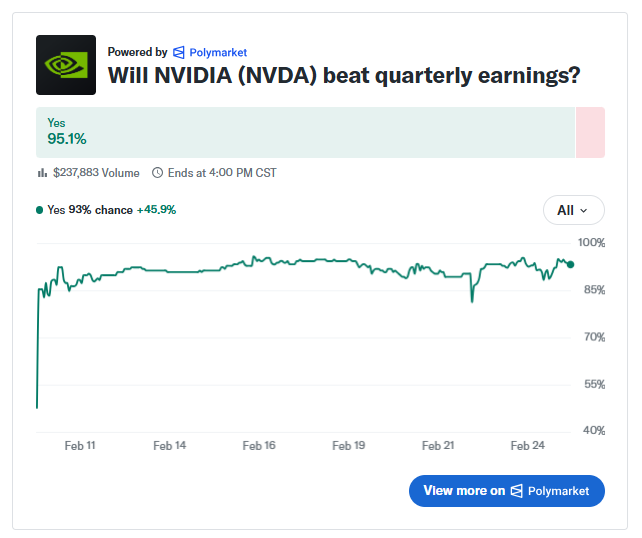
However, the immediate market reaction saw Nvidia’s stock price retreat by nearly 4%. Financial analysts attribute this disconnect to the "physics of expectations." In the lead-up to the announcement, probability markets and "whisper numbers"—unofficial earnings targets held by high-level traders—had moved significantly higher than the official consensus. Some aggressive models had anticipated revenue closer to $80 billion. When a corporation reaches the scale and influence of Nvidia, traditional "beats" are often insufficient to maintain upward momentum if they do not exceed the most optimistic projections of the market’s most bullish participants.
A Chronology of the AI Ascent: 2022 to Present
The current market environment is the culmination of a rapid acceleration in compute demand that began in late 2022. To understand the significance of Nvidia’s latest report, it is necessary to examine the timeline of the AI buildout:
- November 2022: The release of ChatGPT by OpenAI serves as a catalyst, demonstrating the commercial and consumer potential of generative AI.
- Early 2023: "Hyperscalers"—including Microsoft, Alphabet, Amazon, and Meta—begin a massive reallocation of capital toward AI infrastructure, leading to a shortage of Nvidia’s H100 chips.
- May 2023: Nvidia stuns the market with a massive guidance raise, signaling that the AI boom is a tangible revenue event rather than a theoretical trend.
- 2024: The market enters what is being termed "Stage 1" of the AI Dislocation. During this phase, investment is concentrated in the "obvious" leaders—the chip designers and the cloud service providers.
- Present Day: Nvidia’s latest report suggests the beginning of "Stage 2." While demand for chips remains robust, the market is starting to look toward the secondary layer of the AI ecosystem: power management, thermal cooling, and networking infrastructure.
The Broader Ecosystem and Infrastructure Demand
Nvidia’s results do not exist in a vacuum. The broader AI supply chain continues to show signs of intense activity, though the focus is beginning to broaden. Companies that provide the physical infrastructure required to house and cool massive GPU clusters are seeing significant growth.

Super Micro Computer, Inc. (SMCI), a key partner in providing AI server solutions, has recently reported triple-digit sales growth, mirroring the demand seen by Nvidia. Similarly, Vertiv Holdings, a specialist in data center power and cooling technologies, has delivered strong guidance, reflecting the increasing technical challenges of managing the heat generated by high-density AI chips.
On the manufacturing side, Taiwan Semiconductor Manufacturing Co. Ltd. (TSMC), which produces the physical silicon for Nvidia, reported January sales growth of 37%. This figure was notably higher than the firm’s prior guidance of 30%, indicating that the "bottleneck" in the AI trade is shifting from chip design to manufacturing capacity and infrastructure deployment.
Strategic Challenges and Geopolitical Headwinds
Despite the robust demand, Nvidia faces several structural challenges that contributed to the post-earnings sell-off. Chief among these is the ongoing uncertainty regarding the Chinese market. Due to U.S. export controls and licensing restrictions on advanced semiconductors, Nvidia has been forced to navigate a fluid regulatory environment. The company has excluded certain China-based data center revenue from specific forward-looking forecasts, creating a layer of opacity for investors concerned about long-term global scale.
Additionally, questions regarding the sustainability of AI capital expenditures are becoming more prominent. The "Big Four" hyperscalers are projected to spend approximately $650 billion on AI-related capital expenditures by 2026. While Nvidia CEO Jensen Huang has emphasized that customers are already seeing a return on investment (ROI) through improved productivity and new service offerings, some market participants remain skeptical about whether the revenue generated by AI software can keep pace with the massive cost of the hardware required to run it.
Technical Market Factors and Options Positioning
The decline in share price following the earnings beat was also influenced by technical market mechanics. Nvidia is currently one of the most heavily traded securities in the world, with a massive volume of options activity tied to its earnings dates.
Market makers, who sell options to investors, must hedge their positions by buying or selling the underlying stock. When a significant number of "covered calls" are written or when volatility reaches an extreme peak prior to an announcement, the subsequent "unwinding" of these hedges can create downward pressure on the stock price, regardless of the fundamental quality of the earnings report. This mechanical selling often masks the underlying strength of the company’s fiscal health.
Analysis of the "AI Dislocation" and Market Rotation
The concept of an "AI Dislocation" suggests that the market is entering a phase of leadership rotation. In the initial stage of any technological shift, the primary beneficiaries are the pioneers who provide the foundational technology. However, as the technology matures, the "enablers"—the companies that provide the networking backbone, power systems, and specialized equipment—often begin to show faster earnings acceleration relative to their market valuations.
This transition is evidenced by the diversifying interests of institutional investors. While Nvidia remains the "gold standard" for AI compute, capital is increasingly flowing into overlooked sectors that are essential for the next phase of the buildout. These include:
- Power Infrastructure: The electrical grid requirements for AI data centers are orders of magnitude higher than traditional cloud computing. Companies specializing in transformers, grid stability, and renewable energy integration are becoming critical components of the AI trade.
- Thermal Management: Advanced liquid cooling is becoming a necessity as chip density increases, benefiting specialized engineering firms.
- Edge Computing: As AI shifts from training massive models to "inference" (running the models in real-world applications), demand is expected to rise for chips and systems that can operate outside of centralized data centers.
Broader Impact and Economic Implications
The implications of Nvidia’s performance extend beyond the technology sector. The massive capital deployment in AI is acting as a significant driver of global economic activity. The $650 billion in projected capex by 2026 represents a historic investment in digital infrastructure that could lead to broader productivity gains across the healthcare, finance, and manufacturing industries.
However, the "rising bar" for AI companies suggests that the era of "easy gains" based on hype may be concluding. Investors are now demanding visible cash flow and clear evidence of monetization. Nvidia’s ability to compress its forward valuation through sheer earnings growth—rather than through a declining stock price—suggests that the company is not in a speculative bubble, but is rather a victim of its own extraordinary success in raising the standard for corporate performance.
Future Outlook and Conclusion
Nvidia’s latest earnings report confirms that the demand for artificial intelligence remains the most powerful force in the current global economy. The company’s ability to generate $68.1 billion in a single quarter, with a 73% growth rate, underscores its dominance in the semiconductor space.
Nevertheless, the market’s reaction serves as a reminder that as a technology moves from the "early adopter" phase to "mass deployment," the criteria for investment success changes. The focus is shifting from who can build the fastest chip to who can build and sustain the most efficient infrastructure. While Nvidia is expected to remain a central figure in this evolution, the "AI Dislocation" indicates that the next phase of market growth may come from the broader ecosystem of companies that enable the AI revolution to function at scale. For the global markets, the challenge now lies in identifying the "Stage 2" winners as the pioneers of the industry reach a level of scale where perfection is the only acceptable baseline.