
Political Gridlock and the Historical Correlation with Market Growth through the 2027 Artificial Intelligence Cycle

The recent shift in the balance of power within the United States Congress following the midterm elections has established a divided government, a development that historically correlates with significant periods of stock market appreciation. While the transition to a Democrat-led Congress alongside the Trump administration suggests a period of legislative friction, market historians and financial analysts point to a recurring pattern where political stalemate provides a predictable environment for Wall Street. This phenomenon, often referred to as "gridlock," limits the potential for sweeping legislative changes that could disrupt corporate earnings or alter tax structures, thereby allowing market fundamentals and technological innovation to dictate the trajectory of the S&P 500. As the financial sector looks toward 2027, the convergence of historical seasonal trends, robust corporate earnings, and the ongoing expansion of the artificial intelligence (AI) sector suggests a favorable outlook for disciplined investors despite the perceived volatility in Washington.
The Historical Precedent of Divided Government
The current political landscape mirrors several key moments in American history where an underdog or a perceived stalemate resulted in unexpected outcomes. In the sporting world, the 2000 Olympic wrestling match between Rulon Gardner and Aleksandr Karelin serves as a poignant metaphor for the current legislative environment. Karelin, a Russian heavyweight who had remained undefeated in international competition for 13 years, lost his dominance due to a single technical error during a clinch. Similarly, in the political arena, when two powerful forces—the executive and legislative branches—are locked in a struggle for control, the resulting "clinch" often prevents either side from gaining a decisive advantage.
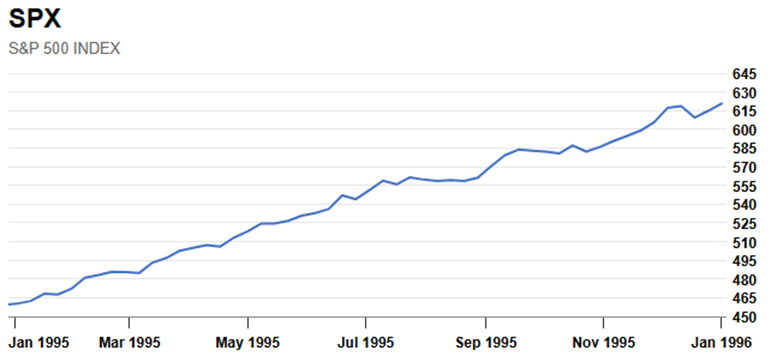
For investors, this lack of movement is frequently viewed as a positive. When neither party can unilaterally push through an aggressive agenda, the regulatory and fiscal environment remains relatively stable. The most cited example of this occurred following the 1994 midterm elections. At that time, Republicans gained control of both the House of Representatives and the Senate for the first time in four decades, creating a sharp ideological divide with President Bill Clinton. Despite contemporary warnings from media outlets, such as the Los Angeles Times, which questioned if the bull market was experiencing its "last gasp," the reality was quite different. In 1995, the S&P 500 surged by more than 34%, marking the beginning of a historic technology-led expansion fueled by the early commercialization of the internet.
Comparative Analysis: The Internet Boom vs. The AI Revolution
The parallels between the mid-1990s and the current environment are centered on technological transformation. Just as the 1995 Netscape IPO signaled the dawn of the dot-com era, the current aggressive deployment of artificial intelligence is reshaping the global economy. Market data indicates that the scale of investment in AI infrastructure is unprecedented. Major technology firms are committing hundreds of billions of dollars toward the development of advanced data centers, specialized computer chips, and the power infrastructure required to sustain them.
Analysts suggest that while a divided Congress may introduce hurdles—such as debates over energy consumption and consumer protection reforms—the momentum of the AI sector is largely decoupled from legislative cycles. The demand for high-performance computing is driven by global competition and corporate efficiency needs rather than domestic policy alone. Furthermore, the economic benefits of AI infrastructure, including job creation and localized tax revenue, provide a bipartisan incentive for state and local governments to support these projects, even if federal leadership remains in a state of gridlock.

Chronology of Market Performance and Seasonality
Historical data provides a compelling timeline for the months following a midterm election. Since 1942, the S&P 500 has consistently demonstrated a "perfect" track record of gains between the November of a midterm year and the following June. In all 21 instances during this period, the index has risen, with an average appreciation of approximately 16%. This trend is often attributed to the resolution of political uncertainty; once the composition of Congress is decided, businesses can plan for the next two years with a clearer understanding of the legislative hurdles they may face.
This historical trend aligns with the broader seasonal patterns identified in the Stock Trader’s Almanac. Data spanning back to 1945 shows that the six-month window from November through April is historically the strongest period for equity markets, yielding an average gain of 7%. In contrast, the period from May to October typically sees more modest growth, averaging around 2%. When these seasonal tailwinds coincide with the conclusion of a midterm cycle, the probability of a sustained rally increases significantly.
Corporate Earnings and Economic Indicators
Beyond political and seasonal factors, the fundamental health of American corporations remains a primary driver of market optimism. According to recent data from FactSet, the S&P 500 is currently exhibiting remarkable earnings momentum. In the third quarter, reporting companies showed a 30.2% growth in earnings, with 82% of those firms exceeding analysts’ consensus estimates. This growth is not confined to a single sector; all 11 sectors of the S&P 500 reported year-over-year earnings increases, with Energy, Technology, and Materials leading the expansion.
Financial analysts have noted a rare trend in the fourth-quarter outlook. Typically, analysts lower their earnings estimates as a quarter progresses; however, current projections for the fourth quarter have been revised upward, with a forecasted 28.4% jump in earnings. This suggests that corporate efficiency and demand remain resilient despite broader macroeconomic concerns regarding inflation and interest rates.
Market Rotation and the "Selective Growth" Strategy
While the macro outlook appears positive, the internal dynamics of the market suggest a shift in leadership. Following the recent elections, Wall Street has engaged in a significant "market rotation." This process involves investors moving capital out of sectors that have reached peak valuation and into areas perceived to have better growth potential or lower risk under the new political configuration.
Initial post-election volatility was characterized by short covering—where investors who bet against certain stocks were forced to buy shares to cover their positions—leading to a temporary bounce in stocks with weaker fundamentals. Simultaneously, some of the highest-performing AI stocks experienced profit-taking as institutional investors locked in gains. However, analysts observe that these rotations are often temporary. Historically, stocks with superior earnings and strong fundamentals (often described as "tennis balls") tend to recover quickly from pullbacks, whereas stocks with poor fundamentals ("rocks") fail to sustain their momentum.
As the market enters 2027, the breadth of the rally is expected to narrow. The "buy-everything" phase of the AI boom is transitioning into a more discerning environment where investors prioritize companies with clear paths to profitability and sustainable competitive advantages.
Regulatory Implications and Broader Impact
The divided government is expected to focus its oversight on the practical implications of the AI buildout. Specifically, the high electricity demands of data centers have become a point of contention. Lawmakers in various states are considering reforms to ensure that the massive energy needs of tech giants do not lead to significant price increases for residential consumers. While these localized regulatory shifts may alter the geographic distribution of new projects, they are unlikely to halt the overall trajectory of the industry.
The broader implication for the 2027 outlook is one of "managed growth." The gridlock in Washington serves as a buffer against radical shifts in corporate tax policy or antitrust enforcement that could otherwise stifle innovation. By maintaining the status quo, the government inadvertently provides a stable backdrop for the private sector to continue its capital expenditure programs.
Conclusion and Future Outlook
The convergence of political gridlock, favorable seasonality, and record-breaking corporate earnings creates a unique set of circumstances for the final years of the decade. While the legislative "clinch" in Washington may dominate news headlines, the underlying economic data suggests a robust environment for equity markets. Investors who focus on fundamental analysis and recognize the long-term potential of the AI-driven economy are likely to find significant opportunities as the market navigates the complexities of a divided government.
The resilience of the S&P 500 following midterm elections is a well-documented phenomenon, and the current cycle appears to be following this historical script. As 2027 approaches, the primary challenge for market participants will be navigating the rotation of leadership within the tech and energy sectors, ensuring that capital is allocated to companies with the earnings power to withstand the inevitable bumps in the political and economic landscape. In this environment, selectivity and a focus on corporate fundamentals remain the most effective tools for navigating the "gridlock rally."