Steve Jobs’ Eighth-Grade Science Project, "What is the SCR?", Fetches Over $34,000 at Auction

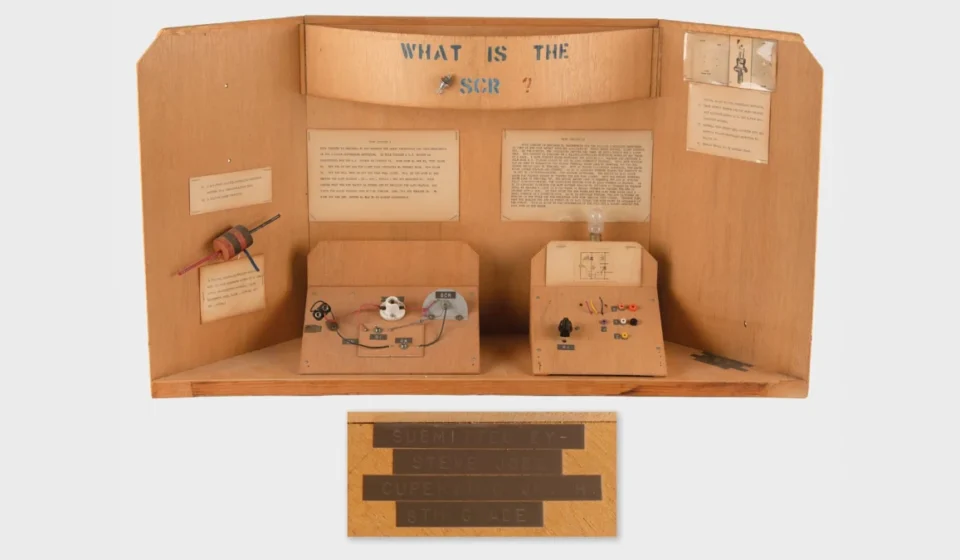
A tangible piece of Silicon Valley history, an eighth-grade science project meticulously crafted by Apple co-founder Steve Jobs, has sold for a remarkable $34,375 at auction. The project, titled "What is the SCR?", offers a rare glimpse into the nascent technical curiosity of one of the most influential figures in modern technology. The sale, conducted by RR Auction, underscores the enduring fascination with Jobs’ early life and the origins of his innovative spirit.
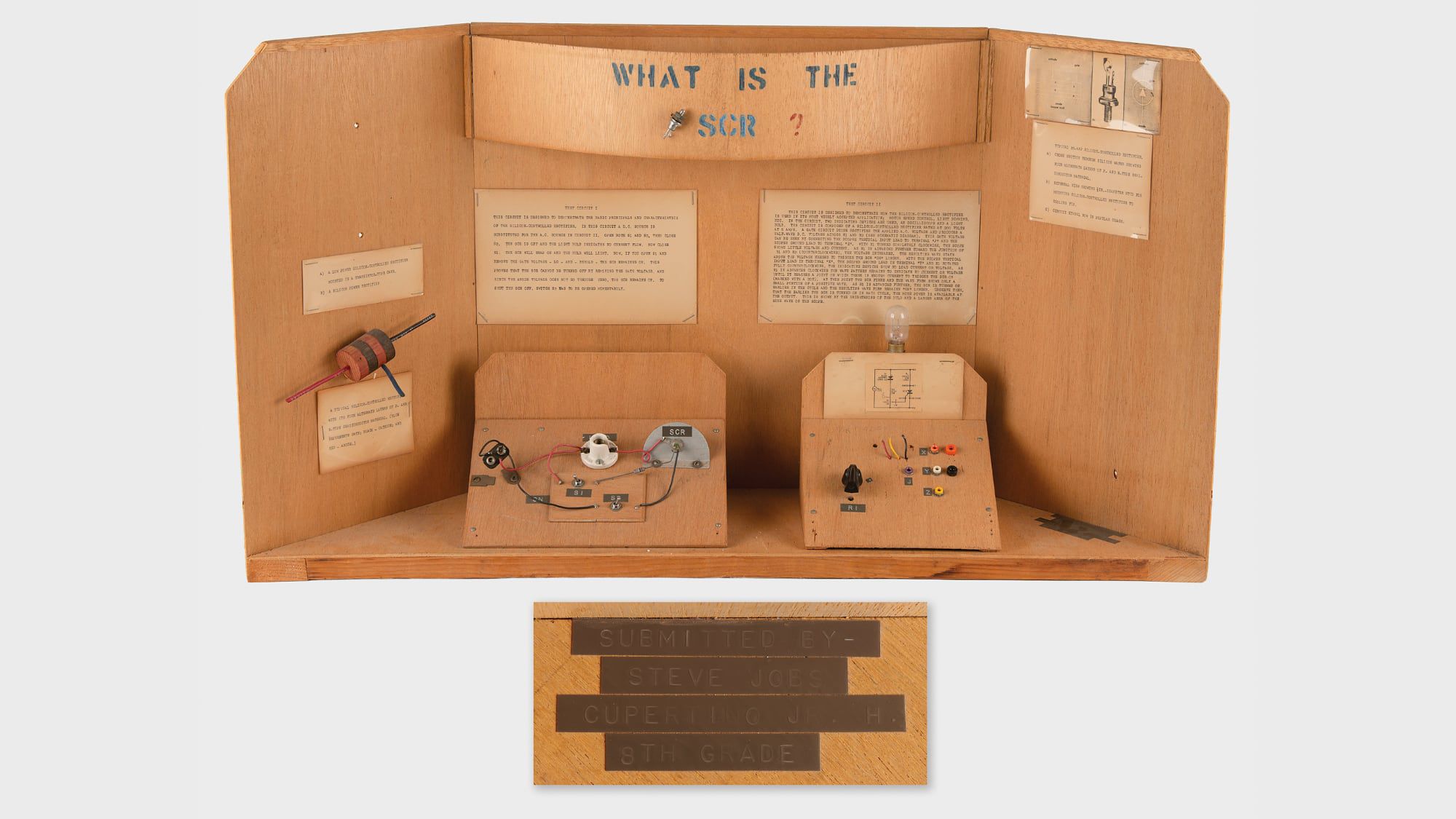
The artifact, dated February 29, 1968, showcases a young Jobs’ engagement with fundamental electronic principles. At the time, Jobs was a student at Cupertino Junior High. The exhibit comprises a plywood display board featuring three distinct explanatory panels and a 10-page report, all dedicated to the silicon-controlled rectifier (SCR). This device, a type of thyristor, plays a crucial role in power electronics, enabling the control of high-power electrical circuits.
A Deeper Dive into Jobs’ Eighth-Grade Endeavor
The left panel of the display board features a wooden model meticulously constructed to represent a "typical silicon-controlled rectifier with its four alternate layers of P- and N-Type semiconductor material." This hands-on approach to visualization demonstrates Jobs’ commitment to understanding and communicating complex concepts. The central section of the display is dedicated to test circuits designed to illustrate the fundamental principles and operational characteristics of the SCR. These circuits also highlight its common applications, indicating Jobs’ focus on practical relevance. The right panel offers a more detailed technical illustration: a diagram and description of a 25-amp silicon-controlled rectifier, suggesting an exploration of its power handling capabilities.
The project is clearly labeled with "Steve Jobs’" name, and the accompanying report bears the full "What is the Silicon-Controlled Rectifier by Steve Jobs, Science, Mrs. Yakel, Feb. 29, 1968." This attribution firmly places the work within an academic context, acknowledging his teacher, Mrs. Yakel, and the specific date of its completion. A handwritten note on the project itself offers a direct instruction to the judges: "plug in Circuit II and the oscilloscope to see it operate." It also includes a crucial cautionary reminder: "please unplug!" the device after testing, a testament to the practical and potentially hazardous nature of working with electrical components, even at this early stage.
The Genesis of the Artifact: A Family Connection
The provenance of this significant piece of memorabilia traces back to John Chovanec, Steve Jobs’ stepbrother. Marilyn Chovanec, John’s mother, married Paul Jobs, Steve’s father, in 1990 and continued to reside in the family home in Los Altos, California. Following the passing of Paul Jobs in 1993, Steve Jobs, who was then deeply immersed in his professional endeavors, reportedly declined to collect certain personal belongings left at the residence.
John Chovanec has recounted his efforts to prompt Steve to retrieve these items. At one point, facing potential disposal, Chovanec informed Jobs that he would keep the items himself. The reported response from Steve Jobs was a pragmatic, albeit somewhat detached, "Fine, but I don’t want to be bothered about it again." This exchange sheds light on Jobs’ focused nature and his tendency to delegate or dismiss matters he deemed less critical to his immediate priorities. It was through this familial connection that the science project, along with other artifacts, ultimately entered the public domain for auction.
A History of Prized Jobs Memorabilia
This is not the first time that items from Steve Jobs’ early life, originating from John Chovanec’s collection, have garnered significant attention and substantial bids at auction. Chovanec has previously offered a range of personal effects belonging to his famous stepbrother, including posters, magazines, bow ties, and even a desk. These past sales have consistently demonstrated a high market demand for tangible links to Jobs’ formative years and the early days of Apple.
For instance, a 1977 Apple Computer poster from Chovanec’s collection previously sold for an impressive $659,900. Another highly sought-after item, an Apple-1 Byte Shop wooden case owned by Jobs, fetched $254,375. Even seemingly less substantial items, such as a collection of Jobs’ bow ties, achieved a considerable sum of $113,580. The current sale of the eighth-grade science project, while not reaching the stratospheric figures of some of the earlier Apple memorabilia, still represents a significant financial valuation, reflecting its unique historical and personal significance.
The Significance of Early Innovations and Educational Foundations
The sale of Jobs’ science project serves as a powerful reminder of the foundational elements that shape technological pioneers. Before the iconic Macintosh, the revolutionary iPod, or the ubiquitous iPhone, there was a young student grappling with the principles of semiconductors. The SCR, a critical component in power control, hints at an early interest in the practical application of electronics, a theme that would become central to Jobs’ career at Apple.
The SCR’s ability to control the flow of electrical current is fundamental to many modern technologies, from dimmer switches and motor speed controllers to power supplies and inverters. Jobs’ exploration of this device at such a young age suggests an innate aptitude for understanding how electrical components function and their potential applications. This early engagement with tangible technology contrasts with the more abstract software development that would later define much of the tech industry.
Analyzing the Market for Tech Memorabilia
The consistent high prices achieved by Steve Jobs’ personal artifacts speak to several market dynamics. Firstly, there is an undeniable cult of personality surrounding Jobs. He is revered not just as a businessman but as a visionary who fundamentally reshaped the way we interact with technology and with each other. His ability to imbue products with emotional resonance and a seamless user experience has cemented his legacy.
Secondly, the rarity of such items plays a crucial role. Personal effects from the early years of technology giants are inherently limited. As the individuals involved move on or pass away, the available tangible links to their past become increasingly scarce, driving up demand among collectors, institutions, and enthusiasts.
Thirdly, the historical context is invaluable. Items like this science project are not just personal possessions; they are artifacts that document the evolution of an industry. They offer a narrative of innovation, tracing the journey from rudimentary experiments to the sophisticated devices that define our modern world. For collectors, owning such an item is akin to owning a piece of that history.
Broader Implications for Understanding Technological Evolution
The story of Steve Jobs’ science project also prompts reflection on the nature of innovation and the educational pathways that foster it. While formal education provided the framework, it was clearly Jobs’ intrinsic curiosity and hands-on experimentation that propelled his understanding. The project demonstrates a willingness to engage with challenging concepts and to translate them into a comprehensible, even physical, representation.
This sale highlights the ongoing public interest in the origins of major technological shifts. Understanding the early experiments and learning processes of key figures like Steve Jobs can provide valuable insights for educators, aspiring entrepreneurs, and anyone interested in the genesis of groundbreaking ideas. It underscores the idea that even the most complex innovations have humble beginnings, often rooted in childhood curiosity and a desire to understand the world around us.
The $34,375 realized for this science project is more than just a monetary figure; it represents a valuation of a historical moment, a testament to the enduring impact of Steve Jobs, and a tangible link to the early days of a technological revolution that continues to shape our lives. As technology advances at an unprecedented pace, the artifacts that document its foundational stages remain objects of intense interest and considerable value.