The AI backlash goes mainstream why Louis Navellier says don’t worry, invest where to put your AI dollars today the chart pointing to $75,000 gold.

The intersection of rapidly advancing artificial intelligence (AI) infrastructure and public sentiment has reached a critical turning point as cultural and legislative resistance enters the mainstream. While beverage brands and viral marketing campaigns highlight environmental concerns regarding the massive water consumption of data centers, institutional investors and market analysts suggest that the underlying economic momentum of the AI sector remains fundamentally sound. Simultaneously, a deteriorating fiscal outlook in the United States, marked by a national debt exceeding $40 trillion, is driving a renewed interest in gold as a hedge against what experts describe as systemic monetary disorder.
The Cultural and Legislative Pivot Against AI Infrastructure
The public perception of artificial intelligence has undergone a significant shift over the last three years. According to recent data from Pew Research, more than 50% of Americans now express more concern than excitement regarding the integration of AI into daily life. This is a marked increase from 2021, when only 37% of respondents voiced similar apprehensions. This skepticism has moved beyond abstract fears of automation and into tangible opposition toward the physical infrastructure required to power large language models and generative AI.
A recent viral advertising campaign by beverage companies Liquid Death and Garage Beer, featuring former NFL athlete Jason Kelce, underscored this sentiment. The campaign focused on the immense cooling requirements of data centers, which often consume millions of gallons of water daily to maintain server temperatures. While the advertisement utilized satirical elements, industry analysts note that the campaign’s popularity reflects a broader, non-partisan concern regarding the environmental footprint of "hyperscale" data facilities.
This cultural pushback has transitioned into the legislative arena. New York recently implemented a first-in-the-nation one-year moratorium on certain data center developments to establish environmental and utility standards. In Pennsylvania, Governor Josh Shapiro signed an executive order requiring developers to secure local municipal approval before the Department of Environmental Protection reviews permit applications. Even in traditionally pro-development states like Texas, officials have begun questioning the long-term impact of data center energy consumption on the state’s power grid.

The Economic Reality of the Data Center Boom
Despite the headlines of moratoriums and public protests, investment experts like Louis Navellier argue that the data center expansion is continuing at an unprecedented pace. Navellier points out that the current friction is a natural byproduct of an industry growing faster than its regulatory and supply chain frameworks can accommodate.
Data from Stanford University’s AI Index Report supports this perspective. As of the end of 2023, there were approximately 5,427 data centers operating in the United States. Current projections indicate that this number could nearly double, with nearly 4,000 new facilities in various stages of planning. Of those, approximately 802 are currently under active construction. Furthermore, data center construction spending rose 7% in June 2024 to an annualized rate of $68.3 billion, representing a 46% increase year-over-year.
Analysts suggest that reports of project cancellations are often misinterpreted. In high-growth sectors, "planned" projects frequently include non-binding letters of intent or preliminary real estate filings that were never guaranteed to reach the construction phase. Additionally, supply chain constraints for specialized components, such as high-end GPUs and industrial cooling systems, have led to delays that are being mistaken for a lack of demand. Navellier maintains that the fundamental need for computational power ensures that the "shovels-in-the-ground" reality will eventually outpace local legislative pauses.
Strategic Shifts in AI Investment
As the first wave of the AI boom matures, the investment landscape is shifting from speculative software applications to the physical and mechanical rungs of the AI ladder. Market experts, including Navellier, Luke Lango, and Eric Fry, have noted that the "multi-bagger" returns of the future are likely to be found in infrastructure, energy solutions, and robotics—sectors that Wall Street has not yet fully priced in.
The current recommendation for investors is a "sort, don’t sell" strategy. This involves identifying companies that provide the essential components for data center reliability, such as power management and advanced thermal regulation, rather than focusing solely on consumer-facing AI applications. Robotics, in particular, is viewed as the next frontier where AI will bridge the gap between digital intelligence and physical labor, potentially creating a secondary boom in industrial automation stocks.
Fiscal Instability and the $40 Trillion Debt Milestone
While the tech sector grapples with infrastructure challenges, the broader macroeconomic environment is being shaped by a historic surge in U.S. national debt. Last week, the total federal debt officially crossed the $40 trillion threshold. To put this figure in perspective, the national debt has doubled since 2017.
The United States is currently borrowing approximately $6 billion per day. A significant portion of this borrowing is dedicated to servicing existing debt; annual interest payments have reached roughly $1.1 trillion. For the first time in modern history, the U.S. government spends more on interest payments than it does on its entire national defense budget. Projections from the nonpartisan Peter G. Peterson Foundation suggest that on the current trajectory, the debt will reach $50 trillion within the next six years.
This fiscal situation reached a point of visible stress last week when Treasury Secretary Scott Bessent announced that the Treasury would begin "making a market" for its own long-dated debt. By doubling the government’s buybacks of long-term Treasuries, the Treasury is effectively manufacturing demand for its own securities. Market observers note that when the issuer of the world’s "risk-free" benchmark must intervene to ensure liquidity, it signals a profound level of disorder in the global financial system.
The Case for Gold in a Disordered Economy
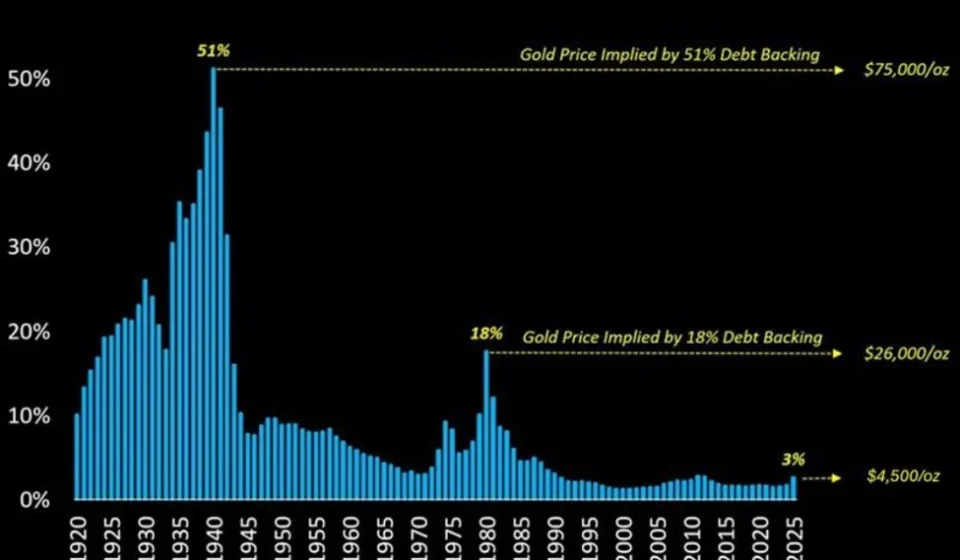
Historically, gold has served as the primary beneficiary of monetary and fiscal instability. Analysts are now looking at the "backing ratio"—the percentage of federal debt backed by the value of U.S. gold reserves—as a metric for potential future gold prices.
In 1940, during the fiscal pressures of the World War II era, the backing ratio reached 51%. By 1980, following a decade of high inflation, the ratio stood at 18%. Today, that figure has plummeted to just 3%. If the market were to demand a return to the 18% backing level seen in the 1980s, the implied price of gold would need to rise to approximately $26,000 per ounce. A return to the 1940s level of 51% would imply a gold price of $75,000 per ounce.
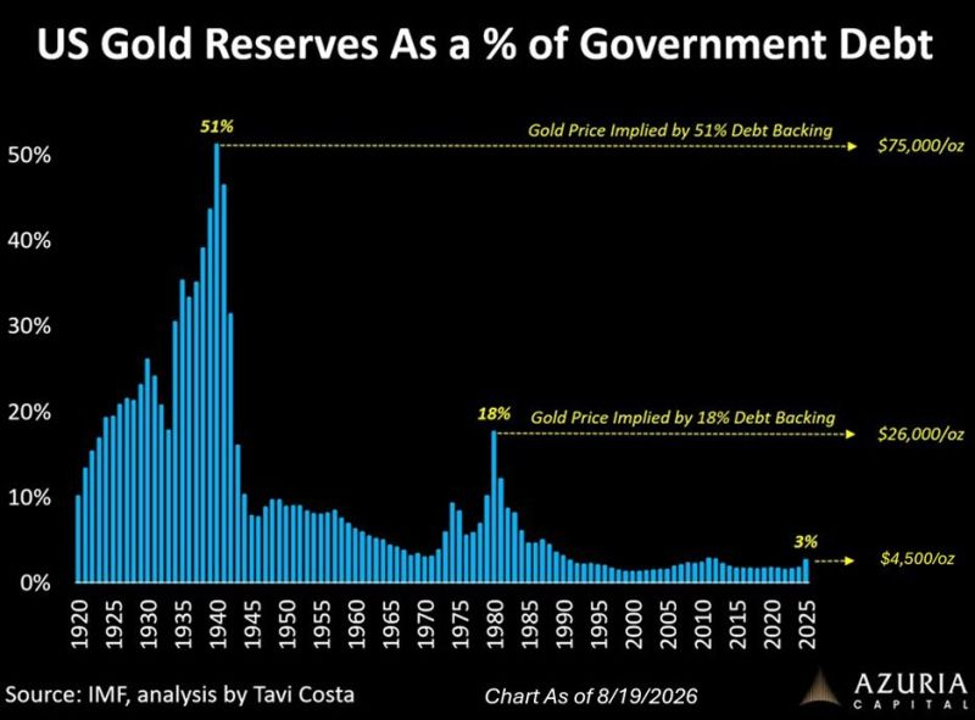
While these figures represent extreme scenarios, they highlight the asymmetry of the current gold market. Even a minor correction toward historical norms could result in significant gains for gold holders. Investors are currently utilizing two primary avenues for gold exposure:
- Physical Proxies: Exchange-traded funds (ETFs) like the SPDR Gold Shares (GLD), which track the spot price of the metal.
- Gold Miners: Companies such as Westgold Resources (WGXRF), which offer leveraged exposure. Because miners’ operating costs are relatively fixed, any increase in the price of gold flows directly to their bottom-line profits, often resulting in stock price movements that outperform the metal itself.
Broader Implications and Conclusion
The dual narratives of the AI infrastructure boom and the U.S. debt crisis represent two sides of the same economic coin: a drive for technological dominance fueled by unprecedented capital expenditure, set against a backdrop of systemic fiscal fragility.
The backlash against data centers is likely to result in more stringent regulations and a shift toward "green" data infrastructure, but it is unlikely to halt the long-term demand for AI processing power. Simultaneously, the escalation of the national debt and the Treasury’s unconventional market-making activities suggest that traditional safe-haven assets like gold will play an increasingly central role in diversified portfolios.
As the "AI Revolution" enters its next phase, the winners will likely be those who can navigate the friction between public sentiment and industrial necessity, while maintaining a hedge against the growing volatility of the U.S. dollar and the global debt market. The coming years will test the resilience of both the digital and the monetary foundations of the modern economy.