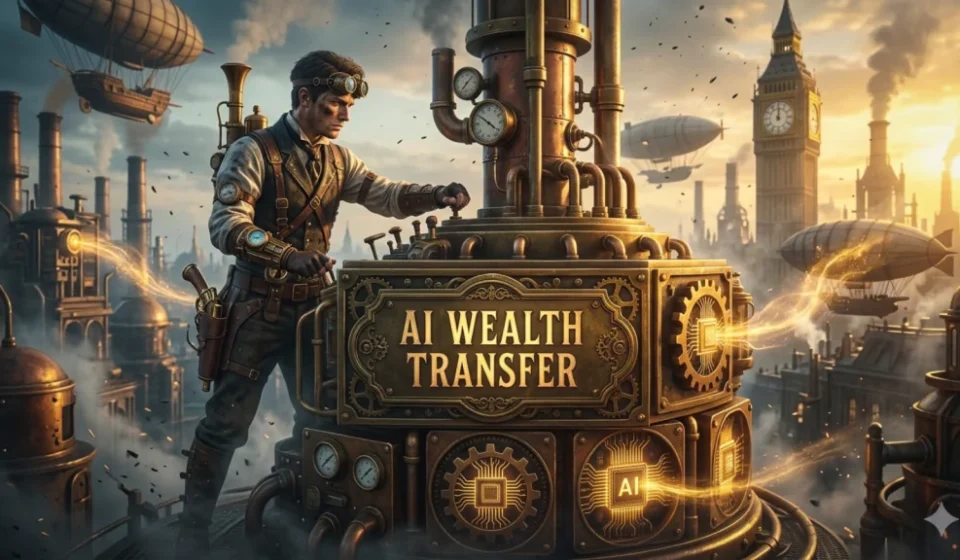
The Hidden Wealth Transfer Inside the AI Revolution and the Future of the Global Knowledge Economy

The global economy is currently undergoing a structural transformation characterized by a massive redistribution of wealth and capital, a shift that remains largely obscured by the celebratory rhetoric of technological progress. While the public discourse surrounding artificial intelligence (AI) focuses on consumer convenience and industrial efficiency, a more fundamental realignment is taking place within the fabric of the labor market and the ownership of intellectual capital. This transition represents a systemic "enclosure" of cognitive labor, where the skills and expertise previously held by individual human actors are being codified, centralized, and privatized by a select group of technological and financial entities.
The Historical Precedent: From Land Enclosure to Cognitive Enclosure
To understand the current trajectory of the AI economy, historians point to the English Enclosure Movement of the 16th through 18th centuries. During this period, the "common lands"—shared resources that provided the economic foundation for the agrarian working class—were systematically privatized through a series of Parliamentary acts. This process replaced communal farming with fenced, privately owned estates. While the movement was justified at the time through the language of "rational improvement" and agricultural efficiency, its immediate impact was the displacement of millions. Farmers who once possessed independent economic agency were transformed into a dependent labor force, eventually fueling the factories of the Industrial Revolution.
In the 21st century, a parallel process is unfolding. Rather than physical land, the resource being enclosed is human intelligence. For decades, cognitive ability—the capacity to analyze data, draft legal documents, write software, and create persuasive content—was a distributed asset. Individuals invested in education and experience to cultivate these skills, which served as their primary "capital" in the knowledge economy.
Today, this distributed intelligence is being harvested to train large language models (LLMs) and generative systems. Once these models reach a certain threshold of capability, the "fences" go up. The intelligence that was once the personal property of a professional is now embedded within proprietary model weights. Access to this intelligence is then sold back to the market as a service, fundamentally shifting the power dynamic from the individual laborer to the owner of the AI infrastructure.
Chronology of a Shift: The Block Layoffs as a Catalyst
The abstract nature of this wealth transfer became tangible in late 2025 and early 2026, marked by a series of high-profile corporate restructurings. A pivotal moment occurred when Block Inc., the fintech conglomerate led by Jack Dorsey, announced a reduction of its workforce by approximately 4,000 employees—nearly 40% of its total staff.
Unlike previous rounds of layoffs in the tech sector, which were often attributed to over-hiring during the pandemic or high interest rates, Block’s leadership cited a fundamental change in operational logic. The company stated that "intelligence tools" had reached a level of maturity that allowed for a leaner, more automated corporate structure. This announcement served as a watershed moment for the S&P 500, signaling to other executives that AI-driven headcount reduction was no longer a future possibility but a current competitive necessity.
The ripple effect was immediate. Following Block’s lead, other major players in the fintech and digital services sectors, including PayPal and Shopify, began accelerating their own automation initiatives. Financial analysts note that in low-margin industries, the first company to achieve a structurally lower cost base through AI forces its competitors into a binary choice: automate at a similar scale or accept a permanent disadvantage in operating margins.
Data and the New Power Structure: The Five Pillars of AI Capital
The concentration of wealth within the AI revolution is organized around five distinct layers of the global economy. Each layer acts as a gatekeeper, extracting value from the transition away from human-centric labor.
1. The Hyperscale Infrastructure Owners
The primary beneficiaries of the AI buildout are the "hyperscalers"—Microsoft, Alphabet (Google), Amazon, and Meta. These companies own the physical data centers and cloud platforms required to host and train AI. In 2025 alone, capital expenditures (CapEx) for these four entities exceeded $200 billion, a figure larger than the GDP of many sovereign nations. By controlling the cloud, they act as the "landlords" of the digital era, collecting rent from every business that utilizes AI.
2. The Model Builders
Companies such as OpenAI, Anthropic, and Google DeepMind represent the intellectual core of the enclosure. By encoding humanity’s collective knowledge into proprietary software, they have created a new asset class: synthetic intelligence. Market valuations for these private entities have soared, with OpenAI reaching a reported valuation exceeding $150 billion, reflecting the immense perceived value of owning the "cognitive engine" of the future.
3. The Semiconductor Gatekeepers
The physical hardware required for AI processing remains a significant bottleneck. Nvidia, Taiwan Semiconductor Manufacturing Company (TSMC), and Broadcom maintain a near-monopoly on the production of high-end Graphics Processing Units (GPUs) and specialized AI chips. Nvidia’s ascent to a multi-trillion-dollar market capitalization underscores its role as the "oil well" of the AI economy; without its hardware, the entire system ceases to function.
4. The Capital and Private Equity Layer
Institutional investors and private equity firms, including Blackstone and KKR, are increasingly positioning themselves to harvest the displacement caused by AI. These firms are targeting "distressed" traditional businesses that have failed to automate, acquiring them at a discount, and then implementing AI-driven efficiencies to increase their value. This "recycling" of capital ensures that the gains from automation remain concentrated within the top tier of the financial system.
5. The Political Integration
The AI enclosure is further reinforced by a deepening alliance between technology leaders and political power. The emergence of the "Technological Republic" ideology—advocated by figures such as Palantir’s Alex Karp and supported by key members of the federal administration—suggests that national security and technological supremacy are inseparable. This framework often views regulatory hurdles or "automation taxes" as threats to national competitiveness, providing a political shield that allows the enclosure to proceed with minimal legislative interference.
Economic Analysis: Entering "Engels’ Pause"
Economic historians warn that society is likely entering a modern version of "Engels’ Pause." Named after Friedrich Engels, this term describes the period during the British Industrial Revolution when national GDP and productivity soared, but real wages for workers remained stagnant or declined for nearly eight decades.
Current data suggests a similar divergence may be occurring. While the S&P 500 has seen record highs driven by AI-adjacent stocks, middle-class wage growth in knowledge-intensive sectors has begun to plateau. The "pause" ends only when society develops new institutional frameworks—such as labor protections, updated education systems, or wealth redistribution mechanisms—to manage the surplus generated by technology. However, in the current political climate, such measures face significant opposition from the very entities benefiting from the concentration of AI capital.
Identifying the Physical Bottlenecks: The "Golden Rivets"
As the digital side of AI becomes increasingly abundant, the economic focus is shifting toward physical scarcity. Analysts have identified several "Golden Rivets"—physical constraints that are becoming extraordinarily valuable as the AI buildout continues.
- Energy and Power Generation: AI data centers are projected to consume upwards of 10% of global electricity by 2030. This has led to a resurgence in nuclear energy and natural gas infrastructure. Companies like Constellation Energy and Vistra are seeing unprecedented demand for long-term power contracts to fuel "AI factories."
- Grid Modernization: The existing electrical grid is incapable of handling the concentrated loads required by massive data center clusters. Firms specializing in power management hardware and grid stability, such as Eaton and Vertiv, have become essential infrastructure plays.
- Data Center Real Estate: Specialized Real Estate Investment Trusts (REITs) like Equinix and Digital Realty own the physical buildings where AI resides. Their moats are built on land permits, fiber-optic connectivity, and proximity to power sources—assets that cannot be replicated by software.
The Impact on the "Friction Economy"
The sectors most at risk during this transition are those that operate within the "friction economy"—businesses that rely on information asymmetry, administrative overhead, or middle-management intermediation. Traditional Software-as-a-Service (SaaS) companies that lack proprietary data, offshore IT service providers, and staffing agencies are facing structural pressure. As AI eliminates the "friction" of human coordination, these business models are becoming obsolete.
In contrast, the "infrastructure of AI" remains insulated. While the application layer (the various AI apps and chatbots) may experience volatility and intense competition, the underlying layers of energy, chips, and data centers represent a more stable concentration of value.
Conclusion: The Institutional Response and Future Outlook
The AI revolution is not a singular event but a prolonged process of economic restructuring. While history suggests that technological gains eventually permeate the broader population, the initial phase is almost always characterized by extreme concentration. The "gate" of the AI enclosure is closing, and the divide between those who own AI capital and those who sell cognitive labor is widening.
The coming years will likely be defined by a "slow, grinding transfer of wealth" rather than a sudden market crash. For policymakers, the challenge lies in navigating the tension between national competitiveness and social stability. For the workforce, the challenge is the devaluation of traditional cognitive skills. And for the global economy, the challenge remains whether the "Technological Republic" can eventually produce a prosperity that is as distributed as the intelligence it was built upon.