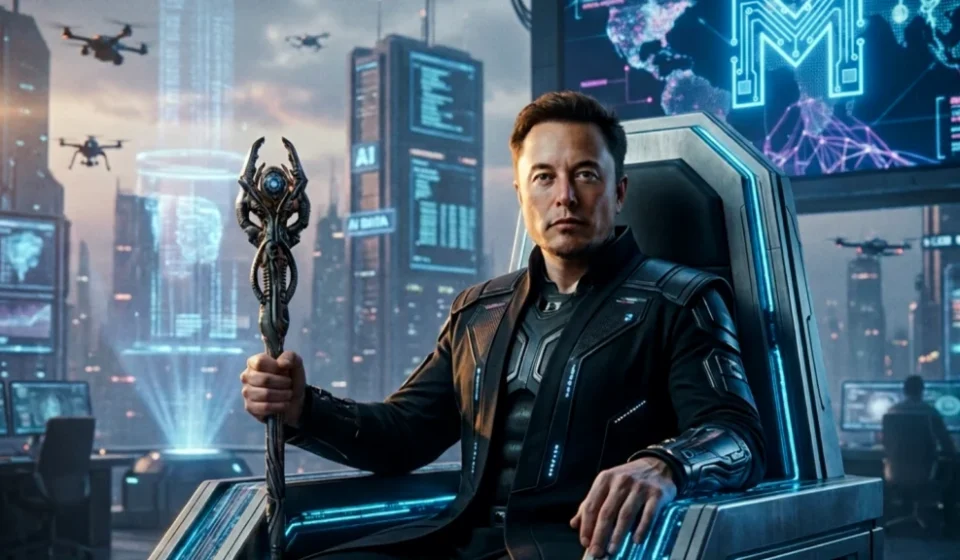
The Magnification Effect How Elon Musks Physical AI Revolution is Driving a New Era of Supplier Dominance

On May 21, 2025, a seemingly routine corporate announcement from Nvidia Corp. (NVDA) sent ripples through the semiconductor industry, marking a pivotal moment in the evolution of data center infrastructure. The tech giant officially named Navitas Semiconductor Corp. (NVTS) as a primary partner for its new 800-volt data center architecture. For Nvidia, a trillion-dollar titan, the disclosure was categorized as standard operational housekeeping—a supplier update that resulted in minimal movement for its massive market capitalization. However, for Navitas, a specialized power-chip manufacturer, the partnership represented a transformative milestone. In the single trading session following the news, Navitas shares surged by more than 180%.
This phenomenon, characterized by the disproportionate impact of a single contract or partnership on a smaller supplier compared to a larger client, is known as the "magnification effect." As the global economy pivots toward the next phase of technological evolution—Physical AI—this effect is becoming a central thesis for institutional and retail investors alike. While the previous decade was defined by digital AI—algorithms living on screens and processing text—the new era is defined by AI with a physical presence: robots, autonomous vehicles, and intelligent industrial machinery. At the heart of this shift is Elon Musk, whose sprawling ecosystem of companies is currently acting as the primary demand engine for the components required to bring Physical AI to life.
The Historical Precedent: Why Suppliers Often Outperform Stars
The current trajectory of Physical AI mirrors previous technological revolutions, where the companies providing the underlying "plumbing" often secured more significant long-term returns than the front-facing brands. In the personal computing boom of the 1980s and 1990s, brands like IBM, Compaq, and Dell became household names. However, the true victor of the era was Intel Corp. (INTC). By providing the microprocessors that served as the "brains" for nearly every PC globally, Intel turned a modest $1,000 investment at the start of 1980 into approximately $252,200 by the turn of the millennium—a staggering 25,210% return.
The pattern repeated during the rise of the internet. While many consumer-facing "dot-com" companies such as Pets.com and Webvan famously collapsed, the infrastructure providers thrived. Cisco Systems Inc. (CSCO), which manufactured the routers and switches forming the backbone of the web, saw its valuation explode. After going public in February 1990, Cisco delivered total returns of over 100,600% by its peak in March 2000, briefly becoming the most valuable company in the world.
More recently, the digital AI explosion saw investors flocking to software and application developers. Yet, the lion’s share of the gains was captured by the hardware supplier: Nvidia. By providing the Graphics Processing Units (GPUs) essential for training large language models, Nvidia returned roughly 33,280% over the decade ending in mid-2026. In each of these cycles—computing, the internet, and digital AI—the suppliers who solved critical bottlenecks became the ultimate beneficiaries of the boom.
Defining the Shift to Physical AI
Physical AI represents a fundamental departure from the generative AI models that dominated headlines in 2023 and 2024. While chatbots like ChatGPT operate within the digital realm, Physical AI requires machines to understand and interact with the laws of physics. This includes the ability to perceive depth, apply variable force, and navigate complex, unstructured environments.
Nvidia CEO Jensen Huang has identified this as the "next great wave" of technology. According to Huang, the future involves AI that can work alongside humans in the physical world, leading to a reality where "everything is going to be robotic." This transition moves the focus from large language models (LLMs) to large world models (LWMs), where machines are trained on physical interactions rather than just text and images.
The financial projections for this sector are unprecedented. Morgan Stanley analysts Adam Jonas and Sheng Zhong have projected that the humanoid robot market could reach $5 trillion by 2050, with over 1 billion units in operation. Citi’s Global Perspectives & Solutions (GPS) team offers an even more aggressive forecast, suggesting a $7 trillion market by 2050. Huang himself has characterized the total addressable market for humanoid robots and labor automation as a $40 trillion industry, potentially the largest in human history.
The Near-Term Ramp and the Musk Demand Engine
While 2050 projections provide a long-term vision, the immediate investment opportunity lies in the near-term production ramp. Bank of America Global Research, in its March 2026 report on Physical AI, projected that humanoid robot shipments would jump from 20,000 units in 2025 to 90,000 in 2026. This fourfold increase in a single year represents the beginning of a massive procurement cycle.
Elon Musk’s portfolio of companies is the primary catalyst for this demand. Tesla Inc. has positioned its Gen 3 Optimus robot as a product designed for mass production, with targets to begin assembly before the end of 2026. Tesla’s Fremont facility has been partially converted to accommodate a capacity of up to 1 million robots annually, while Musk has discussed an aspirational goal of 10 million units per year at Gigafactory Texas.
Simultaneously, SpaceX (Space Exploration Technologies Corp.) has integrated AI into its Starlink and orbital compute initiatives. Following its historic IPO in June 2026, SpaceX reported a 247% increase in AI-segment revenue. Furthermore, xAI, Musk’s dedicated artificial intelligence venture, is constructing some of the world’s largest data centers to support the training of Physical AI models. These initiatives require a massive supply chain of actuators, harmonic drives, sensors, and power-management chips—many of which must be engineered from the ground up.
The Four Essential Layers of the Physical AI Supply Chain
To capitalize on the magnification effect, analysts have identified four critical layers where suppliers are likely to see the most significant impact from Musk’s Physical AI push:
1. Data and Simulation
Unlike digital AI, which can be trained on internet data, Physical AI requires "embodied" data. This involves training machines on how to manipulate objects and navigate physical spaces. Companies like Nvidia, through their Isaac and Cosmos platforms, provide the simulation environments necessary to generate this data. This "synthetic data" generation is becoming a standalone industry, as it allows robots to learn thousands of years’ worth of movement in a matter of days within a virtual environment.
2. Compute and Power Management
The hardware required to run Physical AI models in real-time demands high-performance memory and sophisticated thermal management. Suppliers such as Micron Technology Inc. (MU) provide the high-bandwidth memory (HBM) essential for these tasks, while Monolithic Power Systems Inc. (MPWR) specializes in the power delivery systems that prevent high-density AI chips from overheating.
3. Connectivity and Optical Infrastructure
Physical AI requires massive data centers where tens of thousands of accelerators must communicate instantaneously. This has led to a surge in demand for optical connectivity. Nvidia has reportedly moved to secure long-term supply chains for optical components from firms like Lumentum Holdings Inc. (LITE) and Coherent Corp. (COHR). These companies provide the laser and fiber-optic technology that allows data to move at the speed of light between servers.
4. The Machine Body and Motion Control
The physical "shell" of AI requires precision engineering. Cognex Corp. (CGNX) provides the machine vision systems that allow robots to "see" and identify parts on an assembly line. Teradyne Inc. (TER) offers automated test equipment and collaborative robots (cobots) that are essential for the manufacturing process. Meanwhile, Analog Devices Inc. (ADI) and Rockwell Automation Inc. (ROK) provide the precision motion controls and factory integration software that turn a static machine into a functional, moving robot.
Risk Factors and Market Volatility
Despite the significant upside potential, the magnification effect carries inherent risks. Small-cap suppliers often exhibit high volatility and face "concentration risk," where a significant portion of their revenue is tied to a single customer like Tesla or SpaceX. If a major client decides to switch to a different component design or a secondary supplier, the impact on the original supplier’s stock can be devastating.
Furthermore, timelines in the Musk ecosystem are famously fluid. While production targets for the Optimus robot are set for 2026, Musk has acknowledged that current iterations are primarily for internal learning and refinement. If mass-market adoption slips from 2027 to 2029 or beyond, suppliers whose stock prices have already "priced in" immediate success may face significant corrections. Investors must distinguish between aspirational unit targets and actual purchase orders to avoid the "downward magnification" that occurs when growth expectations are not met.
The Strategic Shift in Investor Focus
The transition to Physical AI represents one of the most significant capital expenditure cycles in modern history. As the "star" companies like Tesla and Nvidia continue to dominate the headlines, the underlying investment strategy is shifting toward the specialized suppliers that make their products possible.
The magnification effect demonstrates that the most substantial percentage gains often occur in the middle of the supply chain. When a company with $100 billion in revenue places a $500 million order, it is a minor event for the buyer but a life-altering event for a supplier with $300 million in annual sales. As Musk’s Physical AI infrastructure moves from the laboratory to the factory floor, identifying these critical bottlenecks and the companies that solve them will remain a primary focus for those seeking to navigate the next decade of technological disruption. The pattern established by Intel, Cisco, and Nvidia suggests that while the names on the products may change, the rewards for those who build the foundation remain consistently high.