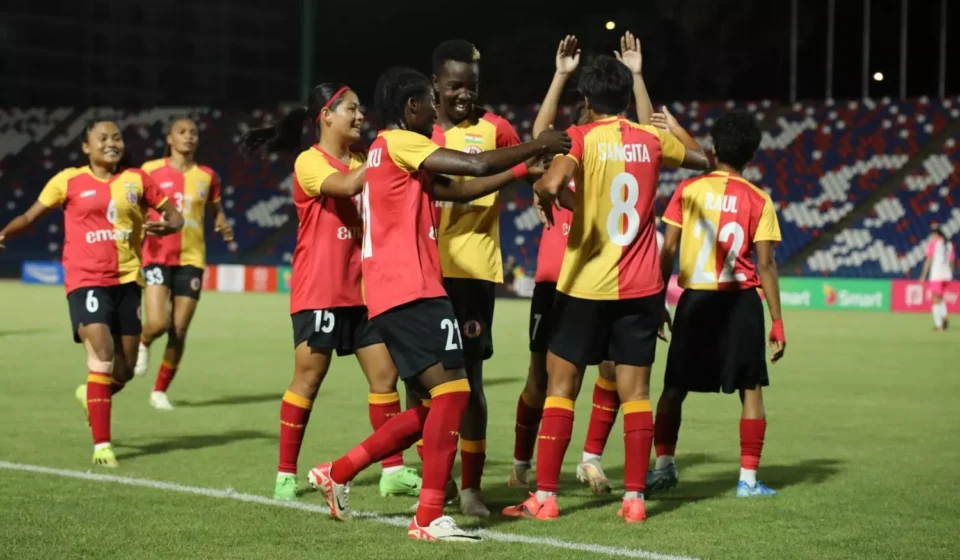
The Rise of the Moshal Girls Analyzing the Institutional Evolution of East Bengal Womens Football

The landscape of Indian football is undergoing a structural transformation, where the traditional pillars of legacy and fan passion are being reinforced by corporate governance and strategic capital. At the forefront of this evolution is the East Bengal Football Club’s women’s team, an entity that has transitioned from a historical curiosity into a dominant sporting institution. Sporting revolutions are rarely driven by performance alone; they are sustained by capital, self-belief, and collective passion. For the "Red and Gold Brigade," the recent surge in silverware is not merely a streak of good form but the result of a deliberate, multi-year blueprint designed to achieve sustained excellence on both domestic and continental stages.
As the 2024–25 and 2025–26 seasons unfold, East Bengal has established itself as the benchmark for professionalization in the Indian Women’s League (IWL). By securing the IWL 2024–25 title and maintaining a pole position in the initial phases of the 2025–26 campaign, the club has demonstrated a level of consistency that was previously rare in the volatile ecosystem of Indian women’s sports. This success reached a regional crescendo in Kathmandu, where the club was crowned champions of the SAFF Women’s Club Championship 2025 after a clinical 3–0 victory over the Nepal Armed Police Force (APF). These milestones serve as a testament to a squad that blends international experience with domestic hunger, all while operating under a financial model that is beginning to show signs of long-term viability.
A Chronology of Dominance: From Domestic Champions to Regional Giants
The resurgence of East Bengal’s women’s wing can be traced through a series of pivotal moments over the last twenty-four months. The journey began with a rigorous recruitment drive following the acquisition of the club’s footballing rights by the Emami Group. This provided the financial oxygen necessary to overhaul the roster and coaching staff.
In the 2024–25 IWL season, East Bengal exhibited a tactical discipline that saw them outmaneuver traditional powerhouses. Their crowning as champions was not just a victory for the trophy cabinet but a signal to the Asian football community that the club was ready for higher tiers of competition. This momentum was seamlessly carried into the 2025–26 season. By the conclusion of Phase 1, East Bengal sat comfortably at the top of the table, showing no signs of "champion’s fatigue."
The international breakthrough occurred in 2025 at the SAFF Women’s Club Championship. Competing in the challenging altitude of Kathmandu, the team faced the formidable Nepal Armed Police Force in the final. A dominant 3–0 performance secured the title, marking the first time the club’s women’s team had achieved such a high-profile regional honor. This victory was particularly significant as it validated the club’s investment in sports science and travel logistics, ensuring the players remained peak-conditioned despite the rigors of an international schedule.
Tactical Synergy: The Architecture of the Squad
Under the stewardship of head coach Anthony Andrews, East Bengal has developed a clearly defined identity on the pitch. Andrews, known for his meticulous tactical preparation, has built a team that thrives on a "reliable spine" and explosive transitions. The squad’s composition is a deliberate mix of three distinct profiles: veteran internationals, clinical foreign imports, and rising domestic stars.
At the back, the experience of Loitongbam Ashalata Devi and Ngangbam Sweety Devi provides a foundation of composure. Ashalata, often cited as one of the finest defenders in Asian football, brings a leadership quality that stabilizes the team during high-pressure knockout matches. In the midfield, the industriousness of Karthika Angamuthu and Sangita Basfore ensures that the team maintains possession and dictates the tempo of the game.
The offensive firepower is led by Fazila Ikwaput, whose clinical finishing has been a recurring theme in East Bengal’s high-scoring matches. She is flanked by the pace and creativity of Soumya Guguloth and Sandhiya Ranganathan, both of whom possess the ability to stretch opposition defenses. Perhaps most encouraging for the club’s future is the emergence of Sulanjana Raul. Her energy and technical proficiency represent the next generation of Indian talent, proving that the club’s scouting network is functioning at an elite level.
The Financial Architecture: Navigating the Economics of Women’s Football
While the trophies capture the headlines, the sustainability of the project is rooted in its financial structure. Women’s club football in India currently operates on a hybrid model that is transitioning from a CSR-adjacent activity to a commercial venture. For East Bengal, the revenue streams are divided into domestic earnings, continental grants, and owner-driven capital.
The domestic landscape remains financially challenging. The Indian Women’s League and other AIFF-sanctioned competitions offer prize pools that, while prestigious, are often insufficient to cover the operational costs of a fully professional side. The championship prize for the IWL typically hovers around ₹10 lakh (approximately US$12,000), a figure that barely scratches the surface of player salaries and training facility rentals.
Consequently, the "performance dividend" from continental competitions has become a critical lifeline. Participation in the AFC Women’s Champions League has emerged as a game-changer. For the current cycle, East Bengal has secured an estimated US$170,000 in AFC-related inflows. This breakdown includes a US$100,000 participation fee for the group stages, a US$50,000 central travel grant to offset the costs of international logistics, and approximately US$20,000 in match-performance incentives.
The AFC’s prize structure is designed to reward deep runs, with the ultimate winner potentially taking home US$1 million. For an Indian club, even reaching the knockout stages can materially reshape their annual budget, allowing for better scouting, higher-quality foreign signings, and improved infrastructure. This direct link between on-field success and revenue impact is the primary driver behind East Bengal’s aggressive pursuit of continental qualification.
The Emami Factor: Stability and Corporate Discipline
The entry of the Emami Group as the principal investor marked a paradigm shift in how the women’s team was managed. Prior to this partnership, women’s football in many legacy clubs was often treated as a secondary priority, frequently subject to budget cuts during periods of financial strain.
Emami brought a corporate approach to the "Red and Gold" camp. This involved predictable capital flows, which translated into timely player payments—a fundamental yet often overlooked aspect of professional sports. Beyond salaries, the investment flowed into coaching staff continuity and the acquisition of overseas recruits like Ikwaput.
The corporate governance model also prioritized sustainability. Rather than chasing short-term "optics" through flashy but unsustainable signings, the focus was placed on building a strategic and reputational pillar. By treating the women’s team as an institutional asset rather than a token initiative, Emami has ensured that the team remains a core part of the club’s broader commercial ecosystem.
Social Media and the #MoshalGirls Phenomenon
In an era where mainstream broadcast rights for women’s football in India are still in their infancy, digital platforms have become the primary medium for fan engagement. East Bengal has successfully integrated its women’s team into its main digital ecosystem, branding them as the #MoshalGirls.
A data-driven review of the #MoshalGirls activity on X (formerly Twitter) reveals a highly engaged, albeit niche, audience. Major milestones, such as the SAFF Championship win and IWL title celebrations, see engagement rates of 8–10%. While the total view counts per post—averaging between 500 and 1,200—may seem modest compared to the men’s team, the engagement-to-reach ratio is significantly higher than the industry average for sports media.
However, the current digital strategy is largely reactive, focusing on match-day lineups and trophy photos. Analysts suggest that the next phase of growth for the #MoshalGirls brand will require a shift toward "distribution-led storytelling." By creating content around player journeys, tactical breakdowns, and "behind-the-scenes" training insights, the club can improve discoverability and provide sponsors with a more nuanced platform for brand alignment.
Analysis of Broader Implications and Future Outlook
The success of East Bengal’s women’s team carries significant implications for the future of the sport in India. It serves as a proof-of-concept for other legacy clubs, such as Mohun Bagan and Mohammedan SC, demonstrating that a well-funded women’s program can yield both silverware and international prestige.
The next phase of growth will depend on whether this model can be scaled. To move beyond being a "success story" and become a repeatable institution, East Bengal must continue to invest in:
- Youth Development: Establishing a dedicated academy pipeline to reduce reliance on external transfers.
- Sports Science: Enhancing injury prevention and recovery protocols to handle increasingly crowded domestic and international calendars.
- Commercial Flywheels: Converting social media engagement into tangible revenue through merchandising and targeted sponsorships.
In conclusion, the rise of East Bengal in women’s football is a case study in how the alignment of capital, governance, and community can turn a sporting ambition into a sustained advantage. Headlines will continue to celebrate the trophies won in Kolkata and Kathmandu, but history will record how East Bengal built an institution that redefined the possibilities for women in Indian sports. As the 2025–26 season progresses, the "Moshal Girls" are no longer just competing; they are leading a revolution that is as much about the balance sheet as it is about the scoreboard.