

The global financial landscape is currently navigating a complex intersection of geopolitical disinformation, central bank policy shifts, and historical market cycles. Recent reports from major technology platforms and financial analysts suggest that a coordinated effort to manipulate public sentiment regarding artificial intelligence (AI) is underway, coinciding with a pivotal Federal Reserve decision that could determine the trajectory of the equities market for the remainder of the year. Investors are being urged to distinguish between organic market volatility and manufactured fear as the 10-year Treasury yield reaches heights not seen in nearly two decades.
Geopolitical Disinformation and the AI Sentiment Shift
In recent weeks, the narrative surrounding artificial intelligence has shifted from one of unbridled optimism to a cautious, and at times fearful, skepticism. While some of this shift is attributed to legitimate ethical and existential concerns raised by researchers within the industry, new evidence suggests a significant portion of the negative sentiment is being driven by foreign state-sponsored actors.
Financial analyst Louis Navellier recently highlighted the emergence of a massive disinformation network aimed at destabilizing the American AI sector. According to Navellier, a "bot farm" consisting of approximately 200,000 fake accounts has been identified as a primary source of anti-AI propaganda. The campaign specifically targets the infrastructure necessary for AI development, such as data centers, by spreading claims regarding environmental degradation, air pollution, and the depletion of local water resources.
The strategic objective of this campaign, Navellier argues, is to derail the United States’ current lead in the global AI race. "China is in an AI race with us," Navellier stated. "We’re winning. They’re losing. So, they’re trying to derail us by spreading false propaganda."
Supporting evidence for these claims has emerged from the safety teams at major social media and AI organizations. In late August, Elon Musk’s X (formerly Twitter) reported the discovery of a suspected Chinese bot farm. The platform identified approximately 200 accounts within this network that were specifically designed to manipulate debates regarding American AI and energy policy. These accounts frequently posted AI-generated cartoons and claims that data centers were directly responsible for surging household electricity prices.
Similarly, OpenAI reported in June that it had dismantled a network it dubbed the "Data Center Bandwagon." This operation utilized ChatGPT to generate content that mimicked American citizens, using VPNs to mask their origins in China. The content focused heavily on the narrative that AI infrastructure was a public burden that primarily enriched corporate operators at the expense of ordinary families. While the concerns regarding the energy grid are rooted in real challenges—data centers are indeed high-energy consumers—the coordinated amplification of these fears suggests a calculated attempt to foster domestic opposition to technological advancement.
The Federal Reserve and the Bond Market Signal
While geopolitical tensions influence the long-term sentiment of the AI trade, the immediate focus of Wall Street is fixed on the Federal Open Market Committee (FOMC). As of Tuesday morning, the 10-year Treasury yield has surged above 5%, marking a 19-year high. This movement in the bond market serves as a stark indicator of investor expectations regarding interest rate policy.

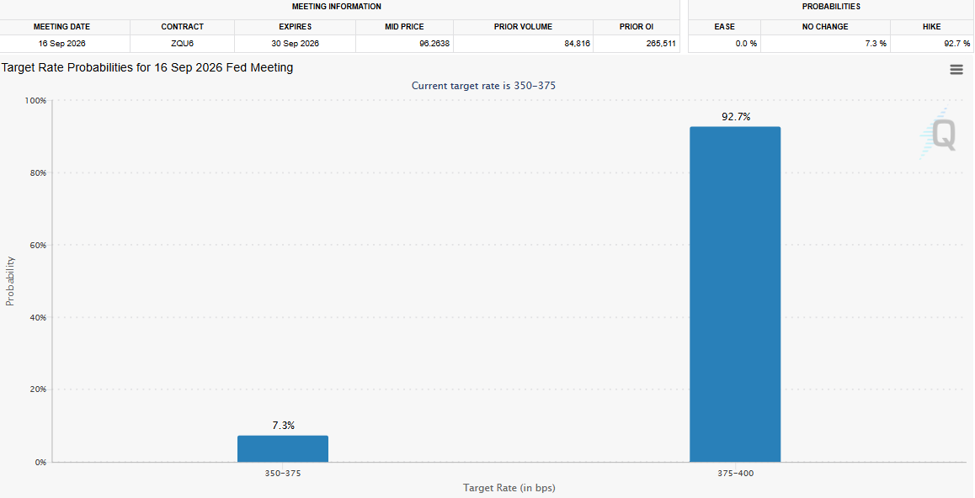
The CME Group’s FedWatch Tool, which gauges investor sentiment based on Fed funds futures, currently indicates a 92.7% probability of a quarter-point (25 basis point) rate hike at the conclusion of the FOMC meeting tomorrow. This expectation represents a shift in the consensus; earlier in the year, many analysts, including Navellier, believed the Fed might pause its tightening cycle. However, the persistence of market rates has forced a recalibration of those expectations.
The logic behind the anticipated hike is two-fold: first, the Federal Reserve rarely fights prevailing market rates, as doing so could lead to a significant weakening of the U.S. dollar. Second, the Fed remains committed to its mandate of price stability, and the current yield environment suggests that the market believes inflation remains a persistent threat that requires further intervention.
Historical Market Performance Post-Rate Hike
The prospect of a rate hike often triggers immediate selling pressure in the equities market, particularly in growth-oriented sectors like technology. However, historical data suggests that the "first hike" of a cycle—or a significant hike in a continuing cycle—does not necessarily signal the end of a bull market.
Lucas Downey, an analyst at TradeSmith, conducted a comprehensive review of S&P 500 and Nasdaq 100 performance following the first rate hike of Fed cycles dating back to 1987. The data reveals a consistent pattern of short-term turbulence followed by significant long-term appreciation:
- One Month Post-Hike: The S&P 500 has historically declined by an average of 2.9%, while the Nasdaq 100 has dropped by 2.3%.
- Three Months Post-Hike: Both indices typically remain in negative territory as the market adjusts to higher borrowing costs.
- Six Months Post-Hike: A recovery usually takes hold, with the S&P 500 rising an average of 4.2% and the Nasdaq climbing 12.4%.
- Twelve Months Post-Hike: The gains solidify, with the S&P 500 up an average of 5.7% and the Nasdaq up 15.2%.
- Twenty-Four Months Post-Hike: The long-term trajectory is overwhelmingly positive, with the S&P 500 averaging a 21.1% gain and the Nasdaq 100 surging 37.1%.
Further research from market strategist Ryan Detrick supports this bullish outlook. Detrick notes that following a modest quarter-point hike, the S&P 500 has been higher one year later 100% of the time, with an average gain of 12.5%. The notable exception to this trend occurred in 2022, a year characterized by aggressive "jumbo" half-point and 75-basis-point hikes as the Fed struggled to catch up with rampant inflation. Given that tomorrow’s expected hike is a standard quarter-point move, historical precedents suggest a high probability of a market recovery within the next 12 months.
The Convergence of Seasonal and Political Cycles
The current market anxiety is compounded by the "September Effect." Historically, September is the single worst month for stock performance. Since 1950, the S&P 500 has averaged a decline of 0.7% during this month, making it the only month with a negative average return over the last seven decades. Furthermore, the index has finished in positive territory only 44% of the time in September, the lowest win rate of any month.
However, the weakness observed in September often serves as a precursor to the "Year-End Rally." From October through December, the S&P 500 has historically averaged a gain of 4.2% and has finished higher 80% of the time. This seasonal pattern suggests that the current drawdown may be providing a strategic entry point for investors looking toward the fourth quarter.
Adding another layer to this analysis is the four-year Presidential Cycle. We are currently in a midterm election year, which is statistically the weakest year of the cycle for equities. Midterm years typically follow a specific rhythm: volatility and choppy trading through the summer and early autumn, a market bottom in the September-October window, and a powerful rally following the election.
The historical reliability of the post-midterm rally is significant. Since 1950, the S&P 500 has been higher 12 months after every single midterm election—a perfect 19-for-19 record. Additionally, the year following a midterm (the pre-election year) is historically the strongest of the entire four-year cycle, with an average return exceeding 17%.
Implications for the AI Trade and Infrastructure
As the market grapples with interest rates and seasonal trends, the fundamental growth story of artificial intelligence continues to evolve. Technology expert Luke Lango suggests that the "AI trade" is shifting from a speculative phase into an infrastructure-heavy phase, which he refers to as "Vertical AI."
This shift focuses on the physical and logistical requirements of AI, including the specialized chips, power systems, and data center cooling technologies required to sustain massive large language models. Lango points to the activities of industry leaders like Elon Musk, who is reportedly focusing on solving four specific "bottlenecks" in AI infrastructure.
"While the market debates whether AI demand can hold up, Musk has spent 20 years assembling the pieces of a very different bet," Lango noted. This bet involves a vertically integrated approach to AI that could bypass current supply chain constraints and open up new markets that dwarf the current software-based AI trade. The implications for infrastructure providers are substantial, as the demand for high-density computing environments shows no signs of abating despite the propaganda campaigns aimed at slowing their expansion.
Conclusion: Fundamentals vs. Sentiment
The current market environment is a battleground between fundamental economic data and psychological sentiment. While the threat of a rate hike and the presence of foreign disinformation campaigns provide ample reason for short-term caution, the underlying historical data points toward a resilient bull market.
Investors who focus on earnings and fundamentals—rather than the "fear campaign" identified by Navellier—may find that the current volatility is a temporary hurdle rather than a structural shift. With the Federal Reserve likely to implement a modest hike, and the seasonal and political cycles approaching their historical bottoming points, the stage appears to be set for a potential year-end recovery. As the AI race continues, the focus will likely remain on the companies that control the essential infrastructure of the future, regardless of the noise generated by bot farms or temporary fluctuations in the bond market.