
The Psychological Hazards of Market Overconfidence and the Quantitative Framework for Timely Equity Divestment

The narrative of Anargyros Karabourniotis, known globally as Archie Karas, remains one of the most cited cautionary tales in the history of high-stakes gambling and behavioral finance. A Greek immigrant who arrived in the United States with minimal resources, Karas eventually transitioned from waiting tables in Los Angeles to orchestrating what is widely regarded as the greatest gambling streak in history, commonly referred to as "The Run." In December 1992, arriving in Las Vegas with $50 in his pocket, Karas utilized a $10,000 loan from a friend to enter high-stakes poker games at the Mirage. Over the ensuing thirty months, Karas transformed that initial capital into a fortune exceeding $40 million. His success was not limited to anonymous opponents; he famously defeated five World Series of Poker (WSOP) Main Event champions, including legends such as Stu Ungar and Chip Reese. However, the conclusion of his story serves as a stark illustration of the overconfidence bias: by 1996, Karas had lost the entirety of his fortune by transitioning from games of skill, like poker and pool, to games of pure chance, such as craps and baccarat, while refusing to adjust his risk profile.
Financial analysts and behavioral economists frequently draw parallels between Karas’s trajectory and the pitfalls faced by modern retail and institutional investors. The phenomenon of overconfidence often manifests when an investor experiences a significant "win"—a stock that doubles or triples in value—leading to an emotional attachment that obscures deteriorating fundamental data. As the market prepares for a significant leadership shift heading into 2027, the ability to decouple emotional history from quantitative reality is becoming a critical differentiator for portfolio preservation.
The Chronology of "The Run" and the Mechanics of Loss
To understand the psychological trap Karas fell into, one must examine the timeline of his ascent and subsequent collapse. From 1992 to early 1995, Karas maintained a disciplined, albeit aggressive, approach to pool and poker. His ability to analyze opponents and calculate odds allowed him to dominate the poker tables at the Binion’s Horseshoe and the Mirage. However, as his bankroll swelled to $40 million, the pool of available opponents capable of playing at his stakes diminished.
Faced with a lack of competition in skill-based games, Karas moved into the pits, where the house maintains a mathematical edge. By mid-1995, he lost $11 million playing craps in a single three-week period. Shortly thereafter, he lost another $17 million playing baccarat. Despite these staggering losses, the overconfidence generated by his two-and-a-half-year winning streak convinced him that a reversal of fortune was imminent. By the end of 1996, every dollar of the $40 million had been returned to the casinos. This sequence highlights a fundamental law of both gambling and investing: the strategies and mindsets that facilitate the accumulation of wealth are often diametrically opposed to the strategies required to preserve it.
Case Study: Lululemon Athletica and the Quantitative Exit
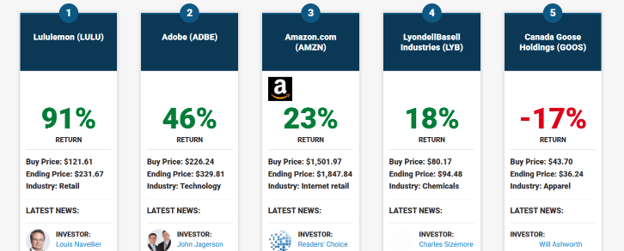
The transition from a high-performing "market darling" to a portfolio laggard is rarely instantaneous; rather, it is characterized by a gradual erosion of fundamental metrics that investors often ignore due to past successes. Lululemon Athletica Inc. (LULU) provides a contemporary blueprint for this cycle. In June 2018, Lululemon was identified by quantitative systems as a premier growth opportunity due to its dominance in the "athleisure" sector. At the time, the company maintained an A-rating based on earnings growth, sales acceleration, and institutional buying pressure.

By 2019, Lululemon’s stock price appreciated by 91%, outperforming the vast majority of the S&P 500. For many investors, this performance fostered a sense of invincibility regarding the brand. However, quantitative discipline necessitates selling when the underlying data—not the brand sentiment—begins to shift. In February 2021, despite the stock’s historical pedigree, systems like the Stock Grader signaled a downgrade as growth momentum began to plateau relative to its valuation. Investors who followed a disciplined exit strategy at that time locked in gains of approximately 156%.
The subsequent years validated this data-driven departure. By 2024, Lululemon began facing significant headwinds, particularly in its core North American market. Comparable store sales growth slowed, and by 2025, management was forced to repeatedly lower its forward-looking guidance. These revisions resulted in a 45% decline in share value over the course of that year. The downward trajectory continued into 2026, with shares falling an additional 47% year-to-date. As of late 2026, Lululemon shares are trading roughly 64% lower than the exit point recommended in early 2021. This case study demonstrates that while the company remained a household name, its "investment grade" status had vanished years before the most significant price collapses occurred.
The Anatomy of the Overconfidence Trap in Investing
The psychological mechanism that trapped Archie Karas is identical to the one that keeps investors in declining stocks. Behavioral finance identifies several key biases that contribute to this failure:
- The Disposition Effect: This is the tendency of investors to sell assets that have increased in value while holding onto assets that have dropped in value. The investor views the "winner" as a validation of their intelligence and the "loser" as a temporary mistake that will eventually "break even."
- Recency Bias: Investors often over-weight recent events—such as a three-year bull run in a specific stock—when predicting future performance, ignoring the cyclical nature of retail and technology sectors.
- Endowment Effect: Once an investor owns a stock, they tend to value it more highly than they would if they did not own it, leading to a refusal to sell even when the quantitative outlook turns negative.
Quantitative systems, such as the Stock Grader mentioned in the original report, are designed to bypass these human failings. By focusing exclusively on eight fundamental variables—including earnings surprises, sales growth, and cash flow—these systems provide an objective "Sell" signal that disregards the investor’s emotional history with the ticker symbol.
Market Dynamics and the 2027 Outlook
As the global economy approaches 2027, the urgency for disciplined selling is increasing due to a fundamental shift in market leadership. For the past decade, market gains were heavily concentrated in a handful of mega-cap technology and consumer discretionary stocks. However, shifting interest rate environments and Federal Reserve policies are precipitating a rotation into new sectors.
Analysis of current institutional buying patterns suggests that the "winners" of the 2020-2024 period are increasingly showing signs of exhaustion. When institutional investors—the large pension funds and insurance companies that move markets—begin to quietly liquidate large positions, it often precedes a retail-level price collapse. Quantitative grading systems track this "buying pressure." A drop from an A-rating to a D-rating, as seen with Lululemon, is often the first indicator that big-money managers are moving toward the exits.
The "Fed Warning 2027" framework suggests that the coming year will be defined by heightened volatility as the market adjusts to a "higher-for-longer" interest rate reality. In such an environment, the cost of capital increases, making it harder for companies with slowing sales to maintain high price-to-earnings multiples. For investors, this means that the strategy of "buying and holding forever" may be replaced by a need for active, data-driven portfolio management.
Strategic Implications for Portfolio Management
The primary takeaway from both the Karas saga and the Lululemon analysis is the necessity of a pre-defined exit strategy. Professional traders often utilize "stop-loss" orders or quantitative triggers to ensure that a winning trade does not transform into a catastrophic loss.
To implement this approach, analysts suggest a three-pillar framework:
- Fundamental Monitoring: Regularly reviewing quarterly earnings reports for signs of decelerating sales or margin compression.
- Institutional Tracking: Monitoring volume trends to see if "smart money" is accumulating or distributing shares.
- Emotional Decoupling: Treating every stock in a portfolio as a new position every day. If an investor would not buy the stock at its current price and current fundamental rating today, they should consider why they continue to hold it.
As market leadership shifts toward 2027, the ability to identify the "next generation" of leaders is only half the battle. The other half is the willingness to abandon yesterday’s champions when the data dictates. Archie Karas’s $40 million loss was not caused by a lack of talent, but by a lack of an exit strategy and an inability to recognize when the environment had changed. For the modern investor, the quantitative tools available today serve as the necessary guardrails against the inherent human tendency toward overconfidence, ensuring that paper gains are converted into realized wealth before the market cycle turns.