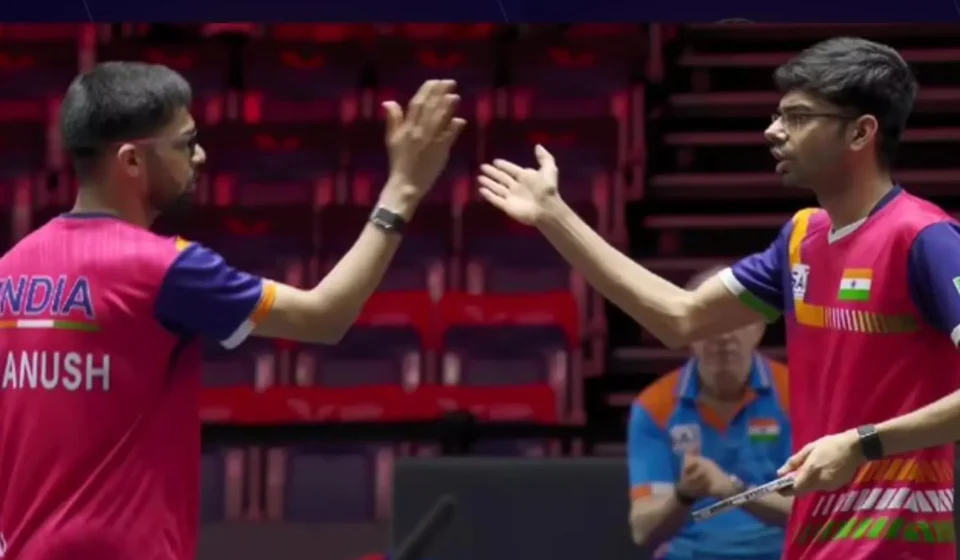
Manav Thakkar and Manush Shah Make History Despite Semi-Final Heartbreak at the 2026 WTT Singapore Smash

The landscape of Indian table tennis reached a historic milestone at the Infinity Arena in Kallang as the nation’s premier doubles pairing, Manav Thakkar and Manush Shah, concluded a groundbreaking campaign at the 2026 WTT Singapore Smash. In a high-octane semi-final encounter that pushed the boundaries of technical skill and mental endurance, the Indian duo was narrowly defeated by the world-renowned French brothers, Alexis and Felix Lebrun. The match, which extended to a full five-game thriller, ended with a scoreline of 6-11, 11-7, 10-12, 11-9, 8-11 in favor of the French pair. Despite the loss, Thakkar and Shah secured their place in the record books as the first Indian players to ever reach the semi-finals of a World Table Tennis (WTT) Grand Smash event, signaling a significant shift in the global hierarchy of the sport.
A Tactical Battle at the Infinity Arena
The atmosphere at the Infinity Arena was electric as the two pairs took to the table for a spot in the prestigious final. The Lebrun brothers, seeded significantly higher and coming off a string of international titles, entered the match as favorites. However, Thakkar and Shah had spent the previous rounds dismantling higher-ranked opponents, establishing themselves as the "giant killers" of the tournament.
The opening game saw the French pair assert their dominance early. Utilizing a combination of Felix’s lightning-fast penhold transitions and Alexis’s raw power from the backcourt, the Lebruns kept the Indians on the defensive. Thakkar and Shah struggled to find their rhythm against the aggressive service returns of the Frenchmen, dropping the first game 6-11.
The second game witnessed a tactical masterclass from the Indian camp. Adjusting their positioning to counter the Lebruns’ wide angles, Thakkar and Shah began to dictate the pace. Manush Shah’s left-handed versatility allowed him to open up the table, creating opportunities for Manav Thakkar to execute clinical forehand winners. By maintaining a high percentage of first-serve attacks, the Indians leveled the match with an 11-7 win, momentarily stunning the French contingent.
The Pivotal Third Game and the Indian Resilience
The third game proved to be the psychological centerpiece of the match. Both pairs traded points in a display of world-class rallies that drew roars from the Singaporean crowd. The Indian duo showcased remarkable defensive resilience, retrieving balls that seemed destined to be winners. At 10-9, Thakkar and Shah held a game point that could have shifted the entire momentum of the semi-final. However, a series of precise, high-spin loops from Alexis Lebrun forced errors from the Indians. The French pair capitalized on the deuce, taking the game 12-10 in extra points.
Falling behind 1-2 in games would have demoralized many, but the Indian pair showed a newfound maturity that has come to define their 2026 season. In the fourth game, they refused to let the previous missed opportunity linger. They focused on a short-game strategy, preventing the Lebrun brothers from unleashing their trademark power. This disciplined approach paid dividends as they secured the game 11-9, forcing a fifth and final deciding game.
The Decider: A Game of Inches and Unlucky Breaks
The fifth game was a microcosm of the entire match: intense, tactical, and decided by the narrowest of margins. The score remained neck-and-neck until the mid-game interval. As the pressure mounted, both pairs showcased why they belong in the upper echelon of the WTT rankings. At 7-7, the tension was palpable.
The turning point occurred at 10-7 in favor of the Lebruns. During a frantic rally, a shot from the French pair clipped the top of the net, resulting in a wicked deflection that left the Indians with no chance of recovery. This "net-cord" point gave the Lebruns three match points. Displaying incredible grit, Manav Thakkar saved the first match point with an audacious low return, picking the ball up just inches from the floor to catch the French brothers off guard. However, the deficit was too large to overcome. The Lebruns secured the final point to win 11-8, ending the Indian dream of a Grand Smash final.
Historical Context: Breaking the Quarterfinal Barrier
To understand the magnitude of Thakkar and Shah’s achievement, one must look at the history of Indian table tennis at the WTT Grand Smash level. Grand Smashes are the "Majors" of table tennis, equivalent to the Grand Slams in tennis. Since the inception of the WTT series, Indian athletes have often struggled to progress past the early rounds, with the quarterfinals previously acting as an insurmountable ceiling.
By reaching the semi-finals, Thakkar and Shah have surpassed the achievements of legendary Indian predecessors. Their run in Singapore included victories over some of the most formidable pairs from China and Japan, proving that Indian doubles play is no longer just competitive but world-leading. This performance is expected to catapult both players in the ITTF World Rankings, potentially placing them within the top 10 of the doubles category.
Technical Analysis of the Thakkar-Shah Synergy
The success of the Manav Thakkar and Manush Shah partnership lies in their complementary styles. Thakkar, known for his incredible speed and ability to stay close to the table, provides the foundational stability. Shah, a left-hander, provides the "angles" that are so crucial in doubles play.
In the 2026 Singapore Smash, their coordination reached a new peak. Their "in-and-out" movement, which allows them to switch positions without obstructing each other, was described by commentators as some of the best in the tournament. Furthermore, their ability to switch between a defensive "blocking" game and a high-intensity "looping" game made them difficult for the Lebrun brothers to read. The Indian pair’s aggressive play against defensive returns was particularly noted by analysts as a major improvement from their previous seasons.
Reaction from the Table Tennis Community
While official post-match statements are often tempered with professional modesty, the reaction from the global table tennis community has been one of overwhelming respect. Sources close to the Indian coaching staff indicated that while the players were disappointed by the narrow margin of the loss, there is an underlying sense of pride in having "breached the barrier."
"We saw two young men play without fear against world-class opposition," noted a senior analyst for WTT. "The Lebrun brothers are the future of European table tennis, but today, Thakkar and Shah showed that the future of Asian table tennis isn’t just restricted to East Asia. India has arrived on the big stage."
The French pair also acknowledged the difficulty of the match, with Felix Lebrun reportedly commenting on the "relentless pressure" applied by the Indians throughout the five games.
Data and Implications for the 2026 Season
The statistical data from the match highlights just how close the encounter was. The total points won stood at 50 for the Lebruns and 44 for the Indians. The Indians actually had a higher success rate on their second-serve returns (52%) compared to the French pair (48%), but the Lebruns’ ability to win points on their first serve proved to be the deciding factor.
This result has significant implications for the remainder of the 2026 WTT calendar. With the World Championships approaching, Thakkar and Shah have established themselves as legitimate medal contenders. Their performance is also likely to result in increased funding and support from the Sports Authority of India (SAI) and the Target Olympic Podium Scheme (TOPS), as the focus shifts toward the 2028 Los Angeles Olympics.
The Growth of Table Tennis in India
The success of Thakkar and Shah is not an isolated incident but the result of a decade-long transformation in Indian sports. The introduction of the Ultimate Table Tennis (UTT) league in India has provided domestic players with the opportunity to train and compete alongside international stars. This exposure has demystified the "invincibility" of top-tier foreign players.
Furthermore, the rise of specialized doubles coaching and the use of sports science and video analytics have allowed Indian players to bridge the technical gap. Manav Thakkar and Manush Shah represent the new generation of Indian athletes who are physically fitter, mentally tougher, and tactically more astute than their predecessors.
Conclusion: A New Era for Indian Table Tennis
As the dust settles on the 2026 WTT Singapore Smash, the story of the tournament remains the historic ascent of Manav Thakkar and Manush Shah. While they did not leave the Infinity Arena with the trophy, they left with something perhaps more valuable: the realization that they belong among the elite.
The five-game thriller against the Lebrun brothers will be remembered as the moment Indian table tennis moved from being a participant in Grand Smash events to being a protagonist. For Thakkar and Shah, the semi-final exit is not an end, but a beginning. The "quarterfinal barrier" has been broken, and the path to a Grand Smash title now seems not just possible, but inevitable. The sporting world will be watching closely as these two young stars continue to redefine the boundaries of what Indian table tennis can achieve on the global stage.