Snapchat Introduces AI Sponsored Snaps, Turning Conversations Into a New Ad Channel

The Evolution of the Conversational Interface
The introduction of AI Sponsored Snaps represents the culmination of several years of strategic development at Snap Inc. Historically, social media advertising relied on the "interruption model," where ads appeared between stories or within feeds. However, as consumer behavior shifts toward private messaging and niche communities, the value of the "Chat" tab has skyrocketed. For Snapchat, which reported over 950 billion chats in the first quarter of 2026 alone, the chat feed is the most frequented area of the platform.
AI Sponsored Snaps allow brands to create and deploy sophisticated AI agents that appear alongside a user’s friends in their inbox. These agents are designed to be responsive rather than broadcast-oriented. When a user interacts with an AI Sponsored Snap, they are not simply clicking a link; they are initiating a consultation. This technology leverages the foundational success of My AI, Snapchat’s internal chatbot, which has seen engagement from more than 500 million users since its inception. By opening this conversational capability to advertisers, Snapchat is effectively turning every ad into a potential customer service representative, personal shopper, or brand ambassador.
A Chronology of Snap’s Advertising Innovation
To understand the significance of AI Sponsored Snaps, one must look at the trajectory of Snap Inc.’s ad product development over the last decade. The company has consistently sought to move away from static imagery toward immersive experiences.
- 2015: The Introduction of Sponsored Lenses: Snap pioneered Augmented Reality (AR) advertising, allowing users to interact with brand assets through face filters. This was the first step in moving from "looking at" an ad to "playing with" an ad.
- 2023: The Launch of My AI: Powered by OpenAI’s GPT technology, My AI familiarized the Snapchat user base with conversational agents. It served as a massive beta test for how Gen Z and Millennial audiences interact with non-human entities in a social context.
- 2024: The Deployment of Sponsored Snaps: This format allowed brands to send Snaps directly to a user’s inbox. While effective, these were largely one-way communications or directed users to an external website.
- 2026: AI Sponsored Snaps: The current iteration introduces a "brain" to the Sponsored Snap. The ad is no longer a destination but a starting point for a multi-turn conversation.
This timeline illustrates a clear move toward "native" advertising—ads that do not feel like external intrusions but rather like functional features of the platform itself.
Quantifying the Impact: Data-Driven Performance
The transition to AI-driven conversational ads is supported by compelling performance metrics from early testing phases. According to data released by Snap Inc., the preceding "Sponsored Snaps" format already demonstrated a significant lift in traditional marketing KPIs. Specifically, the format yielded a 22% increase in conversions compared to standard Story or Spotlight ads. Furthermore, the cost per action (CPA) was nearly 20% lower, suggesting that users are more likely to take a desired action when the prompt appears in their personal chat feed.
The addition of AI is expected to amplify these figures by addressing the "friction" inherent in digital shopping. In a traditional ad flow, a user sees an ad, clicks a link, waits for a website to load, searches for the product, and then navigates a checkout screen. With AI Sponsored Snaps, the user can ask, "Do you have this in blue?" or "Will this arrive by Friday?" and receive an immediate, authoritative response. By removing the need for external navigation, Snapchat aims to capture the "impulse" phase of the consumer journey more effectively than ever before.
Official Perspectives and Industry Reactions
The strategic importance of this launch was underscored by Ajit Mohan, Snapchat’s Chief Business Officer. In statements provided to industry analysts and media outlets, Mohan emphasized that the "real estate" of the conversation is the next frontier for the digital economy. "Conversation is becoming the most valuable real estate in advertising," Mohan stated. "AI is accelerating that shift, turning chat into the place where people discover products, ask questions, and make decisions in real time."
Industry reactions have been largely positive, though analysts note the high bar for execution. Marketing experts suggest that for AI Sponsored Snaps to succeed, the AI agents must be sufficiently "intelligent" to avoid the frustrations associated with early-generation chatbots.
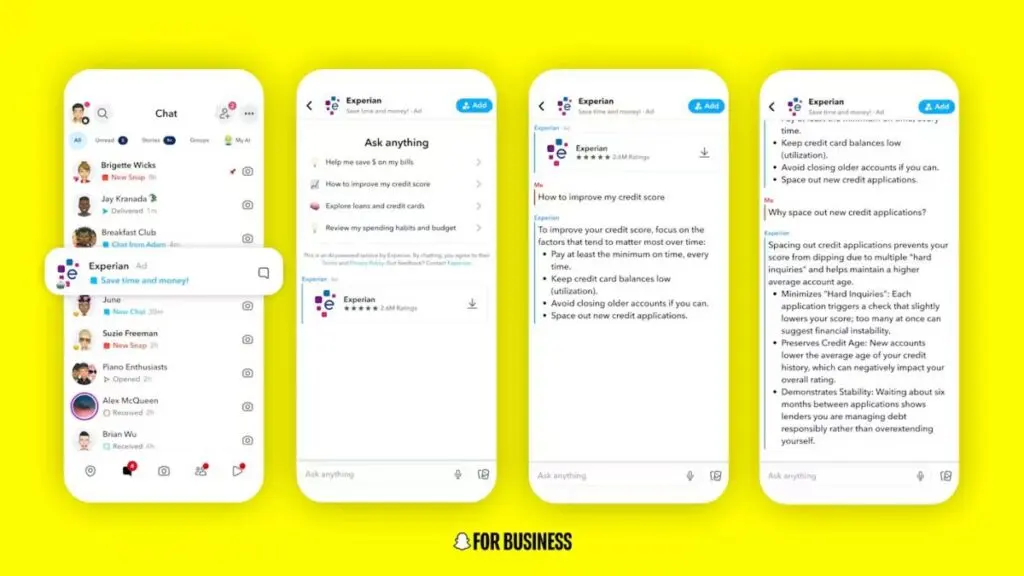
The financial sector has also taken note. Alpha partner Experian has already begun utilizing the format to engage users in discussions regarding financial health and credit scores. By turning complex financial topics into interactive chat sessions, Experian is able to provide utility to the user, fostering a sense of trust that static display ads rarely achieve. This move toward "utility-based advertising" is seen as a way to combat "ad fatigue" among younger demographics who are increasingly skeptical of traditional marketing tactics.
Full-Funnel Integration and Brand Strategy
For marketers, AI Sponsored Snaps represent a tool that functions across the entire marketing funnel.
- Top of Funnel (Awareness): AI agents can introduce brand concepts through personalized greetings and discovery questions.
- Middle of Funnel (Consideration): Users can explore product catalogs, compare features, and receive recommendations based on their stated preferences within the chat.
- Bottom of Funnel (Conversion): The AI can provide direct links to "Buy Now" buttons or schedule appointments, closing the loop between a casual chat and a financial transaction.
This full-funnel capability reduces the "leaky bucket" problem where potential customers are lost during transitions between different apps or websites. By keeping the user within the Snapchat environment, brands can maintain a cohesive narrative and gather better data on user intent.
Broader Implications for the Social Commerce Landscape
The launch of AI Sponsored Snaps is a clear volley in the ongoing war for "Social Commerce" dominance. Competitors such as Meta (through WhatsApp and Instagram) and TikTok have also been investing heavily in messaging-based business tools. However, Snapchat’s specific focus on the "Best Friends" network gives it a unique psychological advantage. Users on Snapchat often feel a higher level of intimacy and trust within the app’s chat interface compared to the more public-facing feeds of other platforms.
Furthermore, this move reflects a broader industry trend: the shift from "Deterministic Targeting" to "Intent-Based Interaction." As privacy regulations and the phasing out of third-party cookies make it harder for brands to track users across the web, the ability to engage a user in a direct conversation provides a wealth of "zero-party data"—information that the user voluntarily shares with the brand. This allows for hyper-personalization without the invasive tracking methods that have drawn regulatory scrutiny in recent years.
Technical Considerations and User Privacy
As with any AI-driven product, the implementation of AI Sponsored Snaps raises questions regarding data security and user experience. Snap Inc. has indicated that these AI agents will operate under strict guidelines to ensure user safety. The interactions are transparently labeled as "Sponsored," and users have the ability to manage or block these interactions just as they would with any other contact on the platform.
The technical challenge for brands will lie in the integration of their proprietary data with Snapchat’s AI infrastructure. For an AI agent to be truly effective, it needs real-time access to inventory, pricing, and customer service protocols. Snap is facilitating this by allowing brands to "bring their own AI," essentially acting as a host for the brand’s existing conversational logic while optimizing it for the mobile-first, vertical format of the Snapchat interface.
Conclusion: The Future of the "Conversion Surface"
The introduction of AI Sponsored Snaps signals that the era of the "passive ad" is drawing to a close. In its place is a new paradigm of conversational commerce, where the boundary between communication and consumption is increasingly blurred. For Snapchat, the move is a gamble on the idea that users want more than just to see brands—they want to talk to them.
As this technology rolls out globally, the success of the format will depend on the ability of brands to move beyond "sales pitches" and toward "value-driven dialogue." If executed correctly, AI Sponsored Snaps could redefine the standard for digital advertising, making the chat feed the most powerful sales tool in the modern marketer’s arsenal. For now, the industry will be watching closely as early adopters like Experian pave the way for a future where every "Snap" is the start of a potential transaction.