DIGIMON UP Review: An Analysis of Bandai Namco’s Latest Mobile Venture and its Reception

Bandai Namco Entertainment Inc. has released DIGIMON UP, an idle RPG developed to bring the beloved Digimon franchise to mobile devices. The title aims to capitalize on the deep emotional bonds between Tamers and their partner Digimon, a hallmark of the series, by offering players the opportunity to collect, train, and strengthen a vast array of Digital Monsters through automated battles and progression systems. However, initial assessments suggest a mixed reception, particularly among long-term fans, raising questions about whether this adaptation delivers the comprehensive Digimon experience they anticipate. This review delves into the game’s mechanics, presentation, monetization strategies, and broader implications, drawing from extensive gameplay analysis totaling over 20 hours on an iOS device.
The Digital Legacy: Context of the Digimon Franchise
The Digimon franchise, originating in 1997 with the Digital Monster virtual pet, has evolved into a sprawling multimedia phenomenon encompassing anime series, manga, films, and a diverse range of video games across various platforms. Central to its enduring appeal is the narrative emphasis on partnership, growth, and adventure within the Digital World. Unlike its contemporary, Pokémon, Digimon often features more mature themes, intricate character development, and a focus on the symbiotic relationship between human Tamers and their evolving Digimon partners. This narrative depth has cultivated a dedicated fanbase that expects strategic gameplay, compelling storylines, and meaningful interactions with their Digital Monsters.
Bandai Namco, as the primary publisher for Digimon games, has a long history of adapting the IP to various gaming formats, including console RPGs like Digimon Story Cyber Sleuth and mobile titles such as Digimon ReArise and Digimon New Century. The company consistently seeks to leverage the franchise’s recognition to reach diverse player demographics. DIGIMON UP represents their latest foray into the highly lucrative mobile gaming market, specifically targeting the idle RPG genre, which prioritizes accessibility and passive progression.
The Rise of Idle RPGs in the Mobile Market
The mobile gaming landscape has seen a significant proliferation of idle RPGs, a genre characterized by automated gameplay loops, minimal player input during combat, and continuous progression even when the player is offline. This genre appeals to a broad audience, particularly those with limited time for intensive gaming sessions, offering a sense of accomplishment through incremental power gains and collection mechanics. The financial success of idle RPGs, often bolstered by aggressive monetization through gacha systems, has made them an attractive proposition for publishers like Bandai Namco. These games typically feature simplified controls, a focus on resource management and character upgrades, and a constant stream of rewards to maintain engagement. The design philosophy behind auto-battlers allows for lower development costs compared to graphically intensive, narratively rich console titles, while still tapping into established intellectual properties to attract a ready-made player base.

DIGIMON UP aligns perfectly with this trend, aiming to provide a casual, accessible entry point into the Digimon universe. Its design inherently emphasizes convenience over complex strategy, a trade-off that often defines the idle RPG experience.
DIGIMON UP: Core Gameplay and Player Interaction
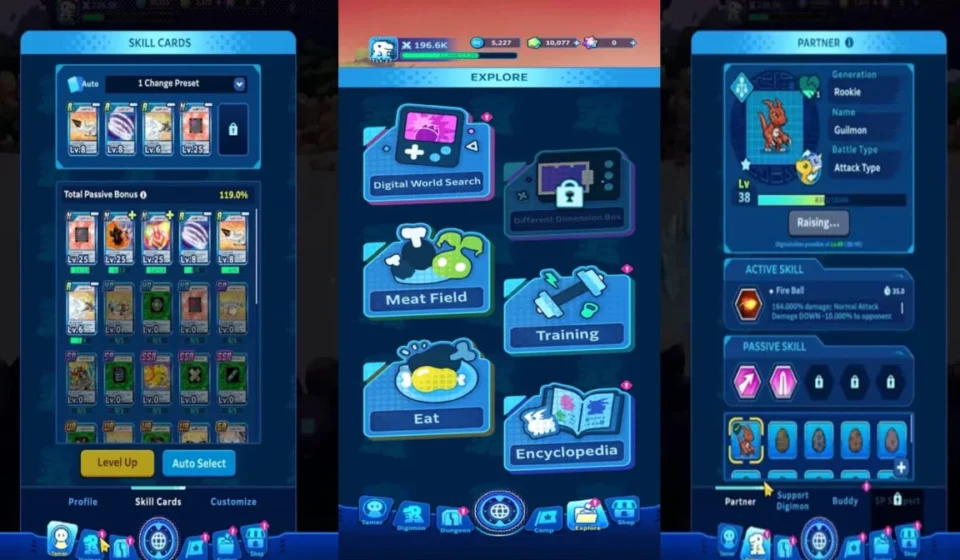
Upon initial engagement, DIGIMON UP introduces players to a multitude of gameplay systems, creating an immediate impression of depth. Beyond the core task of raising a partner Digimon, the game progressively unlocks features such as support Digimon, Skill Cards, and the Hologram device, alongside various upgrade pathways. This abundance of interconnected systems initially suggests a rich, strategic experience, with frequent notifications prompting player actions.
However, after several hours of play, this perceived depth diminishes significantly. The combat in DIGIMON UP operates almost entirely autonomously. The player’s partner Digimon, along with any deployed support Digimon, engages enemies automatically, executing attacks and abilities without direct input. Even Skill Cards, which might otherwise introduce tactical elements, activate passively. Consequently, victory in DIGIMON UP hinges predominantly on the player’s cumulative "Combat Power" (CP), a numerical representation of their team’s overall strength. This design choice fundamentally shifts player interaction away from real-time tactical decision-making and towards extensive menu navigation, resource allocation, and numerical optimization.
The initial satisfaction derived from watching a partner Digimon evolve, assembling a formidable team, and witnessing the tangible increase in Combat Power is undeniable. DIGIMON UP effectively leverages the visual appeal of Digimon evolutions and team building to create an illusion of strategic engagement. Yet, beneath these layers, the game reveals itself as a quintessential idle RPG. Progression is less about skillful execution and more about patience, consistent resource farming, and the steady accumulation of power. For players who appreciate the passive nature of idle games, this may suffice. However, for those accustomed to the strategic depth and active combat of traditional Digimon RPGs, this lack of meaningful interaction during battles is a notable drawback, leading to a sense of detachment from the action unfolding on screen.
Expansive Modes, Underwhelming Narrative
Despite its idle core mechanics, DIGIMON UP attempts to diversify player engagement through a gradual unlocking of various activities. The game offers a range of modes including PvP battles, Dungeons, and specialized Battle Stages, suggesting a wealth of content designed to prevent monotony. Initially, this variety appears promising, providing different avenues for progression and resource acquisition.

The primary gameplay loop revolves around the main Battle Stages, where the player’s partner Digimon automatically progresses through waves of enemies, continuously gathering essential resources. Yet, the automated combat inherent to the game’s design means these stages quickly devolve into a repetitive cycle of boosting Combat Power to overcome successive thresholds. The "side activities" — such as daily challenges, special events, and the aforementioned PvP and Dungeons — while offering temporary breaks from the main grind, ultimately serve the same overarching purpose: to accumulate more resources to further enhance Combat Power. This unified objective across all modes contributes to a pervasive sense of repetition, despite the superficial variety.
Perhaps the most significant departure from the franchise’s legacy lies in DIGIMON UP‘s narrative presentation. The Digimon series is renowned for its compelling storylines, often exploring complex themes of friendship, courage, and sacrifice set against epic adventures across the Digital World. The emotional resonance between Tamers and their partners is a cornerstone of the IP’s identity. In stark contrast, DIGIMON UP offers a surprisingly sparse and underdeveloped story. The narrative fails to provide a strong hook or sufficient investment, leaving players with little emotional connection to the unfolding events or the broader world. This narrative deficiency is a critical point of concern for fans seeking the rich storytelling synonymous with the Digimon brand. The game provides numerous daily activities, catering to players who enjoy frequent check-ins, but without a robust narrative or more engaging core gameplay, the sheer volume of modes struggles to mask the underlying repetitiveness.
Visual Charm Amidst Repetition: Art Style and Presentation
One of the undeniable strengths of DIGIMON UP is its visual presentation, particularly its charming pixel-art sprites. From the moment the game loads, the beautifully animated Digital Monsters capture attention, showcasing expressive animations that successfully convey each creature’s unique personality. The game boasts an extensive roster of Digimon, a feature that will undoubtedly delight long-time fans eager to collect their favorites. The visual fidelity of these sprites is a clear highlight, demonstrating a commitment to aesthetic quality within the constraints of the pixel art style.
However, the initial excitement generated by these detailed sprites gradually wanes as other aspects of the visual and auditory presentation fail to maintain the same high standard. Battle environments, while functional, quickly become repetitive, offering little visual variety across hundreds of automated encounters. Given the fully automated combat, players spend a significant amount of time observing similar animations play out repeatedly, which can lead to visual fatigue.
The background music, while fitting the relaxed, passive atmosphere of an idle game, is generally unobtrusive and largely unmemorable. Similarly, the sound effects competently accompany attacks and menu interactions, providing adequate impact without becoming distracting. While neither the music nor the sound design detracts from the experience, they also do not elevate it, settling for a functional rather than an inspiring role. In essence, DIGIMON UP‘s visual charm is heavily front-loaded in its character designs, but the overall presentation struggles to sustain a lasting impression beyond that initial appeal due to environmental monotony and repetitive combat animations.

Accessibility and User Experience: Controls and UI
As an idle RPG, DIGIMON UP inherently does not demand the precise reflexes or complex input schemes typically associated with action-oriented games. Player interactions are primarily confined to navigating menus, claiming rewards, upgrading Digimon, and managing the game’s various systems. In this regard, the game’s controls are highly responsive and straightforward, facilitating an easy assimilation into its core gameplay loop.
Navigation between different menus is fluid, requiring only a few taps, and most critical features are conveniently accessible directly from the main screen. From a technical perspective, DIGIMON UP demonstrates a commendable level of polish. Menus load quickly, transitions between screens are smooth, and the reviewer rarely encountered noticeable lag or performance issues during interface navigation. This technical competence is crucial for an idle game, where frequent menu interactions are a given, helping to prevent user frustration.
Despite its technical polish, the user interface (UI) can occasionally feel overly busy. This is a common characteristic of many modern mobile RPGs that pack numerous features and progression systems into a single screen. While all elements are functional and accessible, the sheer density of icons, notifications, and numerical displays might initially overwhelm new players. Nevertheless, the intuitive layout and responsive controls largely mitigate this potential issue, ensuring that the UI, despite its busyness, remains generally easy to navigate and operate.
Monetization Model: Free-to-Play and Gacha Dynamics
Like the vast majority of mobile RPGs in today’s market, DIGIMON UP operates on a free-to-play model, heavily supported by gacha mechanics. The gacha system, a common monetization strategy, involves players spending in-game currency (often purchased with real money) for a chance to acquire new Digimon, Skill Cards, or other valuable resources from a randomized pool.
Commendably, DIGIMON UP exhibits a degree of generosity towards its free-to-play (F2P) player base. The game regularly provides summon tickets, daily login rewards, mission bonuses, and a sufficient quantity of premium currency (DigiEmeralds) to allow for frequent multi-summons on specific premium banners without requiring real-money expenditure. This approach ensures that F2P players can indeed make meaningful progress and acquire a substantial roster of Digimon over time. The reviewer noted successfully obtaining numerous Digimon without spending a single dollar, a testament to the game’s F2P viability.

However, while the game remains entirely playable without financial investment, it consistently employs psychological nudges and strategic design elements to remind players that paying can significantly accelerate progression. Premium bundles, special offers, and limited-time gacha banners are ever-present, offering pathways to faster power accumulation and access to rare or powerful Digimon. This duality – playable for free but incentivizing spending – is characteristic of the gacha model. While DIGIMON UP avoids creating hard paywalls that completely impede F2P progression, the constant presence of paid options can create a perception of slower progress for non-spenders. Nevertheless, for dedicated fans willing to invest time rather than money, the game does offer a feasible path to enjoyment and progress, underscoring its relatively fair approach within the often-criticized gacha landscape.
Community Reception and Industry Implications
Early community reception for DIGIMON UP has been predictably bifurcated. Casual mobile gamers and those who appreciate the convenience of idle progression have found enjoyment in its accessible mechanics and the thrill of collecting their favorite Digimon without significant time commitment. These players often prioritize passive growth and the aesthetic appeal of the Digimon themselves. Conversely, a vocal segment of the long-term Digimon fanbase has expressed disappointment, citing the game’s lack of strategic depth, automated combat, and underdeveloped narrative as significant deviations from the core tenets that define the franchise. This sentiment reflects a desire for a more immersive and interactive RPG experience, akin to console titles that emphasize player agency and storytelling.
Bandai Namco’s strategic goals with DIGIMON UP appear to be multi-faceted. On one hand, the game serves to broaden the Digimon audience, appealing to mobile-first players who might be unfamiliar with or disinclined towards traditional RPGs. On the other hand, it represents a calculated effort to leverage the immensely popular IP for consistent revenue generation through the proven gacha model, a common practice in the mobile gaming industry. The challenge for Bandai Namco lies in balancing these commercial imperatives with the expectations of its loyal fanbase. A game like DIGIMON UP, while potentially successful in terms of downloads and revenue, risks alienating core fans if it is perceived as a mere cash-grab that fails to uphold the franchise’s established values of deep storytelling and engaging gameplay. This dynamic highlights a broader industry trend where established IPs are adapted into mobile formats that prioritize monetization and accessibility over the original property’s intrinsic gameplay or narrative strengths. The future outlook for Digimon on mobile platforms will likely be influenced by how DIGIMON UP performs financially versus its impact on overall brand perception among its dedicated followers.
Conclusion: A Compromised Vision for the Digital World
After extensive evaluation, DIGIMON UP emerges as a title characterized by both commendable presentation and notable compromises in gameplay depth. At its core, the game functions as a generic idle RPG adorned with the aesthetically pleasing veneer of the Digimon franchise. While the pixel-art visuals are outstanding and the extensive roster of Digimon is a significant draw, these strengths are largely overshadowed by repetitive idle gameplay, an absence of strategic depth, and a narrative that struggles to leave a lasting impression.
The game’s design, which heavily favors automated combat and menu-driven progression, diverges sharply from the active, strategic combat and compelling storytelling typically associated with the Digimon brand. This approach may resonate with players who specifically seek the convenience of idle mechanics and the simple joy of collecting Digital Monsters. However, for long-standing Digimon enthusiasts who anticipate a more engaging, story-rich monster-raising RPG, DIGIMON UP is likely to fall short of expectations, leaving them yearning for a more interactive and narratively fulfilling adventure in the Digital World. Ultimately, DIGIMON UP represents an average idle RPG package, albeit one beautifully wrapped in a beloved franchise’s aesthetic. Its place within the Digimon canon is one of an accessible, casual entry, but not a definitive one that captures the full spirit and depth of the Digital Monster experience.

Review Score Breakdown:
- Gameplay Mechanics: 6/10
- Initial depth illusion quickly fades due to automated combat and heavy reliance on Combat Power, diminishing player interaction.
- Game Modes and Storyline: 6/10
- Numerous modes offer variety but ultimately serve repetitive resource gathering; the narrative lacks the franchise’s characteristic emotional investment.
- Graphics and Music: 7/10
- Charming, well-animated pixel sprites and a vast Digimon roster are highlights, though battle environments and music are less memorable.
- Controls and UI: 6.5/10
- Responsive controls and technically polished UI ensure ease of navigation, despite a sometimes busy interface.
- Free-to-play elements: 7/10
- Generous F2P rewards allow for steady progression, though constant reminders of paid acceleration are present.
Overall Average: 6.5/10 – Average
DIGIMON UP succeeds in delivering beautiful pixel-art visuals and an impressive roster of beloved Digimon, but these strengths are overshadowed by repetitive idle gameplay and limited strategic depth. While dedicated Digimon fans who prioritize collection and idle RPG enthusiasts may still find it enjoyable, those looking for a more engaging and traditional Digimon adventure may come away disappointed.
For further insights and assistance within DIGIMON UP, players may consult available resources such as a Beginners Guide, Reroll Guide for optimal starts, and Redeem Codes articles for in-game freebies.