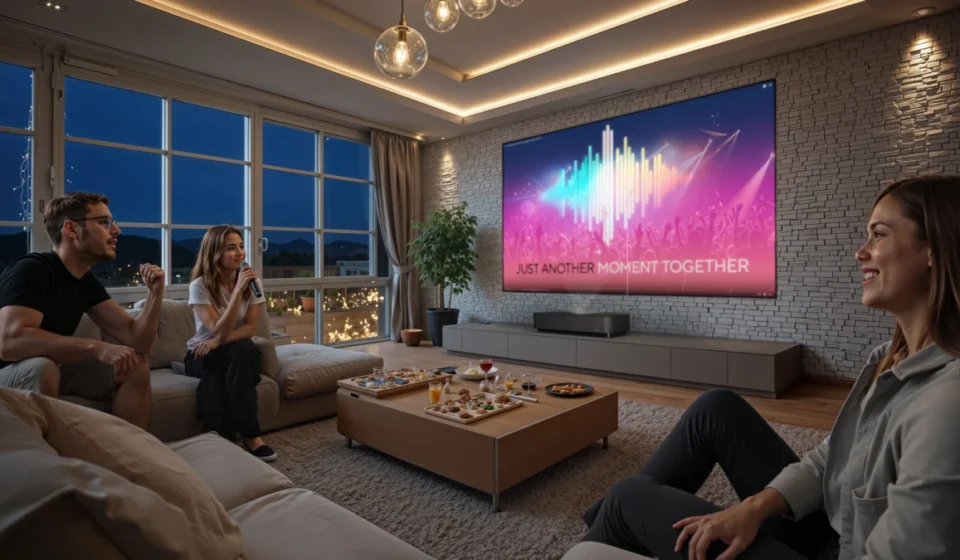
Epson Unveils Lifestudio Grand Plus, Elevating Ultra Short Throw Projector Market with Enhanced Brightness and Integrated AI

Epson, a global leader in imaging and innovation, has officially launched the Lifestudio Grand Plus, a new flagship ultra short throw (UST) laser projector designed to redefine the home entertainment experience. This latest offering builds upon Epson’s existing Lifestudio lineup, making a compelling pitch for consumers seeking to replace traditional large-screen televisions with a more versatile and immersive projection solution. The announcement underscores a growing industry trend where UST projectors are increasingly positioned as viable and often superior alternatives to conventional flat-panel displays, particularly as screen sizes continue to expand beyond the 100-inch mark.
The Lifestudio Grand Plus enters a burgeoning market segment, distinguishing itself with a suite of enhanced features. On paper, it shares a foundational architecture with the base Lifestudio Grand model, which was introduced in late 2024. Both models are engineered for convenience, capable of projecting expansive images from just inches away while sitting on a standard TV stand. At their core, these projectors leverage Epson’s proprietary 4K PRO-UHD pixel shifting technology alongside a robust 3-chip 3LCD laser system, ensuring vibrant and accurate color reproduction. Furthermore, both support HDR10 content, critical for delivering the dynamic range and contrast expected from modern high-fidelity visual experiences. However, the Grand Plus is meticulously positioned as a true, all-in-one television replacement, offering significant upgrades that aim to solidify its premium status.
Technological Advancements and Performance Benchmarks
A primary enhancement in the Lifestudio Grand Plus is its substantial boost in brightness. The device pushes output to an impressive 4,000 lumens, a notable increase from the 3,600 lumens offered by its predecessor. This elevated brightness is crucial for maintaining image vibrancy and clarity, even in environments with moderate ambient light, a common challenge for projectors in typical living room settings. Higher lumen output directly translates to a more impactful viewing experience, allowing for deeper blacks and brighter whites, contributing to a more dynamic picture. This improvement reflects Epson’s understanding of real-world usage scenarios, where living rooms are rarely entirely dark.
Beyond brightness, the Grand Plus also expands its projection range significantly, capable of casting images up to a colossal 150 inches diagonally, a substantial leap from the 120-inch maximum of the previous model. This expanded capability provides users with the flexibility to create an even larger, more immersive cinematic experience in their homes, pushing the boundaries of what is traditionally achievable with consumer-grade displays. The ability to project such a large image from such a short distance is the hallmark of UST technology and a key driver of its appeal.
The 4K PRO-UHD technology employed by Epson is a sophisticated form of pixel shifting. Unlike native 4K projectors that use a single imaging chip with 8.3 million physical pixels, Epson’s 3LCD projectors utilize three high-definition LCD panels (one for each primary color: red, green, and blue) and shift pixels diagonally at an incredibly high speed. This process effectively quadruples the pixel density, delivering a perceived resolution that is remarkably close to native 4K, often indistinguishable to the human eye under normal viewing conditions. This method allows for excellent color accuracy and brightness, a strong suit of 3LCD technology, while being more cost-effective than true native 4K, thereby making large-screen 4K experiences more accessible.
Integrated Audio and Smart Home Ecosystem
To further cement its status as an all-encompassing TV replacement, the Lifestudio Grand Plus integrates a high-fidelity 2.1-channel "Sound by Bose" speaker system. This is a feature carried over from the previous generation, highlighting Epson’s commitment to providing a complete audiovisual solution straight out of the box. The inclusion of a reputable audio brand like Bose signifies a focus on delivering robust and clear sound, eliminating the immediate need for external soundbars or complex home theater speaker setups. This integrated sound system allows the projector to function as a self-contained entertainment hub, streamlining installation and reducing clutter in living spaces where a traditional television typically holds court. The goal is to offer an effortless plug-and-play experience that rivals the simplicity of a TV.
A significant leap forward for the Grand Plus, and a preview of future enhancements for the entire Lifestudio lineup, is its status as one of the first projectors to ship with Google TV and integrated Gemini. Google TV provides a streamlined, personalized interface that aggregates content from various streaming services, making discovery intuitive and user-friendly. The inclusion of Gemini, Google’s advanced AI model, points to a more sophisticated, AI-driven approach to navigation, content discovery, and interaction. While existing Lifestudio models already feature built-in streaming apps and voice controls via Google Assistant, Gemini is poised to elevate this experience through more natural language processing, predictive recommendations, and potentially more seamless integration with other smart home devices. Epson had previously signaled this strategic upgrade to the Lifestudio lineup during CES, indicating a clear direction towards smarter, more interconnected home entertainment systems.
Market Context and Competitive Landscape
The rise of ultra short throw projectors like the Epson Lifestudio Grand Plus is a direct response to evolving consumer demands and technological advancements. For years, the home entertainment market has been dominated by flat-panel televisions, with sizes steadily increasing. However, once screens push past 85-90 inches, the cost, weight, and logistical challenges of manufacturing, shipping, and installing traditional TVs escalate dramatically. UST projectors offer an elegant solution to this dilemma, providing screen sizes well over 100 inches at a fraction of the physical footprint and often a more competitive price point for a comparable scale.
The global projector market, and specifically the UST segment, has witnessed robust growth. According to recent industry analyses, the UST projector market is projected to grow at a significant compound annual growth rate (CAGR) over the next five to ten years, driven by factors such as increasing demand for large-screen home entertainment, advancements in laser light source technology, and the integration of smart features. Major players like Samsung, LG, Hisense, and others have also entered or expanded their presence in this space, creating a vibrant and competitive ecosystem. Epson, with its deep roots in projection technology, is well-positioned to capitalize on this trend, leveraging its established reputation for image quality and reliability.
Epson’s Lifestudio Grand Plus is priced at $3,799.99 and will be available in both elegant black and white finishes, offering aesthetic flexibility to complement various interior designs. This pricing positions it as a premium offering within the UST market, reflecting its enhanced brightness, larger projection capability, and advanced AI integration. Importantly, the Grand Plus joins, rather than replaces, the existing Lifestudio Grand, which remains available at a more accessible price point of $2,699. This tiered product strategy allows Epson to cater to a broader spectrum of consumers, from those seeking a high-value entry into the UST space to enthusiasts demanding top-tier performance and features.
Broader Implications and Future Outlook
The introduction of the Lifestudio Grand Plus has several implications for the home entertainment industry. Firstly, it further validates the concept of the projector as a primary display device, moving beyond its traditional role as a niche home cinema component. The "TV replacement" narrative is no longer a futuristic dream but a present reality, supported by devices that offer convenience, performance, and smart capabilities comparable to, or even exceeding, high-end televisions.
Secondly, the integration of Google TV and Gemini signals a broader trend of artificial intelligence becoming an indispensable part of consumer electronics. AI is moving beyond simple voice commands to truly intelligent content curation, personalized recommendations, and seamless device interaction. For projectors, this means not just projecting an image but becoming a central intelligent hub for the smart home, capable of understanding user preferences and proactively enhancing the entertainment experience. This evolution suggests that future iterations of such devices will likely feature even deeper AI integration, potentially enabling adaptive picture settings based on ambient conditions, dynamic content recommendations, and even interactive, AI-driven experiences.
Thirdly, the emphasis on integrated audio and design versatility (color options) highlights the importance of an all-encompassing user experience. Consumers are looking for simplified solutions that blend seamlessly into their living environments without compromising on performance. The ability to achieve a massive screen size with high-quality sound from a compact, aesthetically pleasing unit that sits flush against a wall is a significant advantage over traditional large-screen TVs that can dominate a room visually.
The competitive landscape will continue to intensify, driving further innovation in laser light sources, optical design, and smart platform integration. As manufacturing efficiencies improve and technologies mature, the cost of UST projectors is likely to become even more competitive, making large-screen home entertainment accessible to an even wider audience. Epson’s Lifestudio Grand Plus is not merely a new product; it is a significant step in the ongoing evolution of how we consume and interact with digital content in our homes, pointing towards a future where immersive, intelligent, and adaptable displays are the norm. The battle for the living room continues, and with devices like the Grand Plus, projectors are demonstrating their readiness to claim a decisive victory.