

In a period of strategic leadership transition at the Digest investment publication, senior analyst Brian Hunt, editor of Money & Megatrends, has identified several pivotal market themes that are currently dictating the flow of global capital. These themes, which range from the aging demographic’s impact on healthcare to the massive infrastructure requirements of the artificial intelligence (AI) revolution, suggest a robust outlook for specific sectors of the American economy. As traditional market indicators show signs of volatility, institutional and retail investors are increasingly looking toward "megatrends"—long-term, transformative forces—to anchor their portfolios.
The Healthcare and Biotechnology Megatrend
The healthcare sector has demonstrated significant momentum over the past 12 months, driven by a combination of demographic shifts and technological breakthroughs. The S&P Biotech ETF (XBI) has surged by 72% within this period, while the Health Care Select Sector Fund (XLV) has climbed 23%. A primary catalyst for this growth is the "Boomer healthcare" trend. As the massive Baby Boomer generation enters a life stage characterized by increased medical necessity, the demand for diagnostics, chronic disease management, and specialized treatments is projected to remain elevated for at least the next decade.
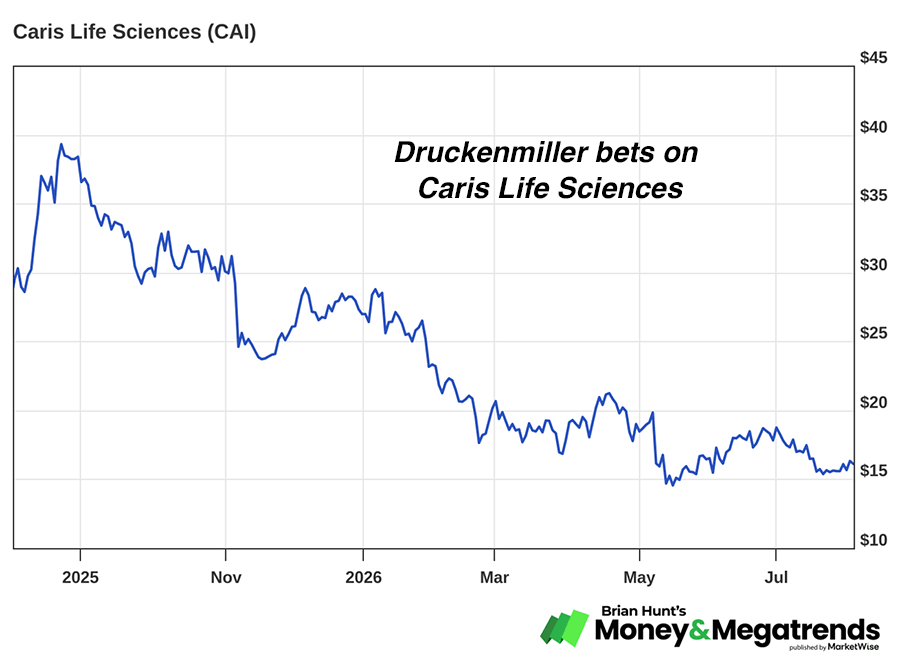
This trend is further amplified by the entry of legendary investor Stanley Druckenmiller into the sector. Druckenmiller, renowned for achieving 30% annual returns over three decades without a single losing year, has recently shifted focus toward healthcare and biotechnology. According to his latest 13F filings—quarterly reports required by the U.S. Securities and Exchange Commission (SEC) for institutional investment managers with over $100 million in assets—Druckenmiller is betting heavily on the convergence of AI and genomics.

Actionable Healthcare Stock Profiles
Based on an analysis of recent 13F filings and market performance, four companies have emerged as key players in the healthcare megatrend:
-
Caris Life Sciences (CAI): With a market capitalization of $4.4 billion, Caris focuses on oncology diagnostics. The company utilizes a proprietary database of molecular characteristics—including DNA, RNA, and protein information—to help physicians tailor cancer treatments to the individual patient. As personalized medicine becomes the gold standard in oncology, Caris’s ability to support pharmaceutical research through real-world data is viewed as a high-value asset.
-
Option Care Health (OPCH): Valued at $3.5 billion, this company provides home and alternate-site infusion therapy. The business model capitalizes on the broader industry shift toward decentralized care. Home-based treatment for immune disorders and cancer is significantly more cost-effective than hospital-based care, making Option Care Health a beneficiary of both an aging population and systemic pressure to reduce healthcare expenditures.
-
Olema Pharmaceuticals (OLMA): This clinical-stage firm, with a market cap of approximately $985 million, is developing palazestrant, an oral therapy for hormone-receptor-positive breast cancer. The drug is designed to degrade estrogen receptors, specifically targeting mutated forms that often resist traditional treatments.

-
Belite Bio (BLTE): A $6.2 billion biotechnology company, Belite Bio is targeting retinal diseases caused by toxic vitamin-A byproducts. Its primary research focus includes Stargardt disease and geographic atrophy related to dry age-related macular degeneration, both of which represent significant unmet medical needs in the elderly population.
The AI-Driven Power Grid Overhaul
Beyond healthcare, a secondary and equally potent megatrend is the urgent need for a modernized electrical grid. This demand is being propelled by the rapid expansion of AI data centers. Leading technology firms, including Google (Alphabet Inc.), Microsoft, and Amazon, are currently investing trillions of dollars into AI infrastructure. However, the operational viability of these data centers depends entirely on a stable and high-capacity power supply.
Goldman Sachs Research recently forecasted that global data center power demand will increase by 50% by 2027 and could rise by as much as 165% by 2030. This surge comes at a time when the United States’ electrical infrastructure is under duress. The American Society of Civil Engineers (ASCE), in its most recent Infrastructure Report Card, issued the energy sector a "D+" grade, citing aging transmission lines and a lack of capacity to handle modern loads.
Eaton Corporation as a Market Bellwether
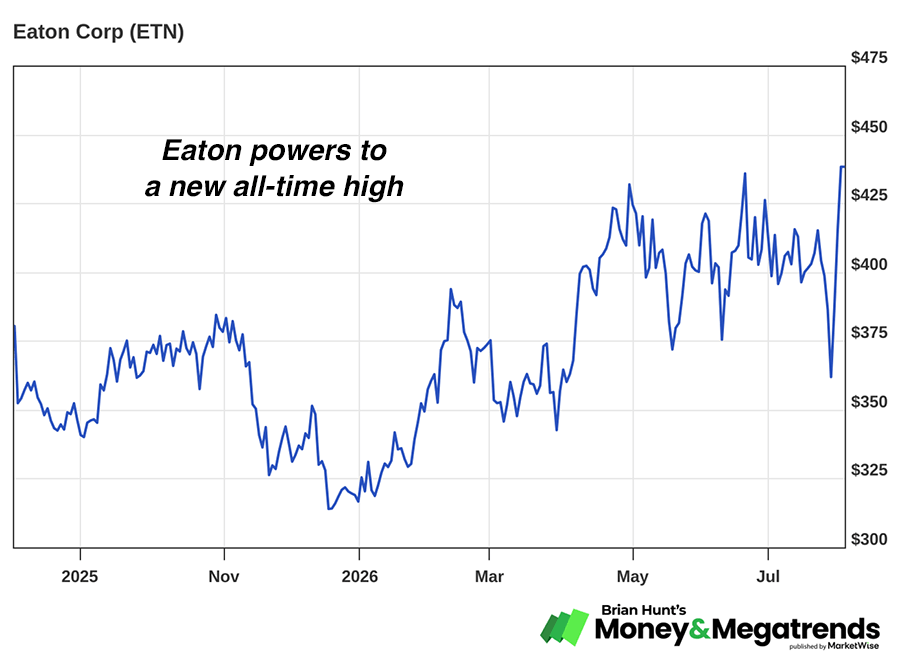
Eaton Corporation (ETN), a $170 billion giant in electrical components, recently reported quarterly earnings that exceeded Wall Street expectations. The company, which manufactures transformers, circuit breakers, and utility voltage regulators, has seen its stock reach all-time highs following reports of a record order backlog. Eaton’s fastest-growing business segment is currently dedicated to equipping AI data centers with necessary electrical infrastructure.
Industry analysts suggest that the "Power Grid Upgrade" theme will involve massive capital flows over the next five years. PowerLines, an industry advocacy group, estimates that investment plans for 51 investor-owned utilities will total approximately $1.4 trillion through 2029. This relentless flow of capital into grid modernization is expected to support a prolonged bull market for companies specializing in electrical infrastructure and domestic manufacturing.
The Resilience of the American Consumer
While macroeconomic headlines often highlight consumer anxiety and fluctuating sentiment readings, market data from the retail sector suggests a different reality. Williams-Sonoma (WSM), a leading retailer of high-end home furnishings and kitchenware, recently reached an all-time high, with its stock price appreciating 25% over the past year.
Williams-Sonoma operates over 600 stores under brands such as Pottery Barn and West Elm. Its success is particularly noteworthy because its products occupy the "accessible premium" segment—price points that require significant discretionary income. The company’s growth contradicts the pessimistic readings of the Michigan Consumer Sentiment Survey, which has frequently reported dismal consumer outlooks.
Market analysts observe a "sentiment-spending gap," where consumers report feeling pessimistic about the broader economy while simultaneously maintaining high levels of personal spending. This resilience is a critical indicator for investors, suggesting that despite inflationary pressures, the mid-to-high-end American consumer remains a stable pillar of the domestic economy.

Chronology of Recent Market Events
To understand the current trajectory of these megatrends, it is essential to look at the timeline of recent financial disclosures and reports:
- Late July 2024: Eaton Corporation releases its Q2 earnings report, showing a significant beat on both top and bottom lines, driven by the AI data center boom.
- August 2024: Institutional 13F filings reveal Stanley Druckenmiller’s increased positioning in biotechnology and specialized healthcare diagnostics.
- August 2024: Williams-Sonoma stock hits a record high, signaling robust demand in the premium retail sector despite high interest rates.
- Early 2025 (Forecasted): The American Society of Civil Engineers is expected to release updated findings on the U.S. power grid, likely reinforcing the need for the $1.4 trillion investment plan currently being discussed by utility advocates.
Official Responses and Economic Analysis
Government and industry officials have begun to react to these shifting trends. Energy regulators have noted that the "Made in America" movement—which encourages the domestic manufacturing of semiconductors and electric vehicle batteries—is adding further strain to the grid. In response, federal initiatives are being explored to streamline the permitting process for new transmission lines.
From an investment perspective, the convergence of these trends creates a unique environment. The AI revolution is not just a software story; it is a hardware and energy story. Similarly, the biotechnology boom is not just about scientific discovery; it is a demographic inevitability.
The analytical consensus suggests that the "Power Grid Upgrade" and "Boomer Healthcare" themes are less susceptible to short-term economic cycles because they are driven by structural needs rather than discretionary whims. While a recession could slow growth, the necessity of upgrading a failing grid and treating an aging population provides a fundamental "floor" for these sectors.
Broader Impact and Future Implications
The long-term implications of these megatrends suggest a reconfiguration of the S&P 500’s leadership. For the past decade, software-as-a-service (SaaS) and social media companies have dominated market gains. However, the next phase of market growth appears to be shifting toward "hard assets" and "biological intellectual property."
Investors who align their portfolios with these shifts are essentially betting on the physical requirements of the future. Whether it is the transformers that power AI, the diagnostic tools that identify cancer, or the premium furniture that populates American homes, these actionable ideas reflect a reality that is currently being reflected in price action, if not always in the headlines. As the U.S. power grid undergoes its most significant upgrade since the post-WWII era and biotechnology enters a "golden age" of discovery, the capital flows into these sectors are likely to remain a dominant force in the global financial landscape for years to come.