Google Unveils Advanced Gemini Features for Google TV, Enhancing User Experience and Expanding Global Reach

The integration of Google’s advanced artificial intelligence, Gemini, into the Google TV platform is taking a significant leap forward, with key features initially teased at CES 2026 now beginning to roll out to users. This strategic enhancement promises a more intuitive, visually rich, and deeply personalized entertainment experience, marking a pivotal moment in the evolution of smart home entertainment. Google had previously indicated that these innovations would arrive "in the coming months" following their grand reveal at the Consumer Electronics Show, and the company is now making good on that promise, starting with a phased deployment across key markets.
The Genesis at CES 2026: A Vision for Intelligent Entertainment
The journey to this expanded functionality began earlier this year at CES 2026, the world’s most influential technology event held annually in Las Vegas. Google, a perennial fixture at the show, dedicated a significant portion of its presentation to outlining its vision for the future of connected living, with Google TV and the Gemini AI at its core. Industry analysts and tech enthusiasts keenly observed Google’s demonstrations, which showcased how artificial intelligence could transform passive content consumption into an active, conversational, and highly personalized experience. The CES announcement served as a clear signal of Google’s commitment to leveraging its AI prowess to maintain a competitive edge in the fiercely contested smart TV and streaming device market. The initial preview highlighted functionalities designed to anticipate user needs, offer more comprehensive information, and streamline content discovery, all powered by Gemini’s sophisticated natural language understanding and generative capabilities.
Rolling Out the Innovation: Three Core Features Emerge
As of today, users in the United States are beginning to see the first wave of these promised Gemini-powered enhancements. Google has officially confirmed the rollout of three distinct features for Gemini-enabled Google TV devices: enriched visual assistance, in-depth content "deep dives," and concise sports briefs. These features represent a calculated effort to move beyond basic voice commands, offering a richer, more interactive layer to the Google TV interface.
-
Richer Visual Help: This feature is designed to elevate the visual feedback provided by Gemini. Instead of merely displaying text responses or a simple list, Gemini will now leverage the full screen real estate of the television to present information in a visually engaging and easily digestible format. For instance, when a user asks for movie recommendations, Gemini might not only list titles but also display large, high-resolution thumbnails, cast information, genre tags, and critic ratings directly on screen, organized in a visually appealing grid. If a user inquires about a particular actor, the TV could present a biographical overview alongside a filmography, complete with movie posters and clips. This visual enhancement aims to reduce the cognitive load on users, making information discovery faster and more intuitive, aligning with the large-screen viewing experience. This feature is crucial as it addresses a long-standing challenge for voice assistants on TVs: how to present complex information without requiring users to scroll through endless text or navigate cumbersome menus.
-
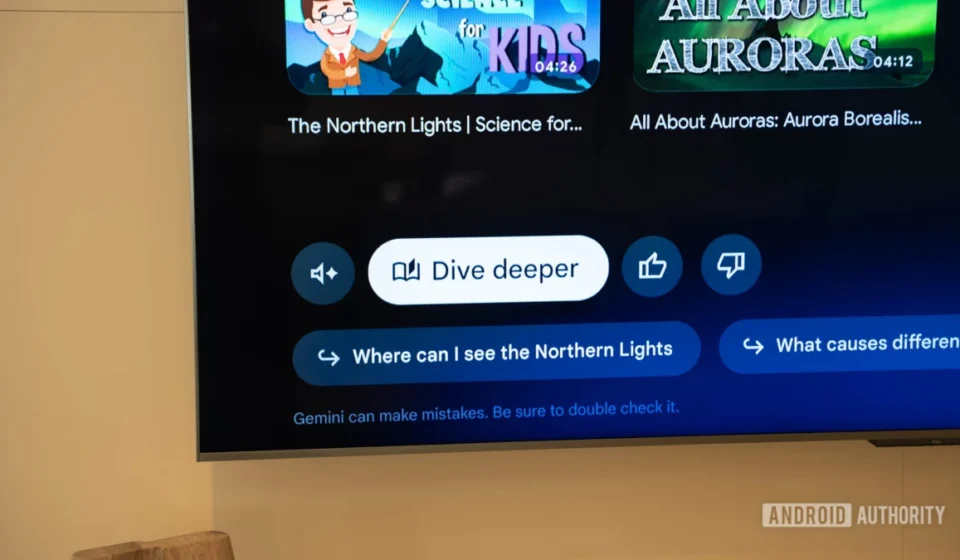
Deep Dives: The "deep dives" functionality is poised to revolutionize how users explore content and related topics. Imagine watching a historical drama and being curious about a specific event or figure depicted. With "deep dives," users can simply ask Gemini, "Tell me more about the Roman Empire during that period," or "Who was the real Queen Elizabeth I?" Gemini will then compile and present detailed, contextual information, potentially drawing from Google Search, Wikipedia, and other authoritative sources, directly on the TV screen. This goes beyond a simple search result; it’s an intelligent aggregation and presentation of knowledge, designed to enrich the viewing experience without requiring users to reach for a secondary device like a smartphone or tablet. This feature holds immense potential for educational content, documentaries, or simply satisfying casual curiosities that arise during entertainment consumption. It transforms the TV from a passive display into an interactive learning portal.
-
Sports Briefs: For sports enthusiasts, the "sports briefs" feature promises timely and concise updates. Users can quickly ask Gemini for the latest scores, game summaries, upcoming schedules, or even specific player statistics across various leagues and sports. Instead of having to navigate through multiple sports apps or websites, Gemini will aggregate this information and present it in an easy-to-read format. For example, a user could ask, "What were the NBA scores last night?" or "Give me an update on the Premier League standings." Gemini would then provide a succinct, relevant brief, potentially accompanied by team logos or player images. This feature caters to the fast-paced nature of sports news, providing instant access to critical information without disrupting the overall viewing experience. The convenience offered here aims to keep users engaged with their favorite sports without needing to switch inputs or devices.
Phased Global Rollout and Broader Accessibility
The initial rollout prioritizes the United States for all three features. However, Google has outlined a clear plan for international expansion. Users in Canada will gain access to the "richer visual help" feature starting today, with "deep dives" and "sports briefs" slated to arrive later in the spring. This staggered approach often allows companies to monitor performance, gather feedback, and fine-tune features before a broader deployment.
Beyond these specific feature rollouts, Google also announced an expansion of the core Gemini for Google TV voice assistant to more regions globally. This broader rollout is anticipated to commence this spring, with Australia, New Zealand, and Great Britain identified as the first countries to receive access to the full voice assistant capabilities. This geographical expansion is critical for Google, as it broadens the addressable market for its AI-powered entertainment platform, leveraging the strong English-speaking user bases in these territories. The strategic importance of these markets lies in their robust adoption of streaming services and smart home technologies, making them fertile ground for advanced AI integration.
Google TV and Gemini: A Strategic Convergence
Google TV, which evolved from the earlier Android TV platform, serves as Google’s primary interface for smart televisions and streaming devices. It aims to unify content from various streaming services, live TV, and personal libraries into a single, personalized experience. Its strength lies in its deep integration with Google’s ecosystem, including YouTube, Google Play, and now, critically, Google Assistant and Gemini.
The integration of Gemini, Google’s most capable and general-purpose AI model, represents a significant strategic pivot. Gemini’s multimodal reasoning capabilities allow it to process and understand different types of information, including text, code, audio, image, and video. By bringing this advanced AI to the living room, Google is not just adding a voice assistant; it’s embedding a highly intelligent, conversational agent directly into the heart of the home entertainment system. This move is part of a broader strategy by Google to infuse Gemini across its product portfolio, from search and productivity apps to mobile devices and smart home gadgets, aiming for a cohesive and intelligent user experience across all touchpoints.
The rationale behind this deep integration is multi-faceted. Firstly, it addresses the increasing fragmentation of content. With dozens of streaming services available, finding specific content can be a frustrating experience. Gemini can act as an intelligent concierge, sifting through vast libraries based on nuanced requests. Secondly, it enhances user engagement. A more interactive and helpful interface encourages users to spend more time within the Google TV ecosystem. Thirdly, it strengthens Google’s position in the smart home. The television often serves as a central hub in many households, and by making it smarter, Google reinforces its presence and utility in daily life.
Enhancing the User Experience: A New Era of Interaction
The implications of these new Gemini features for the end-user experience are profound. Current smart TV interfaces, while functional, often require tedious navigation through menus and sub-menus. The introduction of richer visual help, deep dives, and sports briefs promises to streamline these interactions dramatically.
For the average consumer, this means:
- Reduced Friction: Less time spent searching and more time spent enjoying content.
- Personalized Discovery: AI-driven recommendations that go beyond simple genre matching, understanding mood, context, and even specific details within a query.
- Enriched Knowledge: The ability to instantly access supplementary information about what they are watching, fostering a deeper understanding and appreciation of content.
- Hands-Free Convenience: A more natural way to interact with the TV, especially when engaged in other activities or simply relaxing on the couch.
This evolution signifies a shift from a command-based interaction model to a more conversational and context-aware one. Users can speak naturally, and Gemini’s advanced understanding will interpret their intent, providing relevant and visually appealing responses. This aligns with broader trends in human-computer interaction, where natural language processing and intuitive interfaces are becoming paramount.
Industry Reactions and the Competitive Landscape
While official statements from competing platforms are typically reserved, industry analysts have been quick to weigh in on Google’s latest move. Tech analyst firm, DataStream Insights, noted in a recent report, "Google’s aggressive integration of Gemini into Google TV is a clear signal of their intent to lead in the AI-powered entertainment space. The emphasis on visual richness and contextual information is a smart play, differentiating them from more text-heavy or basic voice assistants currently on the market." Another analyst from Global Tech Research commented, "The battle for the living room is heating up. Amazon with Alexa on Fire TV, Apple with Siri on Apple TV, and Roku’s voice capabilities are all contenders. Google’s advantage lies in the sheer power and multimodal capabilities of Gemini, which promises a level of intelligence and utility that others will find challenging to match quickly."
The competitive landscape in the smart TV and streaming device market is crowded. Key players include:
- Amazon Fire TV: Powered by Alexa, offering extensive content integration and smart home controls.
- Apple TV: Known for its premium user experience, tight integration with the Apple ecosystem, and Siri voice commands.
- Roku: A dominant player with a simple, user-friendly interface and broad content availability.
- Smart TV Manufacturers: Companies like Samsung (Tizen), LG (webOS), and others develop their proprietary smart TV operating systems, often incorporating their own voice assistants.
Google’s strategy with Gemini is to differentiate itself through superior AI, offering a more intelligent, proactive, and visually engaging assistant. The ability to perform "deep dives" and offer "richer visual help" directly addresses areas where current voice assistants often fall short, pushing the boundaries of what a smart TV can do.
The Broader Implications of AI in the Living Room
The deployment of Gemini’s advanced features on Google TV is part of a larger trend toward making home devices more intelligent and seamlessly integrated. AI assistants are no longer confined to smart speakers; they are becoming embedded in everything from refrigerators to thermostats, and increasingly, in the central entertainment hub of the home.
This integration brings several broader implications:
- Content Curation: AI can move beyond simple recommendation algorithms to proactively curate content based on evolving user preferences, even suggesting activities or experiences related to what they’re watching.
- Interoperability: A powerful AI in the TV can act as a central control point for other smart home devices, blurring the lines between entertainment and home management. Imagine pausing a movie to adjust the smart lights or check who’s at the door, all through conversational commands to the TV.
- Accessibility: Advanced voice control and visual feedback can significantly improve accessibility for users with disabilities, making entertainment more inclusive.
- Data and Personalization: The deeper integration of AI will undoubtedly generate more data on user preferences and viewing habits, which, when handled responsibly, can lead to even more personalized experiences.
Challenges and Opportunities Ahead
While the rollout of these new Gemini features is a significant step forward, challenges remain. User adoption and understanding of advanced AI capabilities will be crucial. Google will need to effectively communicate the benefits of these new features beyond basic voice commands. Privacy concerns related to AI listening and data collection will also need to be continuously addressed with robust safeguards and transparent policies.
However, the opportunities are substantial. As streaming services proliferate and content libraries grow exponentially, intelligent AI becomes indispensable for navigation and discovery. Google’s investment in Gemini for Google TV positions it strongly to capitalize on the increasing demand for personalized, intuitive, and knowledge-rich entertainment experiences. The spring rollout to additional regions and the continuous development of Gemini’s capabilities suggest that this is just the beginning of a transformative era for smart TV interaction. The future of television, it seems, is not just about what you watch, but how intelligently you can interact with it.