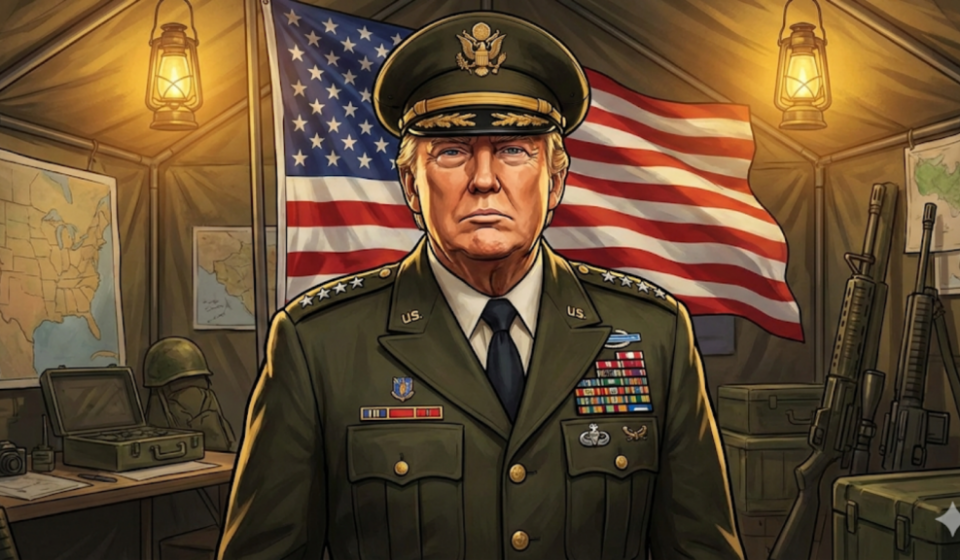

The arrest and removal of Nicolás Maduro by United States special operations forces in Caracas during the opening weeks of 2026 has signaled a fundamental shift in American foreign policy. For decades, the international community operated under the framework of Pax Americana—a period defined by the United States’ role as a guarantor of global stability through institutional cooperation and nation-building. However, the events of early 2026 suggest that this era has been superseded by a more aggressive, resource-centric doctrine known among policy analysts as Imperium Americanum. This new regime prioritizes the securing of strategic assets, the direct elimination of threats, and the control of global supply chains over traditional diplomatic consensus.
The transition from a policy of "winning hearts and minds" to one of "securing assets and leverage" is not merely a change in rhetoric but a structural realignment of the American state. Under this doctrine, the White House has demonstrated a willingness to bypass multi-lateral organizations and historical diplomatic norms to achieve immediate national security and economic objectives. The raid in Venezuela served as the definitive "pilot episode" for this strategy, setting a precedent for a year expected to be characterized by rapid, high-stakes geopolitical maneuvers.
A Chronology of the 2026 Shift
The first quarter of 2026 has been marked by a series of rapid-fire escalations that illustrate the speed of the new American posture.
On January 1, 2026, while global attention was focused on New Year celebrations, U.S. special forces executed a pre-dawn raid in Caracas. The objective was the apprehension of Nicolás Maduro, who was subsequently transported to the United States to face long-standing narcoterrorism charges. By mid-January, the administration had already pivoted its focus toward the North American continent and the Arctic Circle, signaling that the Venezuelan operation was not an isolated incident but part of a broader "imperial sprint."
By late January, the Department of the Treasury’s Office of Foreign Assets Control (OFAC) issued a series of updated general licenses. These documents provided the legal framework for U.S. refiners to resume the processing of Venezuelan heavy crude, effectively integrating the nation’s vast oil reserves into the American energy grid under strict federal oversight. Simultaneously, the State Department announced a $10 million reward for information leading to the capture of Mexican cartel leaders, coinciding with a formal push to designate these organizations as Foreign Terrorist Organizations (FTOs).
The Domestic Catalyst: The 2026 Midterm Clock
The primary driver behind this sudden acceleration of foreign intervention is the domestic political calendar. The United States is currently in the lead-up to the 2026 midterm elections. Historically, the sitting president’s party faces significant challenges during these elections, often resulting in a loss of legislative control.
The administration appears to be operating under the assumption that its window for unilateral executive action will close in January 2027. If the opposition party gains control of the House or Senate, the "Imperial Presidency" will likely face a "brick wall" of congressional investigations, frozen funding, and legal challenges regarding the use of military force. Consequently, the White House is maximizing its use of the "checkbook and the committee chairs" while it still maintains full control. This urgency has created a "maximum action abroad, maximum litigation at home" environment, where the executive branch moves to redraw the global map before domestic political shifts can intervene.
Strategic Targets: Mexico and the Kinetic Border
Following the success of the Caracas raid, the administration has turned its attention to the southern border, specifically targeting the Mexican cartels. The proposed designation of groups like the Sinaloa Cartel and the Jalisco New Generation Cartel (CJNG) as FTOs represents a tectonic shift in legal and military strategy.
Under an FTO designation, the legal threshold for military intervention changes. Diplomatic consensus with the Mexican government becomes a secondary concern compared to the direct neutralization of perceived "terrorist" threats. Recent deployments of anti-drone systems in the El Paso corridor and the issuance of indictments involving narcoterrorism charges suggest that the border is becoming "kinetic." This operational shift allows for the use of unmanned aerial vehicles (UAVs) and targeted strikes against cartel infrastructure, framing the drug war not as a law enforcement issue, but as a theater of national security.
Resource Realism in the Arctic and Greenland
The reach of the new American doctrine extends beyond Latin America into the strategic vacuum of the Arctic. Greenland has emerged as a focal point for the "Resource Realism" wing of the administration. This faction views global geography through the lens of inventory management, specifically regarding rare earth minerals and uranium.
Currently, China controls approximately 60% of global rare earth production and nearly 90% of processing capacity. Greenland sits atop some of the world’s largest undeveloped deposits of these critical materials. The American approach to Greenland has evolved rapidly in 2026:
- Early January: Rhetoric from the White House flirted with the idea of annexation, leading to diplomatic friction with Denmark.
- Late January: The tone shifted toward an "Arctic security" framework.
- Current Status: The U.S. is leveraging NATO channels to establish a security partnership that ensures American access to Greenlandic minerals while excluding Chinese investment.
This "same objective, different mask" approach highlights the administration’s flexibility in using both hard power and security leverage to secure the supply chains necessary for the next generation of American technology and defense.
Economic Implications and the "Aligned Market"
The shift toward Imperium Americanum has profound implications for global markets and the defense industrial base. The era of the "free market" is being replaced by what analysts call the "aligned market," where corporate success is increasingly tied to the fulfillment of strategic state priorities.
In the defense sector, the focus has shifted from "Cold War" programs to "Shadow War" technologies. Traditional platforms like the F-35 Lightning II, while technologically advanced, are costly and require long production lead times. The current high-tempo environment demands "attritable" technology—systems that are relatively inexpensive, disposable, and capable of rapid deployment.
Key Industrial Shifts:
- Unmanned Systems: Companies specializing in high-performance, expendable drones (such as Kratos Defense & Security Solutions) are seeing increased demand as the U.S. engages in more frequent, low-intensity kinetic operations.
- Surveillance and Intelligence: Real-time, low-latency imagery has become the "eyes of the empire." Firms like BlackSky and Planet Labs, which provide persistent global observation, are being integrated into the national security infrastructure to monitor everything from cartel movements to Arctic mining activity.
- Data Synthesis: The management of a global, asset-first strategy requires massive data integration. Palantir Technologies has become the de facto operating system for this new era, providing the software backbone for AI-enabled targeting, logistics modeling, and sanctions enforcement.
- Energy Integration: The removal of political barriers to Venezuelan oil benefits complex refiners on the U.S. Gulf Coast. Valero Energy, for instance, is specifically configured to process the heavy sour crude that is now flowing more predictably under the Treasury’s updated licensing framework.
Official Responses and International Reactions
The international response to the rise of the American Imperial doctrine has been polarized. Within the United States, critics argue that the administration is conducting an "end-run" around the War Powers Act, using targeted arrests and "security frameworks" to engage in military actions without formal declarations of war. Legal teams representing the former Maduro regime are currently challenging the legality of the Caracas raid in international courts, specifically questioning the mechanics of how the U.S. Treasury is funding the legal defense of a deposed head of state.
In Europe, the reaction has been one of cautious alarm. While NATO allies in the Baltics and Eastern Europe welcome a more assertive American posture against common adversaries, the Nordic countries have expressed concern over the perceived infringement on Danish and Greenlandic sovereignty. In Mexico, the government has officially condemned talk of FTO designations as a violation of national sovereignty, though the increasing "kinetic" reality on the ground suggests that the U.S. is moving forward regardless of diplomatic protests.
Analysis of Broader Impacts
The shift to a high-tempo, asset-first foreign policy in 2026 represents the most aggressive pre-election power sprint in modern history. The implications are twofold:
First, volatility has become a permanent feature of the geopolitical landscape. The administration’s embrace of unpredictability serves as a tool to keep adversaries off-balance, but it also requires market participants to maintain high levels of liquidity and "dry powder" to react to sudden policy shifts.
Second, the definition of American power has been narrowed. The focus is no longer on spreading democratic values or building stable middle-class societies in developing nations. Instead, power is measured by the ability to control the "dashboard" of global trade—knowing where every barrel of oil is, where every gram of neodymium is mined, and having the kinetic capability to interdict any threat to those flows.
As the 2026 midterm window continues to close, the world can expect the United States to accelerate its "shopping list" of strategic objectives. Whether in the jungles of South America, the deserts of Northern Mexico, or the icy expanses of the Arctic, the new era of American power is defined by a singular, uncompromising message: the era of waiting for diplomacy is over. The era of Imperium Americanum has begun.