Kashkari Hawkish Stance Clashes with Soft ADP Jobs Data as Markets Pivot Toward AI Infrastructure Buying Opportunity

Minneapolis Federal Reserve President Neel Kashkari adopted a decisively hawkish posture this Wednesday, advocating for a gradual increase in interest rates despite emerging signs of a cooling labor market. Kashkari’s public statements, which emphasize the resilience of corporate earnings and consumer spending, stand in stark contrast to the latest ADP National Employment Report, which indicates a significant slowdown in private-sector hiring. As the Federal Open Market Committee (FOMC) navigates these conflicting signals, market participants are increasingly looking toward bond market dynamics and the physical expansion of artificial intelligence infrastructure as the primary drivers of future economic growth.
The Hawkish Pivot: Kashkari’s Economic Outlook
In a morning address that surprised several market observers, Neel Kashkari questioned the current restrictiveness of U.S. monetary policy. Citing robust corporate performance and a labor market that he perceives as stable, Kashkari suggested that the Federal Reserve may need to resume a tightening cycle to ensure inflation remains on a downward trajectory toward the 2% target.
"Corporate earnings are through the roof. They’re doing great. The consumer is hanging in there. The labor market is hanging in there," Kashkari stated. He further challenged the prevailing sentiment that current rates are hindering economic progress, asking, "What evidence do I have that monetary policy is particularly restrictive right now?" Based on this assessment, Kashkari argued that the central bank should begin "slowly moving up" interest rates as more data becomes available.
Kashkari’s position aligns him with a hawkish minority within the FOMC, including Cleveland Fed President Beth Hammack and Dallas Fed President Lorie Logan. All three officials voted for a rate hike during the July meeting, signaling a persistent concern that underlying inflationary pressures have not been fully neutralized.
ADP Jobs Report Signals Labor Market Deceleration
While Kashkari expressed confidence in the labor market, the July ADP National Employment Report offered a more sobering perspective. Private companies added only 44,000 positions in July, falling significantly short of the 75,000 jobs anticipated by economists. This figure represents the weakest pace of hiring since January and marks a sharp deceleration in momentum compared to the first half of the year.
A granular analysis of the ADP data reveals specific areas of weakness:
- Goods-Producing Sectors: This segment of the economy experienced a net contraction, shedding 3,000 jobs.
- Service-Providing Sectors: While this area grew by 47,000 positions, the growth was heavily concentrated. The education and health services sectors accounted for 36,000 of those new roles, or approximately 76% of all service-sector gains.
- Manufacturing and Construction: These sectors showed signs of stagnation, reflecting the impact of sustained high borrowing costs on capital-intensive industries.
The ADP report serves as a precursor to the Bureau of Labor Statistics (BLS) official nonfarm payroll report, scheduled for release this Friday. The consensus forecast for the BLS data stands at approximately 80,000 jobs. Historically, a monthly gain of fewer than 100,000 jobs is viewed as a sign of a cooling economy, as it barely keeps pace with the growth of the working-age population.

The Warsh Doctrine: Trends Over Monthly Volatility
The divergence between Fed officials and economic data highlights a broader debate regarding the future of the Federal Reserve under the leadership of Chair Kevin Warsh. Unlike predecessors who may have reacted more swiftly to monthly fluctuations, Warsh has established a reputation for prioritizing durable economic trends over "monthly noise."
Central to the "Warsh Doctrine" is the reliance on more stable inflation gauges, such as the Dallas Fed’s Trimmed Mean PCE inflation gauge. By filtering out extreme price movements in specific categories, this metric provides a clearer view of the underlying inflationary trend. Analysts suggest that Warsh is likely to apply a similar philosophy to the labor market. Rather than reacting to a single soft ADP report or a potentially hot BLS report, Warsh is expected to focus on the broader 2026 trend of uneven and cooling growth.
This approach suggests that the hawkish coalition led by Kashkari may face significant internal opposition. If the Fed leadership views the current labor market softening as part of a necessary rebalancing, the threshold for another rate hike may be higher than Kashkari’s comments imply.
Bond Market Dynamics and the "Self-Tightening" Economy
A critical factor in the Fed’s decision-making process is the behavior of the bond market. Since late June, the 10-year Treasury yield—often considered the benchmark for global borrowing costs—has been on a steady ascent. This rise has effectively tightened financial conditions without requiring direct intervention from the Federal Reserve.
Higher long-term yields translate directly into increased costs for mortgages, corporate bonds, and consumer loans. Chair Warsh has previously expressed comfort with this market-led restraint, noting that it allows the economy to find its own equilibrium. During a recent press conference, Warsh remarked that markets appeared to be "reacting to real-time events" rather than Fed rhetoric, a development he described as "useful."
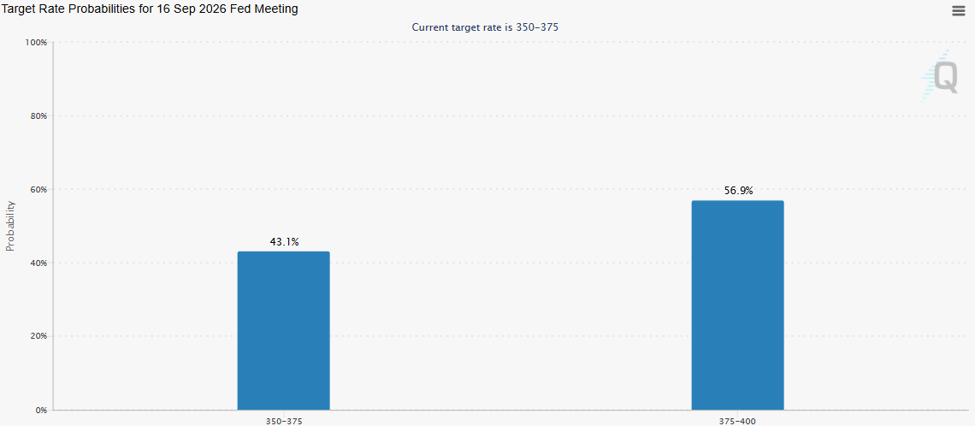
Recent trading data indicates a steepening of the yield curve, where long-term yields rise faster than short-term yields. Jonathan Rose, a veteran trader and market analyst, observed that while the Fed remained stationary, the bond market began "forcing the hand" of policy. This repricing suggests that investors are bracing for a "higher-for-longer" interest rate environment, even if the Fed does not officially raise the federal funds rate in September.
The AI Infrastructure Buildout: A Fundamental Shift
Despite the uncertainty surrounding interest rates, a consensus is emerging among technology and investment analysts: the recent volatility in artificial intelligence (AI) stocks has created a significant buying opportunity. This perspective is driven by the realization that the physical buildout of AI—encompassing semiconductors, data center cooling systems, power management, and networking hardware—is accelerating.
Luke Lango, a prominent technology analyst, recently upgraded his outlook on AI infrastructure names. Lango argues that much of the recent downward pressure on AI stocks was not due to deteriorating business fundamentals, but rather to a massive liquidation event. Leopold Aschenbrenner, manager of the AI-focused hedge fund Situational Awareness, was recently forced to liquidate a $45 billion portfolio following margin calls on over-leveraged positions.
"A meaningful chunk of the recent weakness in AI infrastructure names was not about the businesses getting worse," Lango noted. "It was about one enormous, over-leveraged trader forced to sell stocks it still believed in."
With the removal of this forced seller, the supply-demand balance for AI infrastructure stocks has shifted. Major "hyperscalers"—including Microsoft, Alphabet, and Amazon—have confirmed in recent earnings calls that their capital expenditure on AI infrastructure will continue to grow in 2026 and 2027. This provides a fundamental "floor" for companies involved in the production of high-end GPU chips and the specialized cooling systems required for massive server farms.
Technical Analysis and Investor Sentiment
From a technical standpoint, the Nasdaq-100 Index, tracked by the Invesco QQQ ETF, appears to have found a meaningful support level. Market analysts identified July 29 as a critical turning point where the index bottomed simultaneously with the steepening of the yield curve.
Louis Navellier, founder of Navellier & Associates, characterized the recent market action as a "capitulation" event. In investment terms, capitulation occurs when the last remaining bulls give up and sell their positions, often marking the absolute low of a correction. Navellier points to the sale of the Situational Awareness portfolio to Citadel as the final act of this selling exhaustion.
"Typically, capitulation selling does not have to be retested," Navellier explained. He anticipates that August will serve as a "rebound month" as investors refocus on the strong earnings growth within the technology sector rather than the macro-economic fears propagated by hawkish Fed officials.
Broader Impact and Economic Implications
The collision of hawkish Fed rhetoric, cooling employment data, and a massive technology sector reset creates a complex landscape for the remainder of the third quarter. Several key implications emerge:
- Divergent Monetary Policy: The internal split within the Fed suggests that future meetings will be characterized by intense debate. If the BLS report on Friday confirms the ADP’s weakness, the "hawkish coalition" may lose leverage.
- Market-Led Restraint: The 10-year Treasury yield will remain the most critical metric to watch. If it continues to climb, the Fed may find that the market has already done the "heavy lifting" of slowing the economy, making further rate hikes redundant.
- AI as an Economic Engine: The decoupling of AI infrastructure spending from broader economic trends suggests that "Big Tech" may continue to grow even if the general labor market softens. The physical requirements of the AI boom—power and hardware—are becoming a secular growth story independent of the business cycle.
- Investor Positioning: The consensus among analysts suggests that the "fear of missing out" (FOMO) may soon replace the "fear of the Fed." As technical indicators turn bullish and fundamental spending remains high, capital is expected to flow back into high-growth sectors.
As the market prepares for Friday’s nonfarm payroll data, the overarching narrative is one of transition. The economy is moving away from the post-pandemic volatility and into a phase where market-determined rates and technological innovation are the primary architects of the financial landscape. While Neel Kashkari may continue to sound the alarm on inflation, the broader data suggests an economy that is cooling just enough to keep the Federal Reserve on the sidelines, while simultaneously fueling the next leg of the artificial intelligence revolution.