Solving the Influencer Marketing Conversion Gap Through Creator Specific Landing Experiences

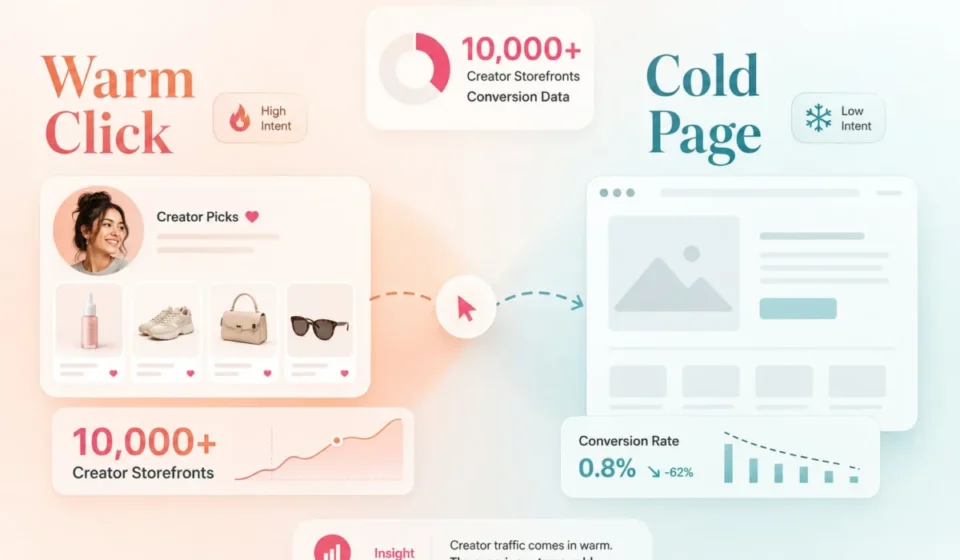
The digital marketing landscape is currently witnessing a significant shift in how brands approach influencer partnerships, moving away from a focus on talent selection and toward the optimization of the post-click experience. Recent data from thousands of creator programs tracked over the past 18 months reveals that conversion rate lifts of 30%, 40%, and in extreme cases, 214%, are being achieved not by changing creators or increasing commission rates, but by fundamentally altering where traffic is directed after a user clicks an affiliate link. This phenomenon, increasingly referred to as the "warm click, cold page" problem, identifies the landing experience as the primary bottleneck in modern social commerce.
While brand teams traditionally audit creator selection, renegotiate contracts, and refine creative briefs, the destination of the traffic remains an overlooked variable. Evidence consistently indicates that the perceived "conversion gap" in influencer marketing is often a destination failure rather than a creator failure. The creator successfully earns the trust of the audience and secures the click; however, the subsequent handoff to a generic brand environment often severs that trust, leading to high bounce rates and abandoned carts.
The Mechanics of the Warm Click Cold Page Problem
To understand the current crisis in influencer conversion, it is necessary to analyze the psychological journey of the consumer. A creator typically spends months or years building a specific context with their audience, whether in the niche of skincare, fitness, or home organization. When a follower clicks a link provided by that creator, they do so within the "warm" context of that established relationship.
The disconnect occurs when that warm click lands on a brand’s generic homepage, a standard product detail page (PDP), or a universal discount-code lander. These destinations are often built for "cold" traffic—users coming from search engines or general display ads—and do not recognize the specific referral source. When a page fails to acknowledge the creator who sent the visitor, the continuity of trust is broken. The visitor is forced to restart their consideration process in a generic environment, effectively cooling the lead and significantly reducing the likelihood of a transaction.
For brands managing hundreds of creator relationships, this problem scales exponentially. Without the infrastructure to automate creator-specific landing pages, most companies resort to the "cold handoff," sending all referred traffic to the same three or four locations on their website.
Historical Context and the Evolution of Creator Commerce
The current emphasis on landing page optimization marks the third major era of influencer marketing. In the first era, roughly 2010 to 2016, influencers were primarily used for "top-of-funnel" awareness, where success was measured by likes and impressions. The second era, 2017 to 2022, saw the rise of affiliate-led performance marketing, where tracking links and discount codes became the standard for measuring Return on Ad Spend (ROAS).
We have now entered the third era: Creator Commerce. In this stage, the focus has shifted from the "who" to the "how." Brands have realized that the infrastructure of the traditional e-commerce site—designed for a 2010s search-and-browse behavior—is ill-equipped for the recommendation-driven economy of the 2020s. The timeline of this shift has accelerated as Customer Acquisition Costs (CAC) on platforms like Meta and Google have skyrocketed, forcing brands to extract more value from every click generated by their organic and paid creator partners.
![What Conversion Data From 10,000+ Creator Storefronts Reveals [Warm Click, Cold Page Problem]](https://influencermarketinghub.com/wp-content/uploads/2026/07/5a619d4d-chatgpt-image-jul-3-2026-12_33_04-pm.jpg)
Statistical Evidence from Industry Leaders
The impact of shifting from generic landing pages to creator-specific storefronts is quantified across several diverse sectors, including fashion, health, and beauty.
Cozy Earth, a luxury bedding and apparel brand, serves as a primary case study for this transition. By moving their creator-driven traffic from standard affiliate links to co-branded creator pages hosted on their own domain, the brand reported an average 214% increase in conversion rates. Furthermore, the Average Order Value (AOV) increased by 67%. These metrics were achieved without altering the creators involved or the volume of traffic, proving that the destination was the sole variable in the performance lift.
In the United Kingdom, the health and wellness marketplace Healf has applied this model to a massive scale, managing more than 1,700 creator partnerships. By utilizing creator-specific pages, Healf reached a 40.8% conversion rate for referred traffic. This figure significantly outperforms standard e-commerce benchmarks in the health category, which typically hover between 2% and 5%. According to Healf’s affiliate leadership, the model also improved creator retention, as influencers felt more confident sharing professional, curated pages that featured their own branding and voice.
The beauty sector shows similar results. Buttah Skin observed a 30% higher conversion rate and a 78% increase in AOV when creator traffic landed on dedicated pages rather than standard product pages. Meanwhile, the functional CPG brand Electro reported that creator-led storefronts now account for 81% of their total e-commerce revenue. This shift indicates that for some brands, creator-centric paths to purchase are becoming the primary revenue driver rather than a secondary channel.
Strategic Patterns of High-Converting Creator Pages
Analysis of high-performing programs reveals two consistent patterns that differentiate successful creator landing pages from those that underperform.
1. Curation Depth Over Catalog Breadth
There is a documented inverse relationship between the number of products on a landing page and the conversion rate of creator-referred traffic. Pages featuring 6 to 15 curated products consistently outperform those that display the brand’s full catalog. The shopper arriving from a creator’s link has already been influenced by that creator’s specific taste; the landing page’s primary function is to validate that choice, not to introduce 200 additional options that may lead to decision paralysis.
2. Continuity of Visibility
The most successful landing experiences ensure that the creator remains visible through the entire purchase journey. This includes the use of the creator’s name, image, and specific testimonial language on the page. In a traditional e-commerce setup, the creator "disappears" once the click is made. In a high-conversion "Creator Commerce" setup, the creator acts as a virtual shopping assistant, maintaining the trust-based context from the social feed to the checkout button.
Implementation and the 30-Day Diagnostic
For brands looking to bridge the conversion gap, industry experts recommend a 30-day intervention strategy. This involves selecting a cohort of 5 to 10 active creators and building dedicated landing pages for them that feature their identity, curated picks, and a seamless checkout process.
![What Conversion Data From 10,000+ Creator Storefronts Reveals [Warm Click, Cold Page Problem]](https://s.influencermarketinghub.com/imaginary/convert?type=webp&url=https://influencermarketinghub.com/wp-content/uploads/2026/07/d15fc009-image3-1024x490.jpg)
During this period, brands are encouraged to track three specific metrics:
- Conversion Rate Differential: Comparing the creator-specific page against the previous affiliate destination. A successful implementation should yield a minimum 20% to 30% lift in the first month.
- Average Order Value (AOV): Determining if the creator’s editorial narrative (the "why" behind their picks) encourages customers to purchase bundles or multiple items.
- 30-Day Repeat Rate: Assessing the quality of the customer acquired. Data suggests that customers who buy through a trust-aligned creator page have higher retention rates than those who buy through generic discount-focused landers.
A common diagnostic tool used by brand auditors is the "CVR Gap Test." If a brand’s standard product pages convert at 3% or 4%, but their creator links are converting at under 2%, it is a definitive signal that the landing experience is the point of failure.
Broader Implications for the E-commerce Ecosystem
The shift toward creator-specific landing experiences has broader implications for the e-commerce and SaaS (Software as a Service) industries. As brands demand more sophisticated ways to handle creator traffic, a new category of "Creator Storefront" tools has emerged, allowing marketing teams to deploy hundreds of pages without requiring custom engineering work for each one.
This trend is also affecting major events and product drops. For instance, the footwear brand Crocs recently utilized a creator-specific landing page for a product drop with influencer Kai Cenat, which drove 350,000 sessions. Such scale requires infrastructure that can maintain a personalized feel while handling massive traffic spikes—a feat that traditional homepages are rarely optimized to achieve.
Conclusion: The Future of Trust-Based Commerce
As the influencer marketing industry continues to mature, the distinction between "traffic generation" and "conversion optimization" is blurring. The brands that are currently compounding their growth are those that treat the landing experience as an extension of the creator relationship rather than a technical necessity.
The "warm click, cold page" problem serves as a reminder that in an era of infinite choice, trust is the most valuable currency. By preserving the context of the creator-audience relationship all the way to the point of sale, brands can fundamentally change the economics of their creator programs, turning underperforming affiliate links into high-efficiency revenue engines. The evidence is clear: the most significant opportunity for growth in influencer marketing no longer lies in finding better creators, but in building better destinations for the audiences they already have.