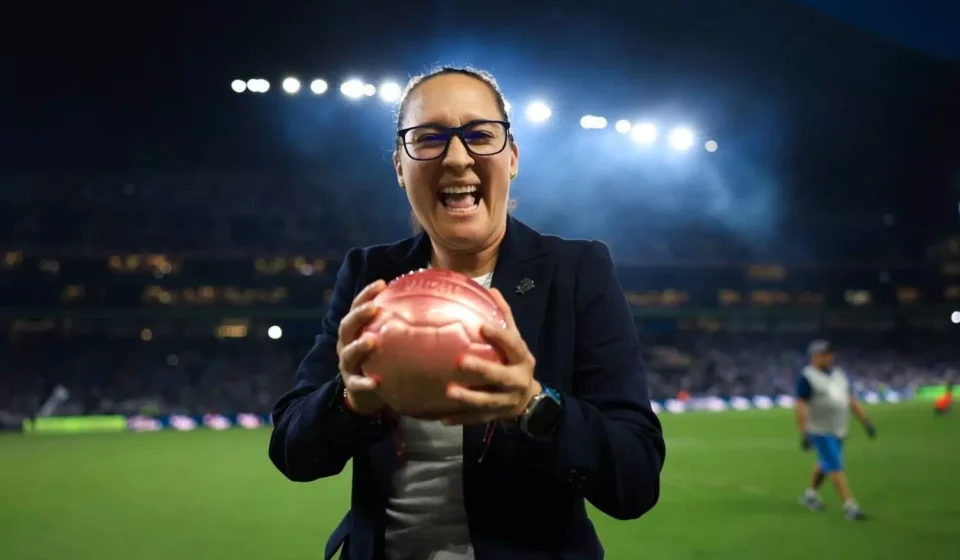
The AIFF Terminates Amelia Valverde Contract as Indian Womens Football Faces Structural Uncertainty Following Asian Cup Exit

The All India Football Federation (AIFF) has officially confirmed its decision to part ways with Amelia Valverde, the head coach of the senior women’s national team, following a disappointing and winless campaign at the AFC Women’s Asian Cup 2026. The decision, which comes after India suffered three consecutive defeats in the group stages of the continental tournament, marks the end of a brief and tumultuous tenure for the Costa Rican tactician. While the federation cited a failure to meet performance expectations and tactical inconsistencies as the primary reasons for the non-renewal of her contract, the move has reignited a broader debate regarding the lack of long-term continuity and systemic support within the women’s footballing ecosystem in India.
The AFC Women’s Asian Cup 2026 served as a stark reality check for the Blue Tigresses. Entering the tournament with high hopes of challenging the continent’s elite, India instead finished at the bottom of their group with zero points. The statistics from the three matches paint a grim picture of the gulf between India and the upper echelons of Asian football: three losses, two goals scored, and sixteen goals conceded. The campaign began with a narrow 1-2 defeat to Vietnam, a match that offered flashes of competitiveness but ultimately highlighted defensive vulnerabilities. This was followed by a staggering 0-11 loss to eventual champions Japan, a result that exposed the immense technical and physical disparity between the two sides. The final blow came in a 1-3 loss to Chinese Taipei, a match India needed to win to maintain any hope of progression, but instead served as a definitive conclusion to a failed mission.
The Short-Term Experiment and the Preparation Deficit
Amelia Valverde was appointed in January 2026 with a specific mandate: to guide India through the challenges of the Asian Cup using her extensive international experience. Valverde arrived with an impressive resume, having led Costa Rica to two FIFA Women’s World Cups. Her appointment was heralded as a step toward professionalizing the national setup by bringing in a coach accustomed to high-pressure, elite-level environments. However, the reality of her tenure was shaped by a chronic lack of preparation time.
Despite the federation’s ambitious goals, Valverde was afforded only nine months in the role before the tournament began. More critically, the actual time spent with the full squad in active training camps was significantly less, with reports indicating she had barely six weeks of intensive preparation with the core group before the opening match. In the world of international football, where tactical cohesion and physical conditioning are paramount, such a short window is rarely sufficient to implement a new philosophy, especially when transitioning from a domestic-led coaching structure to a foreign one.
The AIFF Technical Committee, led by former Indian international IM Vijayan, met on March 24, 2026, to review the performance. The committee’s post-mortem was blunt, stating that expectations were not met and suggesting that India "should have at least managed a draw" in their matches against Vietnam or Chinese Taipei. This assessment, while factually grounded in the results, has been criticized by observers who argue it ignores the context of the opposition’s preparation. Vietnam and Chinese Taipei benefit from more robust domestic leagues and regular international exposure, factors that heavily influence tournament readiness.
Tactical Scrutiny and the Manchester United Analogy
One of the more unusual aspects of the AIFF’s justification for dismissing Valverde was the focus on her tactical "experimentation." The Technical Committee expressed concern that Valverde utilized three different formations across the three group stage matches. In most modern footballing contexts, tactical flexibility is viewed as a necessity to counter different styles of play—particularly when facing a powerhouse like Japan compared to a more balanced opponent like Vietnam. However, the AIFF viewed this lack of a singular, rigid system as a sign of instability.
To support this view, the committee reportedly drew a comparison to English Premier League club Manchester United. The reasoning provided suggested that when Ruben Amorim’s rigid 3-4-2-1 formation was abandoned by Michael Carrick during a transition period, the club saw improved results. The AIFF argued that consistency in formation is key to success. This analogy has been met with skepticism by football analysts, who point out the vast differences between a multi-billion-dollar club with elite global talent and a national team in a developing football market.
Unlike a club manager who works with players daily, a national team coach must often adapt to the limited skill sets and fitness levels of the players available during short FIFA windows. Furthermore, the comparison to Manchester United’s managerial shifts ignores the fact that Michael Carrick operated as an interim manager with his own specific staff and a squad of world-class professionals who had been drilled in various systems since their youth. Applying the same logic to the Indian women’s team, which struggles with a lack of consistent high-level domestic competition, is seen by many as a fundamental misunderstanding of the challenges facing the women’s game in India.
The Coaching Carousel: A Pattern of Instability
The departure of Amelia Valverde is not an isolated event but rather the latest chapter in what has become a "revolving door" policy for the Indian women’s national team head coach position. Valverde is the fifth person to lead the team in the last five years, following Thomas Dennerby, Langam Chaoba Devi, Santosh Kashyap, and Crispin Chhetri.
This lack of continuity has significant implications for player development. Each coach brings a different tactical philosophy, training methodology, and selection criteria. For the players, this means constantly adapting to new demands, which prevents the development of a cohesive "national identity" on the pitch.
The case of Crispin Chhetri is particularly illustrative of the federation’s fluctuating strategy. Chhetri had successfully led India through the qualification rounds for the Asian Cup, securing a vital victory over Thailand. Despite this success, the AIFF decided to move him aside in favor of a "big name" foreign appointment for the main tournament. Now, with Valverde gone, the federation is reportedly considering a return to domestic options, with Chhetri and East Bengal head coach Anthony Andrews being mentioned as potential candidates. This circular logic—moving from domestic to foreign and back to domestic whenever a tournament ends—suggests a lack of a coherent long-term vision for the team’s growth.
Statistical Analysis of the Asian Cup Performance
While the results were poor, a deeper look at the data reveals nuances that the final scorelines often obscure. India’s two goals in the tournament were scored by Sanfida Nongrum and Manisha Kalyan. Kalyan, who plays her club football in Europe, remained a constant threat and demonstrated that individual Indian players can compete at a high level when given the right exposure.
In goal, Elangbam Panthoi Chanu faced an onslaught, particularly against Japan, where she made several high-quality saves despite the double-digit scoreline. The match against Vietnam showed that India could maintain possession and create chances, but they lacked the clinical finishing and defensive discipline required to see out games.
The 0-11 loss to Japan, while humiliating, must be viewed through the lens of Japan’s status as a global powerhouse. Japan’s women’s team has won a World Cup and consistently ranks in the top ten globally. For an Indian team that lacks a year-round professional league and regular friendlies against top-50 opposition, such a scoreline is a reflection of systemic gaps rather than purely a coaching failure.
Broader Implications and the Path Forward
The dismissal of Amelia Valverde raises urgent questions about the AIFF’s "Vision 2047" roadmap, which aims to make India a powerhouse in Asian football. For the women’s game, the path to success is currently obstructed by several structural hurdles:
- Domestic League Duration: The Indian Women’s League (IWL) remains relatively short compared to top Asian leagues. Without a longer season, players cannot maintain the match fitness and tactical sharpness required for international tournaments.
- International Exposure: India often plays "exposure tours" against lower-ranked nations. While these provide winning momentum, they do not prepare the team for the intensity and speed of play encountered against teams like Japan or Australia.
- Grassroots and Scouting: There is a perceived disconnect between the national team and the youth development pipelines. The frequent change in senior coaches means there is no trickle-down tactical philosophy to the U-17 and U-19 levels.
- Financial Constraints: Maintaining a foreign coaching staff with multiple assistants is a significant financial commitment. The AIFF hinted that a longer contract for Valverde would have required "clearer long-term plans" and better financial terms, suggesting that the federation may be tightening its belt or shifting priorities.
As the AIFF begins its search for a new head coach, the focus will likely shift back to domestic talent. While local coaches have a better understanding of the cultural and socio-economic challenges facing Indian players, they often lack the experience of managing at the highest international levels.
The termination of Valverde’s contract may provide a temporary explanation for the Asian Cup exit, but it does little to address the underlying issues. Without a commitment to a multi-year coaching cycle, an overhaul of the domestic league structure, and a realistic alignment of expectations with the current state of the game, the Indian women’s national team risks remaining in a cycle of brief hope followed by predictable disappointment. The scoreboard in 2026 was unforgiving, but the boardroom decisions following it will determine whether 2030 tells a different story.