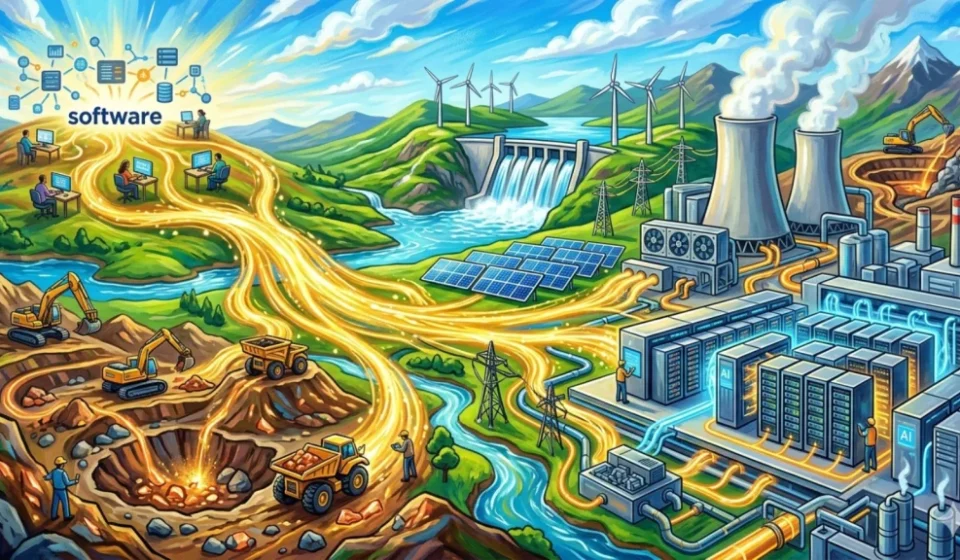
The Great Re-Materialization: How the Artificial Intelligence Revolution is Shifting Economic Value from Software to Physical Infrastructure

The economic landscape of the United States, which for four decades prioritized digital services and software over physical production, is undergoing a fundamental structural transformation. This shift, increasingly characterized by economists and market analysts as the "Great Re-Materialization," represents a reversal of the long-standing trend where value accrued primarily to "asset-light" technology companies. As artificial intelligence (AI) moves from experimental phases into deep integration within the global economy, the scarcity that once defined the value of software is being replaced by a new scarcity: the physical infrastructure, energy, and raw materials required to power the digital mind.
Since the early 1980s, the American economy has been defined by the rise of Silicon Valley and the systematic offshoring of industrial capacity. This era saw the emergence of the "Magnificent Seven"—Apple, Microsoft, Alphabet, Amazon, Meta, Nvidia, and Tesla—which collectively drove a disproportionate share of market returns. By 2025, technology and tech-adjacent firms accounted for more than 30% of the S&P 500’s total market capitalization. The prevailing wisdom suggested that prosperity lived behind screens, facilitated by high-margin Software-as-a-Service (SaaS) models and complex algorithms. However, the rapid advancement of generative AI has begun to disrupt the very foundation of this digital wealth by commoditizing the "intelligence" that once made software valuable.
The Erosion of the Digital Moat
For decades, the value proposition of the digital economy was built on the premise that human intelligence and engineering hours were scarce. Developing a sophisticated enterprise resource planning (ERP) system or a global logistics optimizer required thousands of highly compensated engineers and years of iterative development. This high barrier to entry created "moats"—defensible market positions that allowed companies like Salesforce, Workday, and Adobe to command high subscription fees and massive valuations.
The arrival of advanced AI models has begun to drain these moats. When an AI can generate code, optimize databases, and manage workflows at near-zero marginal cost, the scarcity of software intelligence evaporates. Analysts observe that AI-native competitors, often operating with lean teams of fewer than a dozen people, are now able to replicate the core functionalities of legacy SaaS platforms. Furthermore, the rise of AI agents—autonomous programs capable of browsing the web and making purchasing decisions—threatens the advertising-based revenue models of giants like Google and Meta. As AI begins to perform tasks directly rather than simply helping humans navigate interfaces, the premium once placed on "user experience" and "software stickiness" is diminishing.
The Physical Requirements of the AI Super-Cycle
As the value of software faces deflationary pressure, the value of the physical substrate required to run these models is experiencing a commensurate surge. Unlike traditional cloud computing, AI workloads require specialized high-density hardware that places unprecedented demands on physical infrastructure. This shift has moved the economic bottleneck from the "code" to the "compute."
The "compute stack" is entirely physical. It begins with the Graphics Processing Units (GPUs) produced by firms like Nvidia, but it extends far beyond the silicon itself. These chips are housed in massive data centers that require vast quantities of steel, copper, and concrete. Moreover, the thermal intensity of AI processing has rendered traditional air-cooling methods obsolete in many high-performance clusters. This has birthed a new industrial sector focused on liquid cooling, heat exchangers, and specialized thermal management systems.
Industry estimates suggest that U.S. data center electricity demand is on track to more than double by 2030. This projection has highlighted a critical vulnerability in the national power grid, which had seen largely flat demand for the previous twenty years. The "Re-Materialization" is thus manifesting as a massive capital expenditure cycle directed toward the energy sector, encompassing everything from high-voltage transformers and switchgear to the commissioning of new natural gas plants and the revitalization of nuclear power facilities.
Market Divergence: Software vs. Hard Assets
The financial markets began to reflect this transition clearly in 2025 and early 2026. While the broader market remained volatile, a distinct divergence emerged between "asset-light" software companies and "asset-heavy" infrastructure providers.
Performance data from the first half of 2026 shows that industrial and infrastructure stocks—once considered "boring" or "legacy" investments—have begun to outperform high-growth SaaS names. Companies involved in electrical components, data center construction, and thermal management, such as Vertiv, Modine, and Corning, have seen significant valuation expansions. Conversely, former investor darlings in the cloud-native space, including Atlassian, MongoDB, and HubSpot, have faced headwinds as investors re-evaluate their long-term growth prospects in an AI-commoditized world.
This shift is driven by three primary forces:
- Uncapped Compute Demand: Hyperscalers (Microsoft, Amazon, Google, Meta) are projected to spend over $600 billion on AI infrastructure in 2026 alone. This capital flows directly into the physical supply chain rather than software licensing.
- Re-industrialization Policy: Legislative efforts such as the CHIPS and Science Act and the Infrastructure Investment and Jobs Act have provided a tailwind for domestic manufacturing. The goal of "reshoring" industrial capacity has aligned with the physical needs of the AI era.
- Grid Constraints: The scarcity of power has made energy-related assets highly strategic. Companies that control power generation or provide grid-stabilizing technology are now viewed as the ultimate gatekeepers of the AI revolution.
The Supply Chain Bottleneck and Raw Materials
The "Re-Materialization" has also triggered a renewed focus on the commodity markets. AI infrastructure is incredibly material-intensive. Copper, often referred to as the "metal of electrification," is essential for the miles of wiring required in data centers and the broader grid expansion. Silver and rare earth elements are critical for high-speed connectivity and semiconductor components.
However, the supply side of these materials is structurally constrained. After decades of underinvestment in the mining and industrial sectors, bringing new capacity online is a multi-year, if not multi-decade, process. For instance, the lead time for a new copper mine can range from eight to twelve years. This mismatch between surging demand and inelastic supply suggests the beginning of a multi-year commodity super-cycle. Analysts suggest that the "winners" of this phase will be companies with "HALO" attributes: Hard Assets and Low Obsolescence. Unlike a software version that can be rendered obsolete by a new update, a copper mine or a nuclear power plant retains intrinsic, physical value that is augmented by AI demand.
Socioeconomic Implications and Labor Mismatch
The transition back to a physical economy carries significant social and political implications. For two generations, the American educational system and labor market were geared toward producing "knowledge workers." STEM education focused heavily on coding, data science, and digital management, while the skilled trades were often marginalized.
The Great Re-Materialization has exposed a severe labor mismatch. While AI can now automate entry-level coding and data analysis, it cannot wire a data center, install a modular cooling system, or maintain a high-voltage substation. The U.S. currently faces a shortage of hundreds of thousands of electricians, welders, and specialized technicians. This shortage is expected to drive significant wage growth in the trades, potentially leading to a "blue-collar premium" that could reshape American social classes.
Furthermore, the concentration of the S&P 500 in digital platforms presents a systemic risk for passive investors. As the market rotates toward physical assets, the heavy weighting of software companies in major indices may lead to periods of broad market stagnation, even as the industrial components of the economy thrive.
Future Outlook: From Digital Scarcity to Physical Dominance
The narrative of the past forty years—that the world is becoming increasingly intangible—is being challenged by the reality of AI’s physical footprint. The technology that was supposed to represent the pinnacle of the digital age has instead become the primary catalyst for a return to physical reality.
Looking forward, the focus of the AI boom is expected to shift from the developers of large language models (LLMs) to the companies that enable them to exist in the physical world. This includes not only the chipmakers but the energy providers, the material miners, and the logistics firms that move the heavy machinery of the digital age.
The next phase of this economic cycle will likely be defined by how quickly the physical infrastructure can catch up to the digital ambition. As the "Great Re-Materialization" continues, the distinction between "tech" and "industry" will likely blur, as the most valuable companies become those that can successfully bridge the gap between clever algorithms and the massive physical power required to execute them. In this new era, the most strategic assets will not be lines of code, but the copper, kilowatts, and concrete that form the foundation of the intelligent machine.